One lesson protectionists forgot: Trade interventions backfire
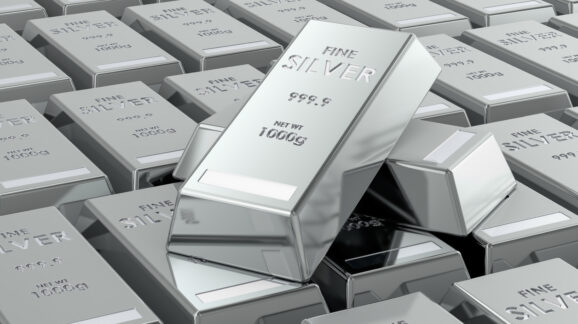
Photo Credit: Getty
It’s not just tariffs that backfire in trade policy. The government has a long history of similar failures. Between 1934 and 1941, the Treasury bought 2.55 billion ounces of silver in an attempt to boost exports during the Great Depression by manipulating exchange rates.
The metal had no immediate or envisioned practical aim and mostly sat dormant in vaults. The government’s goal was to raise silver prices sixfold from 24.5 cents an ounce to $1.29. In fact, the Silver Purchase Act of 1934, which authorized this policy, hurt trade overall and cost taxpayers billions.
A prior blog post discussed how Congress tried to set a minimum price for coal between 1937 and 1943. The result was an administrative boondoggle that subsidized unproductive mine owners at everyone else’s expense.
In a similar vein, the silver purchase experiment shows how knowledge problems, incentive problems, and an impossibility theorem cause trade intervention to backfire. As government-caused instability returns to global commerce, it is a lesson well worth remembering.
Knowledge problems
In the 1930s, prices were low, trade was tepid, and unemployment was high. Some suggested that if the government bought silver, its price would rise. People in countries using silver as a currency would buy more American goods. Then, Sen. Key Pittman (D-NV) argued, “prosperity will be upon us before we can realize it.” He did not know what he was unleashing.
The plan almost immediately fell apart. From January 1, 1933 to September 30, 1935, the Treasury bought about 600 million ounces of silver. Not only was this double what every other business, individual, and nation purchased in the same period, but it was also more than all the new silver mined in the world. Silver’s price more than tripled.
Yet trade did not increase. Congress’s law could not override human behavior. Instead, people in countries on a silver standard behaved according to Gresham’s law, which states that bad money drives out good.
In Mexico, for instance, the silver in one peso was worth 71.9 cents an ounce. When the market price exceeded that, Mexicans sold their pesos as metal instead of using them as money. Countries from Colombia to Singapore responded to the economic shock by devaluing or demonetizing silver, nullifying any benefit to US exporters.
The Republic of China had the world’s only major currency backed by silver alone. Until 1934, China had weathered the Depression reasonably well. But when silver prices soared, Chinese exports became less competitive while Chinese people melted their coins. Massive deflation ensued, followed by demonetization, recession, hyperinflation, and, ultimately, the communist victory in the Chinese Civil War.
Between 1933 and 1934, Chinese imports of foreign goods fell by one-third. Before US silver purchases ended in 1961, Washington had embargoed all trade with Maoist China.
Of course, politicians in 1934 could not have predicted every future event. But they legislated as if they could. Lawmakers should acknowledge there are unknowable consequences to any action and consequently restrain themselves from doing too much.
Incentive problems
Some of Roosevelt’s allies genuinely believed silver procurement would boost US exports. These included G. F. Warren, the architect of a similarly “costly waste of time” scheme involving gold, and Charles Coughlin, the authoritarian radio priest.
However, many contemporaries spotted another incentive. Stanford economist T. J. Kreps predicted four months in advance that Washington would intervene to raise silver prices, even though nothing suggested US trade would increase as a result.
Seven states had powerful mining interests. Silverites comprised one-seventh of the Senate and could block key New Deal programs. Kreps wrote that though “the silver industry in 1929 employed less than 3,000 persons, the political leadership … may soon find it expedient … to ‘do something for silver.’”
The government was uninterested in stopping silver purchases, even as benefits to domestic industries failed to materialize and opposition at home increased.
A Business Week column from 1935 reported that silverware makers were raising prices and firing staff. They “would much rather operate under the old reliable law of supply and demand … than try to unravel the mysteries of man-made market mazes.”
By 1938, silver purchases cost US taxpayers more than $1 billion, or $23.7 billion in modern money. That money was never spent on productive enterprises that met real or anticipated demand.
In 1939, The New York Times reported “the chief beneficiaries of the silver policy of the United States Government have been the foreign producers and sellers of the metal,” with the “most aggressive” seller being Imperial Japan. Still, the Treasury kept buying, whatever the risk to defense or the dollar. Its economic incentives were muddled by unpalatable politics.
The impossibility theorem
The Silver Purchase Act’s fundamental problem was that it interfered with free trade to try and improve it. The best way for Washington to boost trade would have been to stop buying silver. But if they did, they could not meet the Act’s indecorous political goal.
As CEI’s Steve Swedberg and I have recently written, trade flows best when businesses know what to expect from prices and the profit incentive. By its very nature, trade intervention drives trade uncertainty.
Politicians cannot outsmart human behavior, and they can be motivated by special interests. Proponents of tariffs and trade wars take note: there is no silver lining.