The regulatory dark matter beyond Washington’s graveyard of rules: 83,141 ghosts and counting

Photo Credit: Getty
The clocks have turned back, the days are growing darker, and Washington’s regulatory shadows lengthen. Washington’s policy ghouls are waking up to the fact that some of the ghastliest regulatory chills come not from ordinary notice-and-comment regulations published in the daily Federal Register and entombed in the 186,000-page Code of Federal Regulations, but from something murkier and more frightening: federal agency guidance documents.
Guidance haunts us in many guises, even after Halloween: memoranda, circulars, advisory letters, FAQs, statements of policy, notices, opinions, directives, news releases, blog posts, and other frightful proclamations. These instruments of regulatory dark matter can steer business behavior and effectively regulate without going through formal notice-and-comment rulemaking.
They aren’t published in the Federal Register or collected in the Code of Federal Regulations, yet they can bind the living in a bureaucratic crypt all the same.
The abyss stares back
Since 2015, I’ve attempted to informally inventory these cryptic chronicles and shadowy scrolls, hoping for policymakers to devise an official, permanent portal for them.
This fall, the Darklore Depository unearths 83,141 spooks linked on agency websites, compared with 70,401 a year ago and 108,023 in 2024. These figures (maintained at https://bit.ly/2TfWzZ2 and presented as a Supplement at the end of this article) are undercounts, not a census of every federal guidance document in existence. Many unmarked tombs remain hidden, including documents that may lurk in tan filing cabinets across government.
The top five departments and agencies appear below. Letters and legal interpretations account for much of the regulatory leviathan at the Department of Transportation. The Department of Health and Human Services (HHS) ranks No. 2, led by its Centers for Medicare & Medicaid Services (CMS), with 8,101 entries, and the Food and Drug Administration, with 2,237.
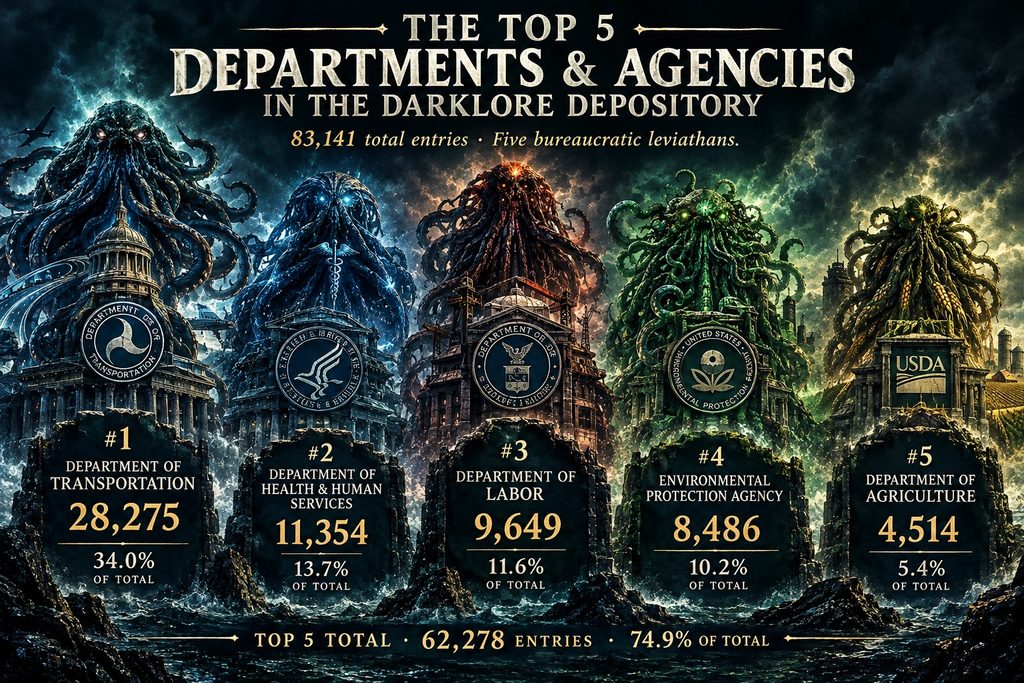
Who goes there?
The tens of thousands of documents compiled here may reveal more about what we don’t know about guidance than what we do. Before Trump’s 2019 Executive Order 13891, “Promoting the Rule of Law Through Improved Agency Guidance Documents,” required public disclosure of guidance on agency web portals, transparency was abysmal. My 2015 “Mapping Washington’s Lawlessness” survey dug up just a few thousand documents. The House Oversight Committee’s 2018 report, Shining Light on Regulatory Dark Matter, exhumed “only” 13,000.
After Trump’s order, however, roughly 73,000 documents emerged from the shadows (see the right-hand side of the Supplement below). Even after Joe Biden buried the full corpus of Trump’s streamlining directives, the accessible tally climbed above 100,000 during his term. The lesson? Even a simple disclosure mandate can bring regulatory corpses into the light.
Cobwebs, cryogenics, and the uneven resurrection of disclosure
Some guidance dates back to the 1970s, including material from the Federal Highway Administration and the Consumer Product Safety Commission. Other agencies post none at all, or disclose only recent guidance. The Commerce Department’s Bureau of Industry and Security, for example, lists guidance and frequently asked questions dating only from the 2020s. Similarly, the National Oceanic and Atmospheric Administration’s National Ocean Service lists guidance dating from the 2000s.
The Department of Agriculture, among the top five, gave its landing page a facelift in 2026, with breakdowns by issuing agency and 289 documents issued in 2026. Other agencies exhibit rigor mortis alongside incompleteness. The Department of War, for example, references the Office of Management and Budget’s 2007 Good Guidance Practices and its own formal rule on guidance, yet its listed total has remained frozen at 935 for the past two years. (Any agency maintaining a public landing page not yet included in this inventory is invited to share it.)
Trump’s www.[agencyname].gov/guidance convention has unraveled like a windblown mummy. Agencies that failed to comply during Trump’s first term may be unlikely to do so now. Many documents in the current inventory lurk beneath headings such as “Laws and Regulations,” “Resources,” and “Legal Guidance and Opinions,” or behind convoluted chains of redirected URLs.
Still, some agencies valiantly maintain searchable, indexed tables with dates and classification numbers. Some even helpfully declare, “This Guidance Portal contains XX documents.” Where numbering and classification are absent, crude shortcuts sometimes work. Searching a page for “PDF,” for example, can yield a rough count. The 719 entries for Individuals with Disabilities Education Act (IDEA) policy guidance illustrate the approach.
At the Federal Emergency Management Agency, the guidance page linked from the Department of Homeland Security yields no guidance at all. Yet a floating guidance page can be found indirectly through FEMA’s own search box. It’s a bureaucratic haunted house in which one entrance leads to an empty room while another reveals the hidden occupants.
Independent agencies, which were never subject to Trump’s original order, are particularly noteworthy now that their traditional exemption from Office of Management and Budget review has been dismantled by Executive Order 14215, “Ensuring Accountability for All Agencies.” The National Labor Relations Board, for example, posts 2,301 Operations/Management Memoranda and more than 307 General Counsel Memoranda. The Federal Trade Commission likewise lists a number of 2026 policy statements.
Executions, cremations — and reanimations
HHS is one of the great thrillers in the inventory, although even its CMS count is drastically lower than in recent years. The most notable reduction in terms of deliberate reform comes from the HHS Administration for Children and Families, which now accounts for 992 guidance documents, down from more than 3,000 two years ago.
Assistant Secretary Alex J. Adams announced a purge of nearly 36,000 pages of regulatory dark matter this year and formalized guidance-review provisions built around a “presumption of obsolescence.” Other notable HHS declines include the Office for Civil Rights, from 1,991 entries in 2024 to five, and the Inspector General’s office, from 207 to one. The National Institutes of Health reports zero, down from 269 in 2024, although that hardly seems plausible.
Among independent agencies, the Consumer Financial Protection Bureau rescinded 67 guidance documents back in May 2025. Many had been reported on the Department of Government Efficiency’s page at the time. The 128 documents the Consumer Financial Protection Bureau (CFPB) then listed have since decayed to 64.
Conversely, the Environmental Protection Agency’s guidance portal, which vanished under Biden, has been reanimated in the spirit of Herbert West. Following an announced 2025 relaunch, the portal now lists 8,486 documents. Yet more than 200 Regional Office documents that appeared under Trump’s first administration no longer show up.
The void of indeterminacy
Across the board, the safest presumption is that actual guidance quantities remain indeterminate, notwithstanding the cardinal numbers presented in this inventory. The Department of Veterans Affairs, for example, implausibly lists just three documents, all relating to recent AI executive orders and use cases.
Many agencies that list no guidance surely have some lurking somewhere. Other pages remain frozen or nearly frozen from year to year, such as that of the National Highway Traffic Safety Administration. It is discouraging, too, to see the Department of Justice, which helped spearhead guidance reforms during Trump’s first administration, remain largely static apart from the Civil Rights Division and Drug Enforcement Administration.
Agencies whose guidance quantities are labeled “indeterminate” sometimes present rotting wormholes of sub-regulatory material: directories, catalogs, manuals, newsletters, PDFs, and more that seem potentially regulatory. Deciding what qualifies will always involve judgment. Some regulatory players, such as the Export-Import Bank and offices operating under the Federal Acquisition Regulation, have no obvious guidance pages despite their significant interventions in the economy and society.
The Federal Communications Commission hosts multiple informational portals, but the quantities of guidance documents relevant to telecommunications carriers, equipment manufacturers, broadcasters, and others remain opaque and therefore are not counted here.
Similarly, the Federal Energy Regulatory Commission likely issues guidance on matters such as horizontal directional drilling and dam safety, but such material does not appear among its 56 “Policy Statements.” And USAID, with all its foreign intrigue, was always murky and indeterminate, even before its dismantling and absorption into the State Department.
“Indeterminate” does not mean that deeper digging could never produce a defensible count, or that one could not derive a tentative figure of “at least X.” In fact, “at least” should be the unspoken qualifier for every entry in the Darklore Depository. The Consumer Product Safety Commission captures the spirit nicely: “This index is intended to assist in locating Opinions on a particular subject, but the CPSC does not attest to its accuracy.”
Complicating matters is the divisibility, or lack thereof, of guidance. A guidance document cannot simply mean any agency publication. Yet a handbook, manual, or set of FAQs might translate into dozens of distinct directives and, in turn, rule equivalents. That is no reason to give up the ghost, though. Conventional rules also vary enormously in cost and burden, with no meaningful unit of examination apart from measures such as dollar costs or compliance burdens.
Grants’ Tombs: Where bigger monsters lurk
Concerns I discussed less prominently a decade ago, including grant programs and procurement policies, matter more than ever, yet remain largely invisible in the Darklore Depository. As the federal government has swollen its subsidy and procurement operations by hundreds of billions of dollars, these mechanisms have become increasingly influential ways to regulate while bypassing not only the Federal Register, but also this inventory. They may be among the most potent forms of rule-equivalent government control.
The Commerce Department’s National Telecommunications and Information Administration (NTIA) and its Broadband Equity, Access, and Deployment (BEAD) Program stand out, particularly because NTIA lacks a guidance page altogether. Federal Transit Administration guidance on procurement and grant programs, along with the trove at Acquisition.gov, represents a growing body of regulatory arcana that remains difficult to quantify.
The problem increasingly extends well beyond conventional guidance. Conditions and stipulations attached to taxpayer-funded subsidies, grants, contracts, procurement programs, and public-private partnerships can shape private conduct without appearing in an agency’s guidance inventory. Notices of Funding Opportunity, for example, can impose conditions that influence recipients’ research agendas, energy choices, labor practices, and other activities. Such provisions deserve attention in any guidance portal that the administration or Congress eventually establishes, even though they are not what we typically find on agency guidance pages.
What we generally see with respect to grantmaking is guidance on filing, processing, and administrative procedure, not necessarily the conditions that directly or indirectly expand federal involvement in research, energy transformations, or social policy through measures such as the Inflation Reduction Act, Infrastructure Investment and Jobs Act, and CHIPS and Science Act. Trump’s own public-private partnerships and corporate equity stakes raise similar concerns.
The larger point is that government can regulate through the money it dispenses as well as through the rules it writes. Any serious inventory of regulatory dark matter must reckon with both.
Mummification: The undead rulebook
Rescinded, superseded, or inactive guidance should be archived for historical and comparative purposes. Otherwise, it obscures what is happening underground in the Darklore Depository and undermines efforts to measure progress in shrinking the administrative state. Some Federal Reserve letters, for example, appear to disappear without notice or archival preservation. At the EPA, guidance documents managed by the Office of Chemical Safety and Pollution Prevention dropped precipitously, from 1,597 to 65, but an outsider cannot readily determine why.
Some agencies lump rescinded and active guidance together, complicating the count. The Bureau of Ocean Energy Management, for example, invokes Trump’s original guidance executive order and commendably retains rescinded documents, but keeps them on the same master list as active ones. The Nuclear Regulatory Commission likewise lists hundreds of documents while embedding withdrawn guidance among them.
A better approach comes from agencies that maintain separate compilations of dead guidance. They deserve a Boo-out for good recordkeeping. The Federal Highway Administration maintains a dedicated Canceled Directives and Memorandums page. At the Department of Education, some rescinded civil rights-related guidance is posted separately.
The Department of Energy, whose loan office has been renamed the Office of Energy Dominance Financing, maintains a new guidance page with 195 directives, along with a separate “archived directives” page. The downsized CFPB also maintains a withdrawn guidance page covering Advisory Opinions, Other Interpretive Rules, Circulars and Supervisory Guidance, and Policy Statements.
Instruction manuals at the Interior Department’s Bureau of Land Management retain hundreds of entries marked “inactive,” and AbilityOne maintains a policy archive of superseded memoranda. The Department of Transportation retains canceled orders, with the Federal Aviation Administration separately identifying canceled Advisory Circulars. Meanwhile, a rescinded-guidance page is promised by the Department of Defense.
Such archives help distinguish genuine reform from mere disappearance. Without them, a document can vanish from a portal without the public knowing whether it was rescinded, replaced, relocated, or simply lost in the crypt.
The final exorcism
The case for reanimating guidance-document portals is strong. Restoring Trump’s original order would be a simple first step toward more representative counts, given the substantial reach of the 2019 executive order from beyond the grave.
The Guidance Out of Darkness (GOOD) Act, which would codify the portals, is even more important for permanence. It passed the House of Representatives and has been marked up by the Senate Homeland Security and Governmental Affairs Committee. It now needs Senate passage to crawl across Trump’s desk.
Uniformity across departments and agencies matters because guidance can so readily mimic, and sometimes effectively accomplish, lawmaking without Congress. Sunlight can burn away the cobwebs of regulatory dark matter, but only if agencies disclose what they are doing in a consistent, searchable form.
Reform could go further. Portals could require agencies to assess guidance costs, flag economically significant documents, allow public comment, and clarify that guidance is nonbinding. Summaries explaining what each document actually does are also critical. The National Park Service, for example, provides descriptions of its 401 documents, although its page has remained static in recent years. Subject-matter classifications for guidance, analogous to the Regulation Identifier Numbers assigned to rules, would help the public search, catalog, and evaluate documents by topic rather than merely by department or agency.
This is an argument for portals, clarity, and less government haunting. As last year’s roundup suggested, the optimistic view is that Trump began a dark-matter disclosure process demonstrating that rapid transparency is possible and that the regulatory underworld cannot be fully buried.
Policymakers can confront the guidance abyss and keep the public from being stalked by regulatory dark matter. Our unofficial portal offers intriguing clues, but remains incomplete, and without official backing, its findings are as fragile as a cobweb in a haunted house. Washington’s hidden rulebook needs more than an annual Halloween tour. It needs to be dragged into the summer daylight.
For past editions, see:
“Washington’s Hidden Rulebook: The 2025 Darklore Depository And The Case For Guidance Document Reform,” Forbes
“Darklore Depository 2024: A Halloween Inventory Of Federal Agency Guidance Documents,” Forbes
SUPPLEMENT
