America250 and the Oath against democratic socialism
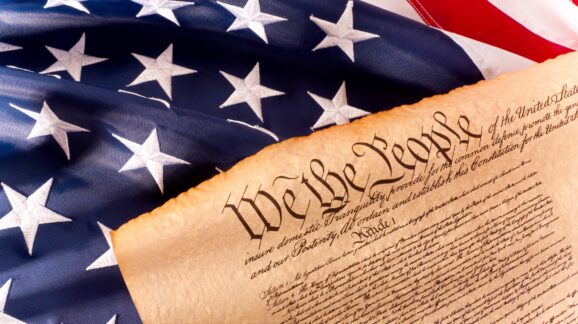
Photo Credit: Getty
Not every ideology seeking power is equally compatible with a faithful commitment to preserve the constitutional order. Turn on cable news or browse conservative commentary, and “democratic socialism” gets treated as either a legitimate political alternative we have no choice but to countenance or a punchline.
The recent debate has brought back waves of memories of studying economic philosophy under James Buchanan at George Mason University, where we grappled with social-contract theory and the legitimacy and limits of political authority.
“Oh wow, look at all the socialists. Too bad we can’t actually stop them. Let’s just call them ‘crazy.’” That about sums up the libertarian and conservative response to an escalating campaign for confiscatory redistribution, boundless entitlements, and the state-directed dismantling and redesign of society. If accomplished, such a transformation could prove irreversible at the ballot box.
The underlying constitutional question seldom gets asked: Can someone openly dedicated to replacing the very institution of checked and bounded, constitutionally limited government faithfully swear to preserve it? And should an already-sworn official administer that oath without confronting the contradiction? Article VI, Clause 3 plainly requires federal and state officers to be bound by “Oath or Affirmation, to support this Constitution.”
Fitness to serve and the very subject matter of “The Vote™” demand scrutiny. Libertarians and conservatives invoke the rule of law but sometimes overlook its ripest fruit: the constitutional Oath of Office itself, which repudiates the chaotic state of nature in which individual rights are subordinated to political ends, the very condition constitutional government exists to overcome.
The ends to which power is directed matter. If we concede the legitimacy of installing across all three branches officeholders who promise or facilitate the state-directed transformation of society on a grand scale, we sound naïve complaining that Congress, the president, the judiciary, and the administrative state have amassed unchecked power. We bear some responsibility for elevating officials whose governing ambitions are fundamentally at odds with the restraints that distinguish a republic from unchecked rule.

An oath is an affirmation of constitutional fidelity, not an empty ceremonial formality uttered before power is exercised. Officeholding is a public trust, steeped in obligation and irreconcilable with doctrines that would transform or displace the very premises on which the office rests. My dad would always say, “Wayne, people tend to be what they are.” Similarly, when someone tells you, in word and deed, that they intend to displace the constitutional order, take them seriously, no matter how dutifully they may raise their right hand. The gesture alone does not imply renunciation of what Fred L. Smith Jr. aptly called “coercive utopianism.”
The constitutional order presupposes fidelity to limited government, divided powers, and protections for life, liberty, and property. It does not confer a general license to subordinate private rights, voluntary exchange, individual autonomy, or the social order itself to collective political objectives. Democratic socialism, as understood here, rejects those limits.
This is not an argument for criminalizing ideas or suppressing political dissent. Citizens remain free to peacefully advocate whatever political philosophy they choose. But advocacy and constitutional officeholding are different matters. The Constitution limits not us, but government, and thus those who wield its power, regardless of electoral mandate.
Constitutional government rests on the principle that public power remain bounded, not only when exercised democratically, but especially then. We vote to elect representatives and appoint officials who operate within defined bounds, not to authorize powers the Constitution never conferred. Inalienable rights are not ours to surrender by vote, even on our own behalf, much less to extinguish by majority vote under the pretext of acting in others’ interests. Violating such rights is tyranny, not merely usurpation.
A further uncomfortable question follows: May an official who has already sworn the constitutional Oath legitimately administer it to someone expressly committed to replacing the foundational premises the oath obligates officials to preserve? Administering the oath formally recognizes the recipient’s undertaking to discharge the obligations of office. It should not be treated as an entirely neutral act.
Democratic socialism is not a subject to dismiss as merely another harmless political viewpoint, yet decades of accommodation to progressive incursions into all three branches of government have left constitutionalists on the back foot and treating relatively marginal developments (such as the overturning of Chevron deference doctrine) as transformative victories. The question of democratic socialism’s compatibility with constitutional fidelity should not be dismissed as impolite, antiquated, or beneath serious consideration. It deserves direct confrontation.
As America marks its 250th anniversary, and with the Constitution turning 250 in a mere decade, the choice is between a republic in which the vote operates within established limits and a majoritarian politics that treats the vote as permission to dispense with them. To celebrate America’s 250th anniversary while shrugging at an ideology that would annihilate limited government would be to forfeit the very constitutional inheritance these anniversaries ought to reaffirm.