DOJ files suit to end California’s unlawful climate and auto power grab

Photo Credit: Getty
The Trump administration’s rollback of Obama and Biden administration climate policies keeps rolling along. The latest initiative is a lawsuit filed by the Department of Justice (DOJ) on behalf of the Department of Transportation (DOT) to overturn the California Air Resources Board’s (CARB) tailpipe carbon dioxide (CO2) emission standards and zero emission vehicle (ZEV) sales mandates.
You might ask, “didn’t Congress and President Trump, in June 2025, use the Congressional Review Act (CRA) to rescind CARB’s ZEV mandates?” Yes, the worst of the worst is gone, but much regulatory mischief is still on the books.
The June 2025 CRA resolution of disapproval nullified the December 2024 Environmental Protection Agency (EPA) waiver approving the ZEV mandates in CARB’s Advanced Clean Cars II (ACC II) program. However, the resolution did not expressly disapprove EPA’s March 2022 waiver for CARB’s ACC I program. ACC I has its own ZEV mandates as well as tailpipe CO2 standards for combustion engine vehicles.
DOJ’s suit asks California’s Eastern District Court to invalidate those policies as “preempted, unlawful, and unenforceable” under Section 32919(a) of the Energy Policy Conservation Act (EPCA) and Supremacy Clause of the US Constitution.
Although DOJ is suing in a district court, the case could eventually reach the Supreme Court. A DOJ victory would be a devastating blow to CARB’s ambition to act as the nation’s de facto industrial policy czar for climate and cars.
Regulatory background
Section 209(a) of the Clean Air Act (CAA) prohibits states from adopting or enforcing vehicle emission standards. However, under § 209(b), the EPA “shall” waive preemption for California, unless the Administrator finds the state “does not need such … standards to meet compelling and extraordinary conditions.” Under CAA § 177, other states may adopt vehicle emission standards identical to those for which California has received a 209(b) preemption waiver.
In January 2013, the Obama EPA granted a 209(b) waiver for California’s ACC I program. In September 2019, the Trump administration National Highway Traffic Safety Administration (NHTSA) and EPA adopted the Safer Affordable Fuel Efficient Vehicles Rule Part One (SAFE I). NHTSA, in its portion of SAFE I, determined that EPCA § 32919(a) preempts state policies regulating or prohibiting tailpipe CO2 emissions because they are directly or substantially “related to” fuel economy standards. The EPA, in its portion of SAFE I, determined that those EPCA-preempted policies are not needed to meet California’s compelling and extraordinary conditions because in-state vehicular CO2 emissions have no relevance to the state’s air quality challenges. Accordingly, SAFE I rescinded the 2013 ACC I waiver.
In December 2021, the Biden administration NHTSA withdrew its portion of SAFE I, but without attempting to rebut the rule’s EPCA preemption analysis. NHTSA acknowledged EPCA § 32919(a) preempts state laws or regulations “related to” fuel economy standards but declined to opine on which state policies those might be. Instead, NHTSA determined it had no authority to prescribe regulations clarifying or enforcing EPCA preemption. That cleared the path for the Obama EPA to reinstate the ACC I waiver in March 2022.
ACC II vs ACC I
ACC II expressly requires in-state sales of electric vehicles (EVs) to increase from 35 percent of the new car market in 2026 to 100 percent in 2035. In other words, ACC II effectively bans in-state sales of gas- and diesel-powered cars by 2035.
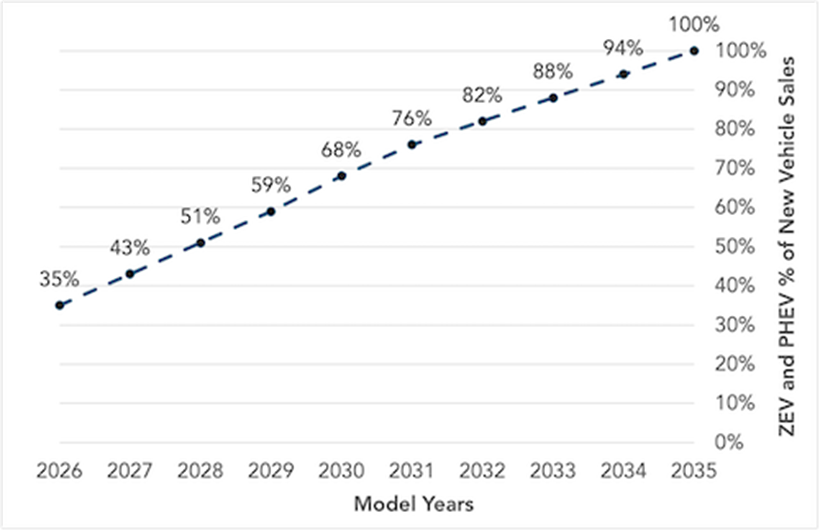
ACC I is less harmful than ACC II to vehicle affordability, consumer choice, and auto-industry competitiveness. Nonetheless, ACC I imposes significant costs on legacy automakers and pressures them to restrict production of many top-selling models.
In model year 2025 and subsequently, ACC I requires 22 percent of new passenger cars sold in California to be EVs.

Notably, ACC I’s 22 percent ZEV sales target continues in perpetuity after 2025, and other states may opt into the ACC I program under CAA § 177.
CARB data indicate that as of May 2022, 16 states plus California had adopted or planned to adopt the ACC I ZEV mandates. At the time, those states accounted for an estimated 35.9 percent of new light-duty vehicle sales. Similarly, 17 states plus California adopted or were planning to adopt the ACC I tailpipe CO2 standards. Those states accounted for an estimated 40.1 percent of new light duty vehicle sales.
Through their collective market power, ACC I states potentially reduce vehicle affordability and choice nationwide, not just within their own borders.
With all the focus these days on ZEV mandates, it is easy to miss the aggressiveness of the ACC I tailpipe CO2 standards. Those standards tighten from 195 grams of carbon dioxide per mile (g CO2/mi) in 2017 to 131 g CO2/mi in 2025 and later, a 33 percent increase in stringency.
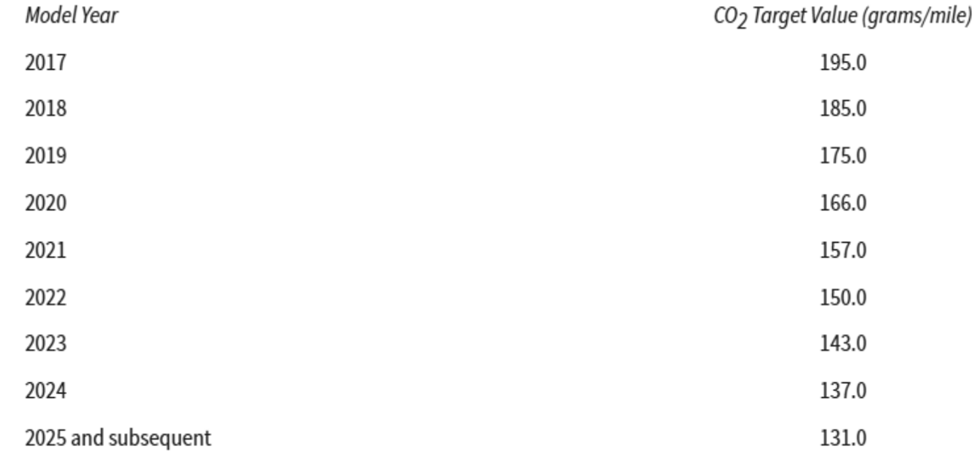
For perspective, consider the emissions profile of Toyota’s best-performing model year 2026 Prius hybrid.
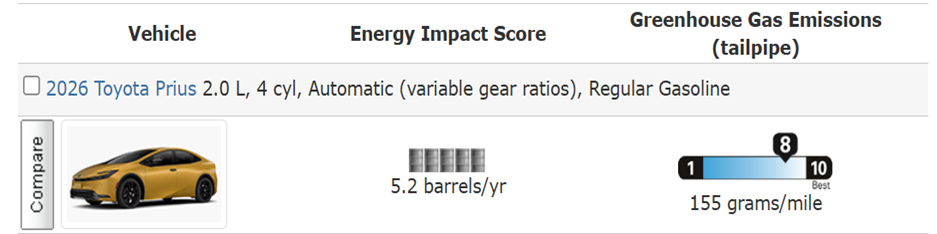
Keep in mind tailpipe CO2 standards are fleet-average requirements, and Toyota also manufactures hybrids and non-hybrids with significantly higher emission profiles. For example, the Corolla Crown AWD hybrid is rated at 214 g CO2/mi, while the non-hybrid Corolla (1-mode TM) is rated at 248 g CO2/mi.
Thus, even if Toyota wiped out its entire product line except for its top-performing Prius, the fleet average (155 g CO2/mi) would still fall short of ACC I tailpipe standards for model years 2022-2025. By model year 2025, the hypothetical all-Prius fleet would fall short by 18 percent.
To comply, Toyota would have to do one or more of the following: restrict sales of combustion engine vehicles, boost sales of EVs, or buy compliance credits from EV companies like Tesla. ACC I both expressly and implicitly rigs auto markets in favor of EVs over combustion engine vehicles.
DOJ’s EPCA preemption lawsuit
In regulatory comments, I have urged NHTSA to propose and adopt a new rule interpreting and enforcing EPCA preemption. I now believe DOJ has a better plan.
Instead of promulgating a new SAFE I rule only to see it overturned by another administration that refuses to debate the rule’s preemption analysis on the merits, the Trump administration is suing CARB for violating EPCA § 32919(a). That ensures the statute’s meaning and application are front and center and ultimately subject to review by the Supreme Court. What’s more, instead of debating whether Congress authorized NHTSA to interpret and enforce EPCA preemption, the Trump administration is leaving enforcement to the branch of government with a clear duty to “say what the law is.”
Key points in DOJ’s brilliant brief may be summarized as follows.
- EPCA 32919(a) prohibits states from adopting or enforcing laws or regulations “related to” fuel economy standards. California’s tailpipe CO2 standards are physically and mathematically related to fuel economy standards. An automobile’s CO2 emissions per mile are directly proportional to its fuel consumption per mile. If an agency regulates tailpipe CO2 emissions, it also regulates fuel economy, and vice versa.
- Congress understood that relationship when it enacted the Corporate Average Fuel Economy (CAFE) program. That is why EPCA § 503(d)(1) directs automotive fuel economy to be tested by measuring tailpipe carbon emissions. Carbon dioxide accounts for about 99.9 percent of such emissions by weight in vehicles with catalytic converters.
- California’s ZEV mandates are substantially “related to” fuel economy standards. As ZEV mandates tighten, EV market share increases, boosting fleet average fuel economy. Conversely, if fuel economy requirements tighten beyond a certain point, compliance requires manufacturers to average in sales of zero and near-zero emission vehicles.
- EPCA 32902(h) effectively prohibits NHTSA from forcing automakers to use vehicle electrification as a compliance option. No Clean Air Act provision similarly prohibits the EPA or CARB from compelling vehicle electrification, but that is because Congress never authorized those agencies to regulate fuel economy in the first place.
- Because state policies regulating or prohibiting tailpipe CO2 emissions are directly or substantially “related to” fuel economy standards, they are expressly preempted.
- EPCA also impliedly preempts California’s tailpipe CO2 standards because they interfere with NHTSA’s determination of CAFE standards. EPCA requires NHTSA to weigh and balance four factors when determining CAFE standards: technological feasibility, economic practicability, the effect of other federal vehicle standards on fuel economy, and the nation’s need to conserve energy. Only by sheer improbable accident would CARB strike the same balance as NHTSA. Indeed, CARB is not bound by EPCA’s four factors and gives considerable weight to climate ambition — a factor nowhere mentioned or implied in EPCA.
- Similarly, EPCA impliedly preempts California’s ZEV program because it conflicts with the CAFE program’s basic structure. The ZEV program is technology-prescriptive, compelling automakers to sell vehicles powered by batteries or fuel cells. CAFE is technology-neutral, allowing automakers to choose the types of fuel-saving strategies to deploy for the types of vehicles they choose to sell.
- Preemption statutes derive their authority from the Constitution’s Supremacy Clause. “It is basic to this constitutional command that all conflicting state provisions be without effect” (Maryland v. Louisiana, 451 U.S. 725, 746 (1981)). Preemption occurs ab initio — the moment a conflicting state policy is enacted or adopted, not when a court later declares it so (Cabazon Band of Mission Indians v. City of Indio, 694 F.2d 634 (9th Cir. 1982)).
- Thus, the Obama and Biden administration Clean Air Act preemption waivers did not legalize ACC I. EPCA preemption is non-waivable, and it voided ACC I’s ZEV mandates and tailpipe CO2 standards years before the EPA agreed to review them.
- Defendant’s claim that “EPCA preemption is not among the factors governing” a CAA § 209(b) waiver proceeding is false. CARB seeks waivers so that California and other states may include CARB vehicle emission standards in their National Ambient Air Quality state implementation plans (SIPs). CAA § 110(a)(2)(E) requires each SIP to provide “necessary assurances” that no “portion” of the plan is “prohibited under any provision of federal or state law.” CAA § 110(k)(1)(A) requires the EPA to review plan submissions for compliance with “the provisions of this chapter.” The EPA may not lawfully fail (much less lawfully refuse) to consider whether ACC I is prohibited by EPCA.
I will monitor this case and post updates as it develops.