Federal regulation 1st quarter 2026 report: Bureaucracy on the back foot

Photo Credit: Getty
Here at the close of the first quarter of 2026, the March 31 Federal Register stands at 16,115 pages, containing 609 final rules and 416 proposed rules.
That pace, roughly 200 final rules per month, puts 2026 on track to be one of the lowest rulemaking years in history, continuing Trump’s sharp break from the 3,000-plus rule norm of recent decades (2025 ended with just 2,441 final rules).
But as detailed in recent roundups (and as will be explored more fully in the upcoming new edition of Ten Thousand Commandments), that topline count understates the story of conventional rulemaking’s precipitous decline. Agencies generally must issue new “unrules” to repeal, replace, or delay old ones, paradoxically making the Register appear more prolific and bloated than it actually is.
Of the 609 final rules so far in 2026, 56 qualify as “significant” under EO 12866, meaning they carry at least $100 million in anticipated economic effects.
More revealing, however, is their composition. The Trump administration’s “one-in, ten-out” framework continues to reshape the character of rulemaking itself.
Many of these “significant” rules are not regulatory in the traditional sense. In 2025, they included repeals and withdrawals, postponements and effective-date delays, technical corrections, rescissions, removal of requirements, streamlining measures, fee cuts, sunset mechanisms putting rules on borrowed time, and more. That pattern appears to be holding in 2026.
My preliminary tally finds 36 of the 56 significant rules to be deregulatory. This assessment is offered in advance of formal administration classifications. Examples from the first quarter include Environmental Protection Agency rollbacks of environmental strictures and certain greenhouse gas standards; the Council on Environmental Quality’s removal of National Environmental Policy Act implementing regulations; pipeline safety flexibility from the Pipeline and Hazardous Materials Safety Administration; revision of the joint employer standard from the National Labor Relations Board; a Nuclear Regulatory Commission regulatory sunset rule; and broader efforts to eliminate obsolete rules and align agency procedures with deregulatory priorities.
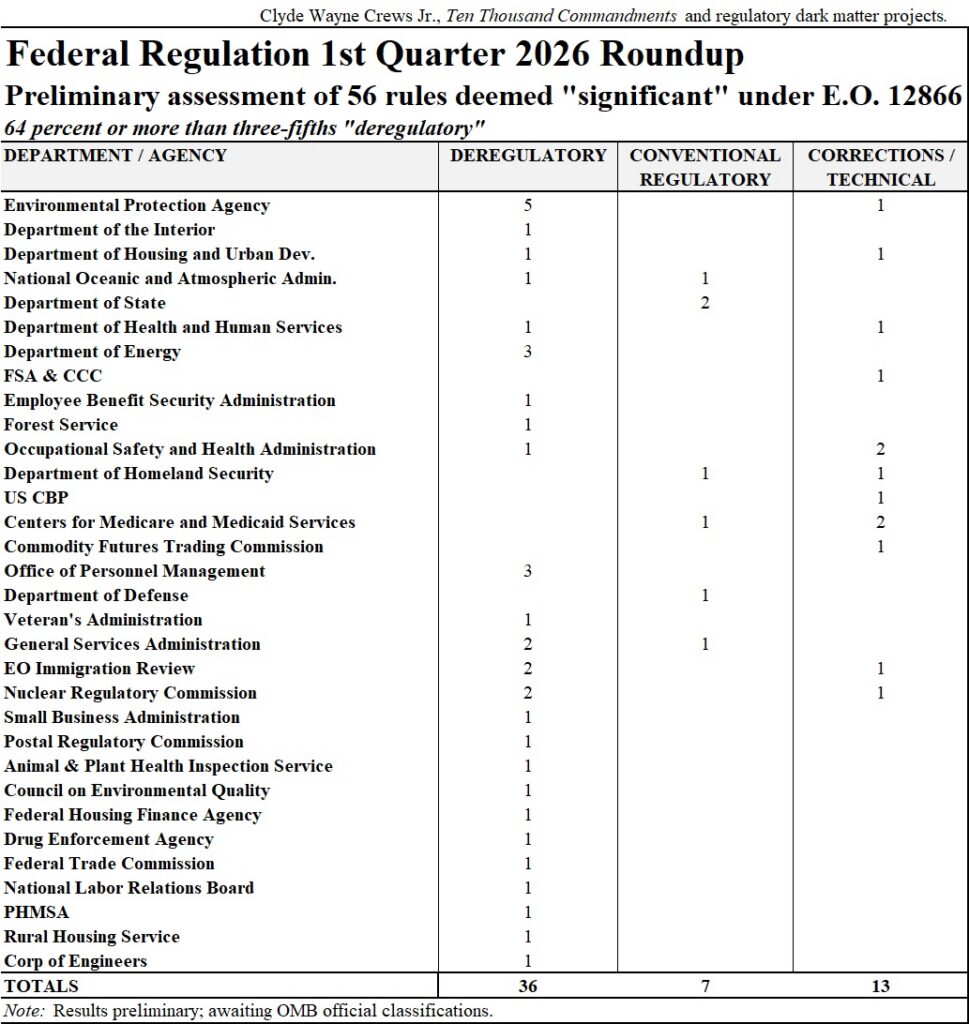
Alongside those 36 deregulatory rules, the table depicts seven assessed as regulatory and 13 consisting of technical corrections, announcements, and similar actions. The bottom line: roughly 64 percent — nearly two-thirds — of significant rules are deregulatory in character, consistent with a “one-in, ten-out” posture.
Given that policy, the seven significant regulatory rules (including certain environmental and health-related measures) must be offset. Those offsets need not come entirely from other significant rules; minor rules and even deregulatory guidance documents can count toward the total.
Still, what stands out is that these seven conventionally regulatory rules — on an apples-to-apples basis — are already offset five-to-one by 36 significant deregulatory measures. That is a fairly striking ratio. Whether the full “one-in, ten-out” target materializes across all rule categories remains to be seen, but the direction is unmistakable: agencies are spending more time undoing than doing.
To be sure, not everything tilts toward laissez-faire. Trump’s interventionist tendencies in trade, industrial policy, and related domains do not appear primarily in the Federal Register and can easily swamp deregulatory progress. Sub-regulatory guidance and statutory mandates continue to exert influence beyond what rule counts capture.
This means the administrative state is not disappearing. Agencies remain funded, staffed, and capable of regulating through enforcement discretion and creative informal mechanisms.
Still, the first quarter of 2026 reinforces a reality that became apparent in 2025: a federal government regulating less does not produce chaos. If anything, constant regulatory expansion looks increasingly like habit rather than necessity.
Making that shift permanent will require Congress to reclaim legislative authority from agencies — and then, crucially, to refrain from exercising it.
For more, see:
“Trump slashed rulemaking in 2025: The hard part starts in 2026,” Competitive Enterprise Institute