GDP and the origins of prosperity
Photo Credit: Getty
The United States is a wealthy and prosperous country. Historically, Americans have looked to Gross Domestic Product (GDP) to measure their prosperity. GDP measures the overall economic output of a country by adding up the market value of its finished goods and services produced in a given year.
GDP can feel impersonal because it measures the output of an entire economy. GDP per capita brings the discussion closer to the average person by showing economic output relative to population size. To calculate it, economists divide real GDP by population size.
Tracing GDP per capita over time reveals how dramatically people’s quality of life has changed. The graph below covers the years 1650-2018. For most of this time period, living standards improve only gradually. War, disease, and famine frequently disrupted slow and fragile economic gains.
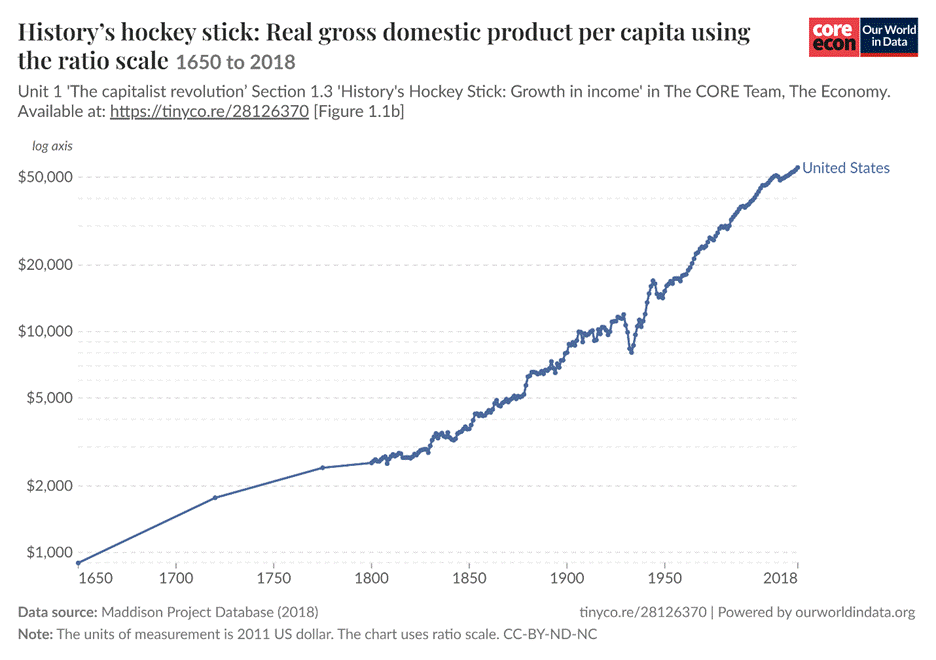
Then industrialization arrived. The line bends sharply upward and continues climbing steeply. Economists often refer to this pattern as the hockey stick of human prosperity. The graph captures a remarkable increase in material prosperity on a scale previously unseen in human history.
But does the graph tell the entire story? Critics argue that prosperity extends beyond GDP. Health, community, environmental quality, work-life balance, and opportunity all contribute to human well-being. However, GDP cannot directly capture these dimensions of life. As a result, many regard GDP as an incomplete measure of human progress.
The discussion is often framed as though GDP and living standards are pulling in opposite directions. The relationship is often more intertwined than the debate suggests. Countries with higher GDP per capita generally experience longer life expectancy, lower child mortality, higher literacy rates, and stronger environmental outcomes. GDP may not measure these dimensions of well-being directly, but it often travels alongside them.
Yet the conversation often stops at measurement. The more fundamental question is how prosperity comes to exist at all.
Prosperity did not appear out of thin air, nor did it emerge simply because someone chose to measure it. Before economists could evaluate prosperity, people first had to create it through effort, creativity, and exchange.
The dramatic rise in living standards following industrialization emerged from millions of individuals solving problems, developing new ideas, building businesses, acquiring skills, and creating value for others. GDP reflects the cumulative results of those efforts. It captures the outcome more directly than it explains the process that produced it.
Recognizing this does not mean GDP captures every aspect of human well-being. Health, family, community, and opportunity all shape people’s lives in ways that no economic statistic can fully capture. GDP’s limitations are real. At the same time, focusing exclusively on those limitations can distract from what GDP does reveal: the economic activity generated when people create value for one another.
The challenge is not just tracking prosperity. It is understanding the forces that allow it to emerge, grow, and endure.