Market-oriented reforms that can save Medicare $100 billion

Photo Credit: Getty
Since 1970, Medicare spending has grown from 0.7 percent of GDP to 4.0 percent of GDP, and it is projected to grow even further. In addition, much of Medicare spending is not covered by beneficiary premiums, Medicare payroll taxes, or general tax revenues, meaning Medicare continues to worsen the national debt.
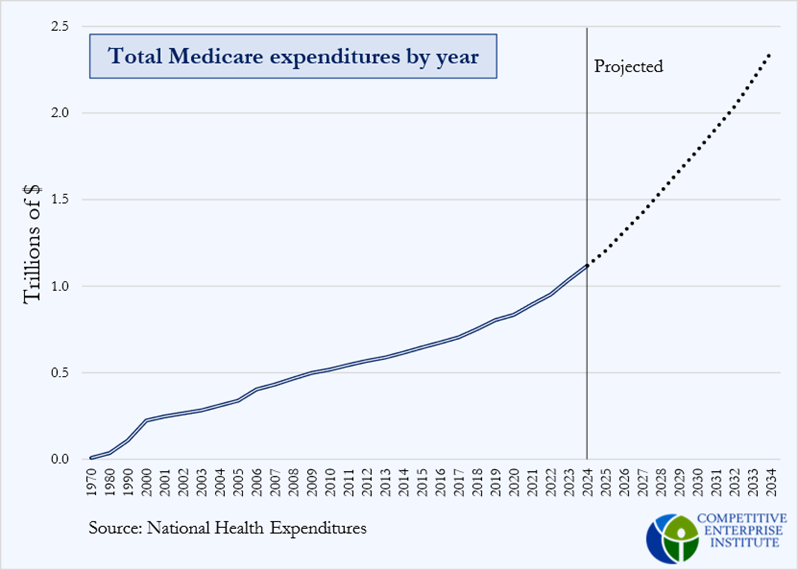
There is a growing realization that reform is needed. The Inflation Reduction Act was supposed to lower the cost of Part D, but, in practice, it seems to be having the opposite effect. Some legislators and candidates see the current state of Medicare and want simply to expand it, without reforming it at all.
However, the better course of action is to reform Medicare to remove policies that both distort market incentives and raise costs. There are many options to do so.
In a recent paper published by Hoover, I explain how Medicare Advantage works and propose several reforms that achieve both goals. These proposals would save more than $100 billion over ten years and have the added benefit of returning choices to Medicare beneficiaries.
Specifically, I suggest eliminating the Quality Bonus Program altogether, or alternatively ending the benchmark quartile adjustments. Both of these policies were put in place by the Affordable Care Act and neither of them improves the system nor reduces costs relative to a simpler, flat benchmark. Recently, Michael Chernew, former chair of MedPAC (the Congressional analysis group that focuses on Medicare), also argued in favor of eliminating the Quality Bonus Program as part of a wider-ranging proposal to end the Star Ratings System.
Medicare Advantage reforms have been proposed by others as well. The problem with many of these other reforms is that they assume that either government can correctly estimate what Americans’ health care costs should be or that government knows better what kind of supplemental benefits insurance companies can offer than the insurance companies themselves.
Many problems in health care come down to government forcing false choices and ignoring trade-offs. Reforms to the system shouldn’t exacerbate those but move toward a system where beneficiaries choose how they want to interact with an affordable health care system.