Protectionism in North America? Not again
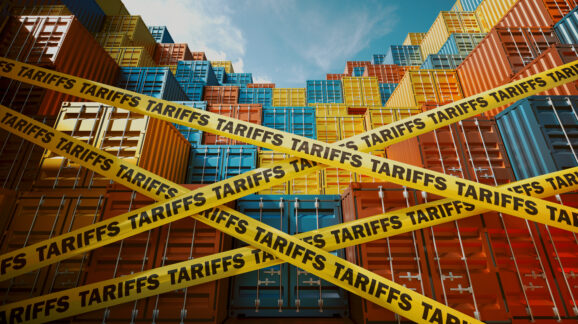
Photo Credit: Getty
Well before its ratification in 1993, the North American Free Trade Agreement (NAFTA) was scorned by its critics as a dangerous, unfair deal. CEI, too, has a long history of criticizing provisions in NAFTA and its successor, USMCA, though from the free-trade perspective.
But as Senior Fellow Iain Murray recently said, a flawed agreement is better than none. Pre-NAFTA instability harmed businesses and consumers. In response to present uncertainty over USMCA’s future, we should remember how Americans fared in the protectionist past.
A smaller market
The North American countries are close in proximity and in taste. Yet, for more than a century, politics kept US producers from reaching markets right next door.
Soon after Canadian confederation in 1867, nationalist governments in Ottawa asserted their independence using hefty import restrictions. Canadian voters rejected free trade in 1878, 1891, and 1911. Over the next seven decades, US exports were tightly restricted and Canada’s cost of living soared, creating “a large but poor economy” above the richest nation on Earth.
Finally, the US-Canada Free Trade Agreement (USCFTA) was reached in 1988. In the US Senate hearings to ratify the deal, firms ranging from GM and Goodyear to Intel and Mobil voiced their support. The President of the National Association of Manufacturers, Alexander B. Trowbridge, listed some “prohibitive” Canadian tariffs that faced repeal. These included 25 percent on surgical gloves, 17.1 percent on handbags, and 12.5 percent on “certain glues.”
Four years later, American businesses again backed expanding USCFTA into NAFTA, to include Mexico. Until recently, the socialist Mexican government restricted trade and private investment, which contributed to stagflation. The economy grew only through heavy subsidies to bloated, nationalized industries. When the state could not repay its debts between 1982 and 1985, GDP flatlined and real wages fell by a third.
Nevertheless, executives told Congress they believed NAFTA would make Mexico a richer and more liberal country. This meant more sales of US farm and factory products: one New York-based group even quoted CEOs looking to sell cell phones, insurance, and designer clothes to a middle-class, liberal Mexico.
Higher prices, less choice
Before NAFTA, Americans could not reliably access foreign goods at affordable prices. This worsened shortages because import regulations prevented producers from meeting their customers’ increased demand.
Food is one example. In 1973, Washington exported wheat to Russia to alleviate a famine. But this created a domestic shortage, and wheat prices doubled until President Nixon allowed Americans to buy wheat from Canada.
In another example of mutual harm, droughts devastated US peanut crops in 1979, tripling prices until President Carter waived import restrictions. Meanwhile in Mexico, farmers were struggling through a credit crunch, or a shortage of upfront cash.
These lost opportunities stemmed from protectionist import quotas, most of which NAFTA abolished within North America. Today, US stores diversify with Canadian pork and Mexican fruits. This had the unintended consequence of introducing variety to the US diet. The avocado was virtually unknown to Americans until NAFTA, while Modelo beer was just “a fad.”
Fair competition and substitute goods drive costs down. A May 2026 study estimated that, without NAFTA, food prices in 2014 would have been 12 percent higher than they actually were.
Not again
US trade with Canada and Mexico has more than quadrupled in the last 30 years. Forty-two US states have either Canada or Mexico as their top trade partner. Companies have millions more potential customers and the competitive pressure and freedom to pursue transnational cost-cutting measures. Shoppers benefit in turn from greater variety and lower prices.
Direct benefits include an $80 billion boost to US GDP and new, well-paid export-related jobs. In retrospect, another benefit becomes clear. For more than a century before NAFTA, protectionism blocked businesses and consumers from innovating and adapting. Now in 2026, political caprice could destabilize North American commerce. Let’s not wind back the clock.