Quartz tariffs are looming and your kitchen could pay the price
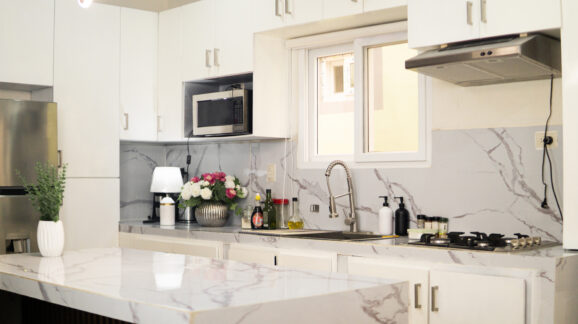
Photo Credit: Getty
Earlier this week, the US International Trade Commission (ITC) ruled that increased quartz imports are injuring the domestic quartz industry. The petitioners, the Quartz Manufacturing Alliance of America (QMAA), saw this ruling as a win because it clears a key legal hurdle toward securing the 50 percent tariffs and import quotas on quartz. This ITC ruling significantly increases the likelihood that such trade barriers will be imposed.
This is not a theoretical quarrel but a pivotal moment in construction and housing, especially kitchens. Quartz accounts for 36 percent of US countertop installations, which makes it the single most popular countertop material. It has become a go-to material for residential construction not only because it is cost-effective and durable, but also because of its high stain resistance and low maintenance.
Quartz is not a niche product. If the QMAA gets its way and these tariff barriers are imposed, it will directly affect the housing market and the broader economy by raising costs and altering how homes are built and renovated.
The price tag of quartz protectionism
Tariffs increase housing costs through a chain of economic effects. First, because tariffs are taxes on imports, they make materials more expensive for suppliers. These suppliers typically pass at least part of the cost onto manufacturers and distributors, who in turn pass costs onto homebuilders.
Builders then face higher material costs and often have limited ability to absorb them without cutting margins. Because labor and financing costs are largely fixed, the additional material expense is usually passed along to homebuyers in the form of higher sale prices or renovation costs.
That helps to explain why the Brookings Institution calculated last October that Trump’s tariffs on housing inputs like lumber, steel, aluminum, and gypsum will increase residential construction costs by $30 billion. Similarly, a 2025 National Association of Home Builders survey estimated that the tariffs will cost $10,900 per newly constructed home.
Quartz countertops are no exception. Roughly 1.5 million new homes were built in the US in 2025. With about 36 percent of kitchens featuring quartz countertops, that would affect about 540,000 kitchens. Given a 50 percent tariff on a market that is 90 percent import-dependent, with an 80-94 percent pass-through rate and slab costs accounting for 40-70 percent of total cost, prices would rise by an estimated 14.4-29.6 percent.
The average cost of a quartz countertop is $3,500. This means that the tariff would cost an extra $504-$1,036 per kitchen. With 540,000 kitchens, the aggregate cost on new kitchens would be anywhere from $272 million to $559 million a year. For families buying a new home or renovating, these costs translate directly into higher monthly payments or delayed projects.
There are caveats worth noting. First, this back-of-the-envelope estimate only covers kitchen countertops. Quartz is also used in other residential and commercial applications, which means the broader market effect is larger. Second, it reflects only the tariff and does not include any potential import quota.
Third, the estimate only accounts for new homes, not replacement countertops. Fourth, this calculation assumes every homeowner and builder continues to choose quartz, which may not hold if alternatives become more attractive.
If not quartz, then what?
Especially with affordability at the forefront of Americans’ minds, it is likely that the cost of quartz would be enough of a factor that homeowners choose a different material. Quartz sits in the middle of the countertop cost spectrum. Installed quartz typically runs about $50–$150 per square foot, whereas laminate can be as low as $25–$40, solid surface around $40–$80, and granite $40–$175 per square foot.
Homeowners facing higher quartz prices could turn to alternative materials, but each option has tradeoffs. Laminate countertops are easier to maintain and much cheaper, but they generally have a shorter lifespan and are more susceptible to scratches, moisture, and heat damage.
Solid surface materials offer seamless design and easier shaping, but they are more susceptible to scratches and burns, are heavier, and cost more. Natural stone like granite can be very durable and handle heat well, but granite is porous and requires regular sealing and careful maintenance. These tradeoffs show that a shift away from quartz can mean accepting lower performance or higher upkeep.
The counterproductive countertop policy
A tariff on imported quartz would increase prices for homeowners and builders while narrowing the choices available in the market. Such a policy primarily benefits a small group of well-connected domestic quartz manufacturers while passing higher costs onto homebuyers, contractors, and other businesses in the kitchen and residential construction supply chains. The quartz market illustrates why free trade matters.
Countries that produce quartz more efficiently and at a lower cost enable US buyers to access better products at lower prices. As CEI scholars Iain Murray and Ryan Young detail in their paper Traders of the Lost Ark, trade barriers distort markets, limit consumer choice, and reduce overall economic efficiency. Those effects apply to the quartz-specific trade barriers, as well.
When all is said and done, such a policy prioritizes a narrow industry interest over the broader public. When the government picks winners in the kitchen, everyone else pays the price. Homeowners and builders should have the freedom to decide which materials best meet their needs without the government tilting the scales towards a select few quartz manufacturers.