Six takeaways from the recent Obamacare announcements

Photo Credit: Getty
Every year, health insurers participating in the Exchanges (Obamacare) must announce their planned premium increases for the following year well in advance, so federal regulators can assess whether they are reasonable. Recent analysis of those proposed increases by the Kaiser Family Foundation indicates that Exchange plans’ premiums will be increasing by 14 percent in 2027, compared with 2026 levels. The plans themselves cite a number of factors, including the end of the expanded subsidies, changing risk pools, and additional costs, among other factors. However, the announcements also point to some broader takeaways about the market itself.
ACA enrollment is still well above pre-pandemic
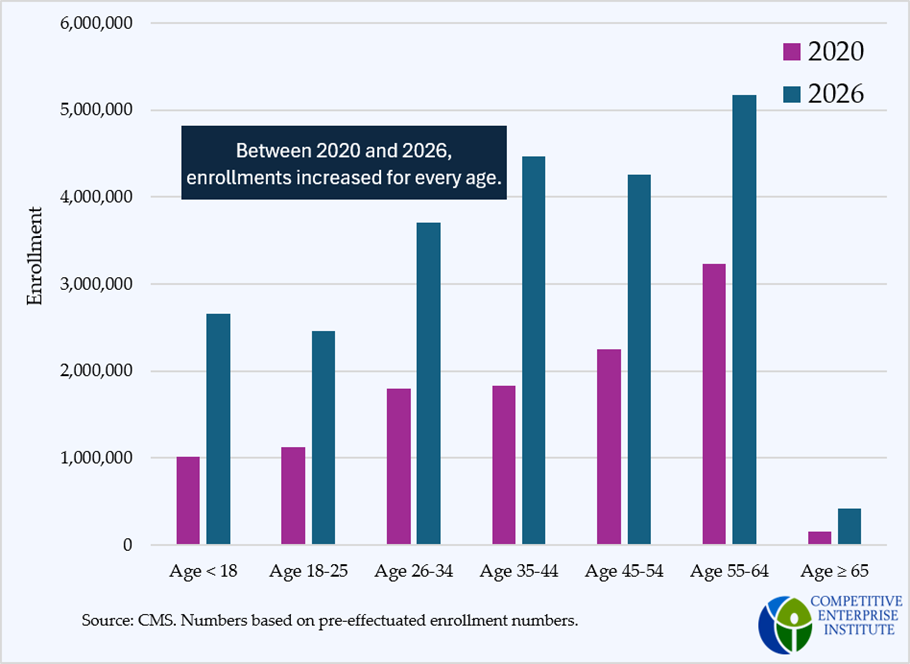
Even with the end of expanded subsidies and the subsequent drop in enrollment, total beneficiaries in the Exchanges are much higher than prior to the pandemic. Every enrollment category includes more participants today than it did before COVID and the expanded subsidies. In fact, initial enrollments for 2026 were double the 2020 level, despite the planned expiration of the expanded subsidies.
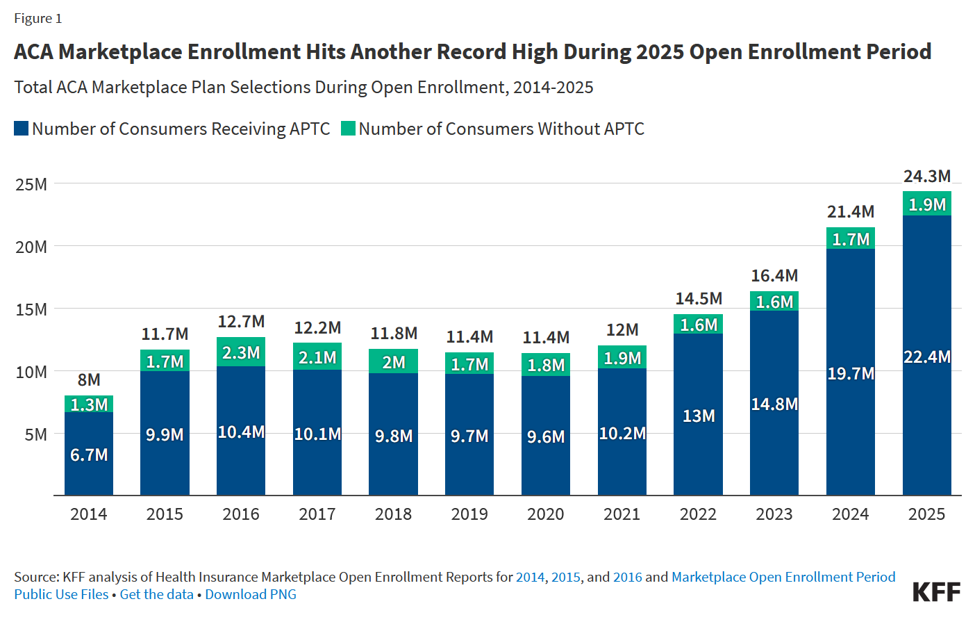
Of course, some enrollees may have planned for the continuation of the subsidies and dropped out when payment was required. Enrollees who maintain coverage after making their first premium payments are due are considered to have effectuated coverage. But even after effectuations are taken into account, enrollment in February of 2026 was still nearly double that of 2020.
No Surprises Act
As part of the No Surprises Act, the government mandated that disputes between providers and payers for patients who receive care from an out-of-network physician enter an arbitration process where a third party determines the payment rate. This has caused costs to explode.
Initially, the CBO projected there would be around 17,000 of these disputes annually, and that the ultimate winner of the dispute would be equally likely to be a payer as a provider, resulting in payments roughly equivalent to what payers pay their in-network providers.
Instead of 17,000 per year, there were 2.5 million disputes filed in 2025. There were 248,000 disputes initiated just in January of 2026. Providers won more than 85 percent of them and payouts that were 2.5 to 4.6 times the amounts that payers negotiated with their in-network providers. This drives up expenses not only from the direct costs from the higher payments that the disputes are creating, but also through added administrative burdens across the industry and a disincentive for providers to participate in payer networks which is one of the primary tools payers have to restrain prices.
GLP-1s
Several payers cited the cost and expanding utilization of GLP-1s in their increased premiums. Some have argued that GLP-1s will actually reduce health care costs over time because of their indirect effects on obesity-related comorbidities. Research hasn’t supported that, so far, but potential benefits would accrue over time.
If the high-end potential for GLP-1s does come to pass, however, what we are seeing today is more of a short-term rise in costs that will lead to long-term cost decreases, which may not be fully realized by these plans, but by Medicare and other plans as the beneficiaries age and move between different types of coverage.
Risk composition
One of the primary drivers of the increased costs, according to the plans themselves, was a change in the risk pools. Forty-six percent of the reduction in enrollment came from people ages 18-34. Of course, people in this age group tend to have lower health care costs than older enrollees, so the overall average cost of care for beneficiaries would tend to go up. Note, however, that the share of beneficiaries under 18 also went up, which would be a counteracting force.
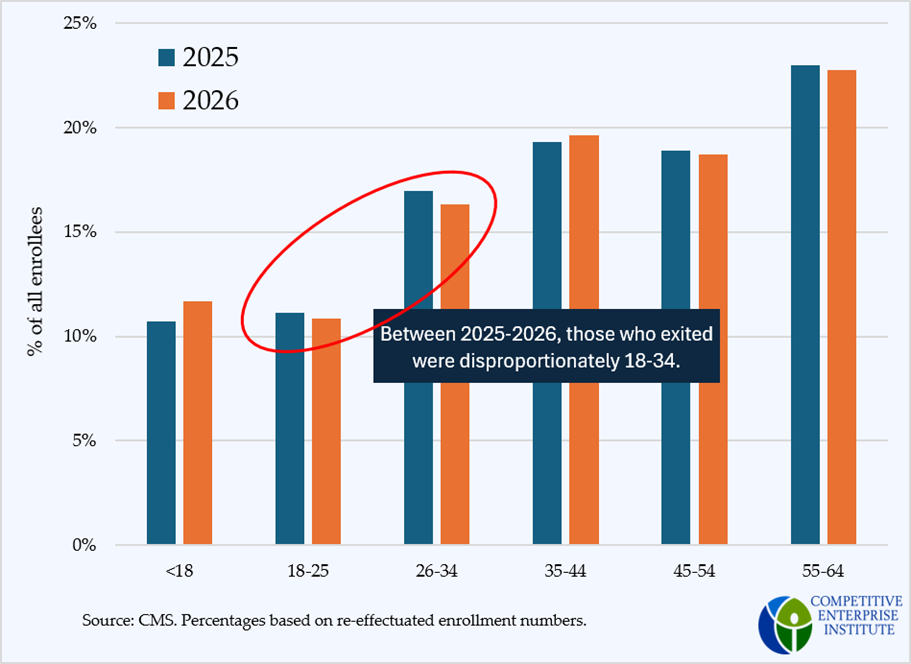
Regardless, this shows that the widespread fears that the end of the expanded subsidies would leave the disproportionately sick or higher cost uninsured were mistaken.
Further, there’s additional reason to be skeptical that composition is a driving factor for 2027’s rates. When analysts were projecting the effect of the end of the expanded subsidies for 2026, all indications suggest that they overestimated the effect by projecting more people would disenroll from the Exchanges than actually did. Like this year, insurers incorporated those projections for 2026 enrollment into their own 2026 premiums. But considering those projections overshot, and overestimated, there’s reason to believe that the plans’ premium projections already overcompensated.
The Great Slowdown
Over the past few years, many health care analysts have remarked that the rapid increase in health care costs has stopped. Prior to 2010, health care took up a larger and larger percentage of the US economy, but that growth slowed considerably in the late 2010s.
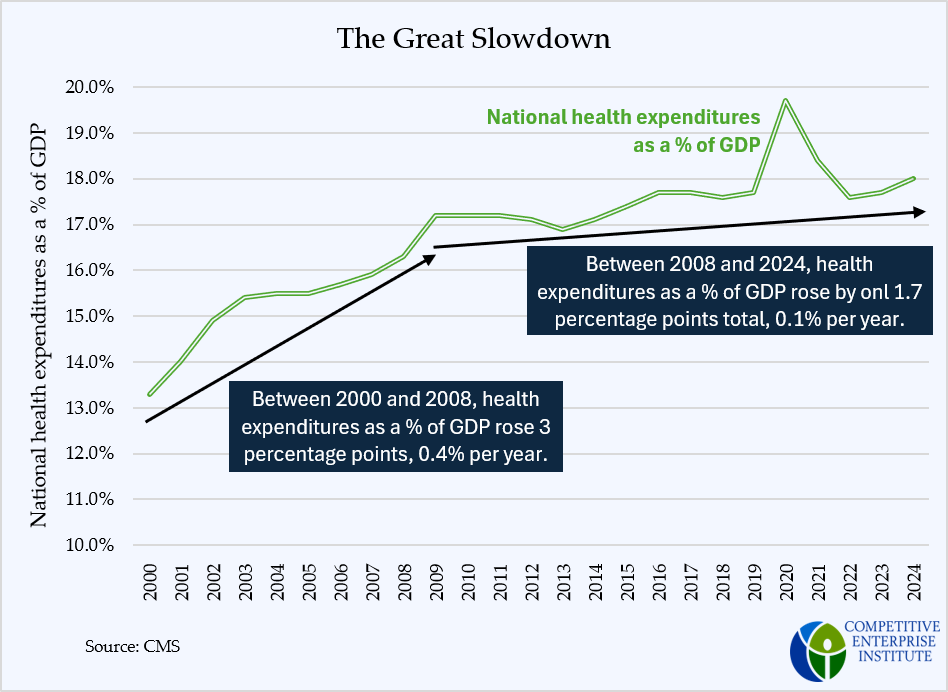
Many argued that this was thanks to Obamacare and the Affordable Care Act, but even a cursory inspection would show that the slowdown came in areas that were not the targets of Obamacare and there was little reason to believe the two were connected.
Subsequent research pointed to factors like drugs. However, some are arguing now that the Great Slowdown may be over, and health care will resume its growth. CMS’s Office of the Actuary predicted that national health care expenditures will reach 20.6 percent of GDP by 2034. These premium increases support that hypothesis.
Reform is needed
The Exchange plan premiums continue to rise, largely because of the structural flaws in the Affordable Care Act. The recent news only reaffirms that enormous reforms are needed in this sector, including reducing mandatory benefits and allowing a broader range of plan designs. CMS under the Trump administration has already proposed several positive reforms, but the best approach is for Congress to completely overhaul this system to allow enrollees more freedom of choice, which will begin to drive down costs.