Stop the snapback: Congress can make small-business deregulation stick
This week, CEI sent a letter to Congress urging the House to pass Rep. Beth Van Duyne’s (R-TX) H.R. 2965, the Small Business Regulatory Reduction Act (SBRRA). Our letter draws partly on new 2025 data outlined in my recent columns showing newly spun red tape has collapsed to extraordinarily low levels — perhaps the lowest since Federal Register recordkeeping began.
But just as Trump’s first-term regulatory reforms were overturned by Joe Biden as one of his first actions, this relief will be temporary unless Congress locks it in. The SBRRA takes a step in that direction by capping the costs of rules affecting small business. Specifically, the Administrator of the Small Business Administration (SBA) is instructed to ensure that “the small business regulatory budget for a small business concern in a fiscal year is not greater than zero.”
A record decline in small-business regulation
Under the Trump administration’s renewed deregulatory push, conventional notice-and-comment rulemaking has cratered. Rules generally number more than 3,000 each year. But as of December 1:
- Only 2,216 final rules have been published, on pace for the lowest annual total ever, besting Trump’s own low of 2,964 in 2019. Trump’s totals are still “lower” in actuality, because a substantial number consist of “unrules”: delays, rescissions, and relaxations in enforcement.
- 554 rules are flagged as affecting small business (again, some of which are deregulatory unrules like delays and burden-easing adjustments).
- Only 26 of these small-business rules are deemed “significant” (typically meaning that they carry $100-million-plus in annual effects).
On a straight-line projection, the year is likely to close with about 604 final rules affecting small business, with 28 significant rules among them, as shown below. That’s well below Trump’s first-term averages of 701 and 70 over four years, respectively.
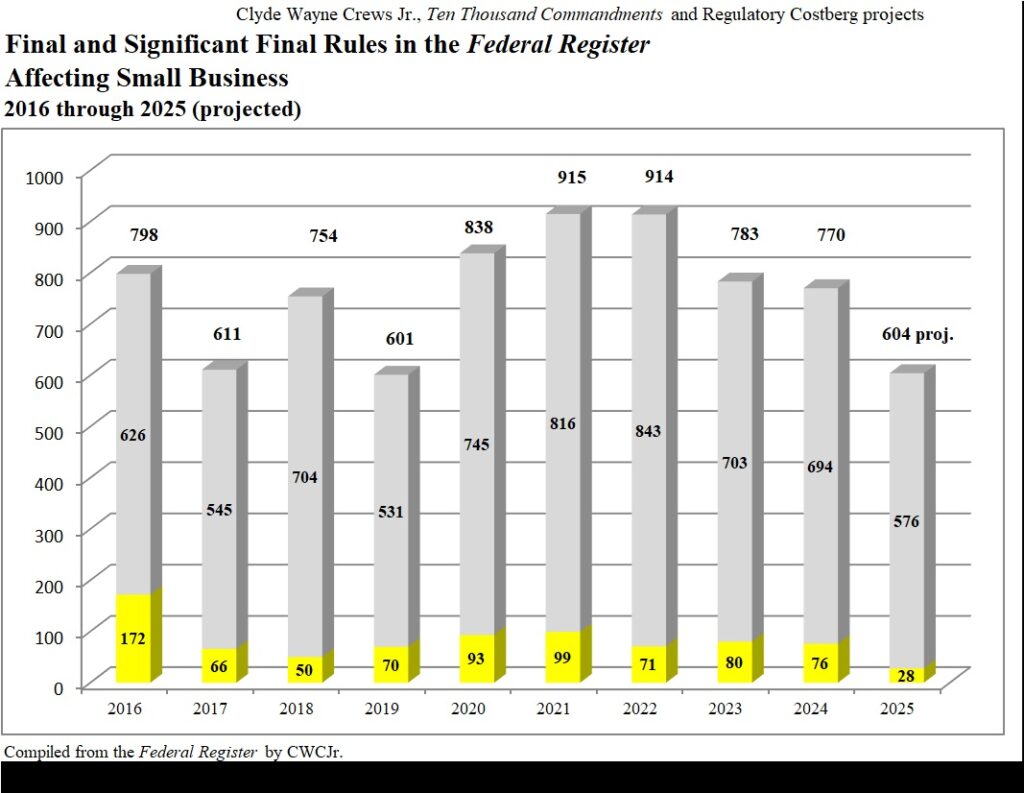
By comparison (see the recent Ten Thousand Commandments for more detail and context):
- The Biden years averaged 846 small-business rules per year, with 82 significant.
- The Obama years averaged 694, with 117 significant.
Why Congress should act
Today’s relief in the form of temporary pauses, delays, and administrative flexibilities is doubtless more than welcome to small businesses, but a future administration can reverse them instantly. As we note in our letter, the SBRRA would make the gains more durable by:
- Requiring the Small Business Administration to oversee a “small business regulatory budget” keeping the net regulatory cost of new rules on small businesses at or below zero; and
- Requiring annual reporting on all rules expected to affect small firms, including details on the agencies issuing such rules.
Steps like these reinforce the spirit of the 1996 Small Business Regulatory Enforcement Fairness Act and restore stability for entrepreneurs who otherwise would need to plan around partisan regulatory whiplash.
Now is the moment
The Trump administration has opened a window for real reform. Only Congress can make it permanent. While more than a dozen Congressional Review Act resolutions of disapproval for Biden-era rules have been enacted into law, general regulatory reform has fallen by the wayside. That could change this week.
As it happens, another bill up for a vote this week called H.R. 4305, the DUMP Red Tape Act (DUMP), from Rep. Tony Wied (R-WI) would also bolster relief. This bill would require the SBA “to establish a Red Tape Hotline to receive notifications of burdensome agency rules.”
Enacting the SBRRA alongside DUMP could be a significant step in protecting small firms from future surges in red tape and preserving today’s historic pause in new rules. DUMP, appropriately enough, stands for “Destroying Unnecessary, Misaligned, and Prohibitive” red tape. Let’s make it so.
For more, see:
- CEI’s full letter to Congress
- “The hidden growth of government in an age of less red tape,” Competitive Enterprise Institute
- “How ‘unrules’ are powering down the bureaucracy,” Competitive Enterprise Institute