The 2026 Unconstitutionality Index: 18 rules for every law
Photo Credit: Getty
Article I of the Constitution vests enumerated legislative powers solely with Congress. In practice, however, administrative agencies do most of the lawmaking. Congress enacts weighty legislation — already problematic enough — and then delegates fleshing out the details to agencies. Agencies welcome this delegation and gleefully use it to expand their turf and power.
In pursuit of regulatory deconstruction and swamp-draining ambitions, we hereby present the 2026 Unconstitutionality Index — a straightforward ratio comparing the number of rules issued by federal agencies to the number of laws passed by Congress and signed by the president in a given calendar year.
During 2025, federal regulatory agencies issued 2,441 rules, compared to 133 laws enacted. This yields an Unconstitutionality Index of 18 rules issued for every law passed in 2025, as seen here:
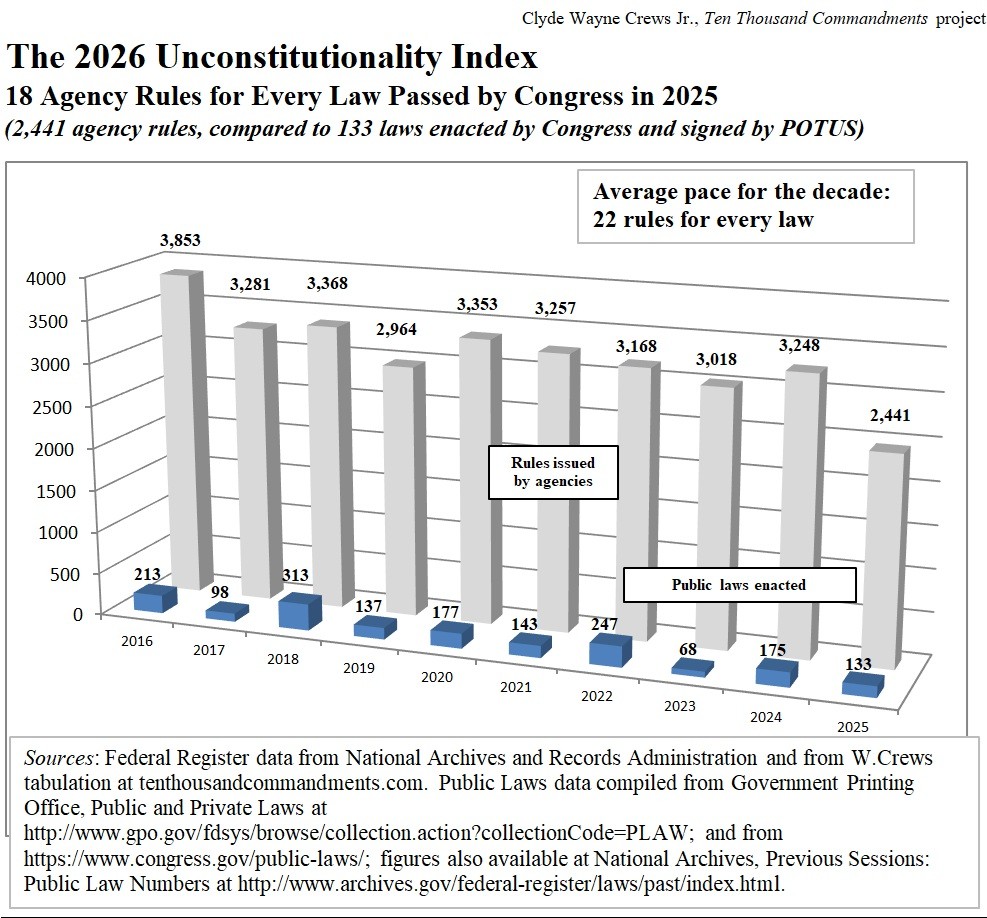
This is comparable to the 19 rules issued for every law passed in 2024. That year agencies under Joe Biden issued 3,248 final rules, while the 118th Congress passed 175 bills signed by Biden. The average over the past decade has been 22 agency rules for every congressional law.
The rule count happens to be an all-time low. Apart from a dip during Trump’s first term, annual rule counts have consistently exceeded 3,000. They peaked at over 4,000 in the 1990s and surpassed 7,000 in the 1970s and early 1980s.
Of the 133 laws passed in 2025, 65 were signed by Joe Biden in early January before he left office, while the remaining 68 were passed by the first session of the 119th Congress and were signed by President Trump.
Both laws and regulations range from trivial to highly consequential and transformative.
Trump’s 2025 enactments included Public Law 119–1, the Laken Riley Act; P.L. 119-12, the TAKE IT DOWN Act; and P.L. 119-21, the reconciliation measure better known as the “One Big Beautiful Bill.”
The Unconstitutionality Index can easily fluctuate with changes in its numerator or denominator, as shown by the uncharacteristically high 2023 score of 44 rules per law, caused by the passage of just 68 laws, down from a peak of 313 laws passed in 2018. Timing and scheduling of official archiving can also contribute to fluctuations in the Index. The 2025 figure of 133 laws is preliminary but reliable, based on my ongoing cross-referencing of records from the Government Accountability Office, Congress.gov, and the National Archives.
This past year has been particularly unusual in that many of the laws and regulations were deregulatory in nature. Of the 68 bills signed by Trump, 22 were resolutions of disapproval overturning late-term Biden rules; meanwhile a hefty number of Trump regulations were “unrules,” consisting of delays, rescissions, and relaxations of enforcement.
Rules in any given year, of course, are highly unlikely to map directly onto the laws passed that same year. Many recent regulations stem from legislation such as the Inflation Reduction Act, infrastructure laws, and the CHIPS and Science Act.
Beyond formal rulemaking, executive orders, memoranda, agency notices, administrative interpretations, and other forms of regulatory dark matter often substitute for traditional lawmaking. I track these in the Darklore Depository as well as in other occasional reports. When accounted for, these could be included in an expanded, higher Unconstitutionality Index.
Agencies are rightly criticized for overreach, but congressional forays beyond enumerated powers cause even greater harm. Congress, after all, created these agencies, granted them authority, and often fails to do anything about their excesses.
Despite all the caveats and disclaimers, the Unconstitutionality Index serves as a discussion tool, offering a big-picture view of rulemaking volume and its outsized role in lawmaking, spotlighting what we must regard as Congress’s abdication of its constitutional role.
The Index may also inspire reforms such as regulatory budgeting, regulatory reduction commissions, or requiring congressional approval of agency rules. As 2026 begins, it is time to renew our call to get things undone.