The major questions doctrine at a crossroads
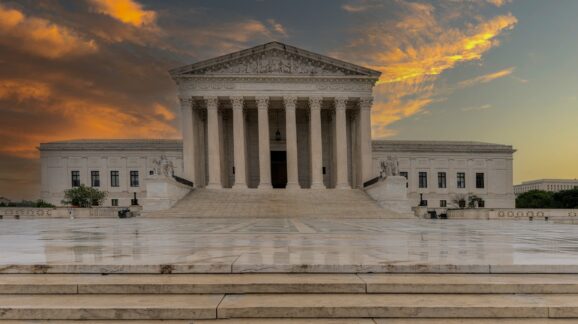
Photo Credit: Getty
In Learning Resources v. Trump, the Supreme Court held that the International Emergency Economic Powers Act (IEEPA) does not authorize President Trump’s tariffs. This did more than resolve a dispute over emergency economic powers; it brought into focus a significant fault line over how the Court views the major questions doctrine (MQD).
Justice Gorsuch and Justice Barrett agreed with Chief Justice Roberts on the central premise that when the executive branch asserts authority with significant economic and political consequences, it must be supported by clear congressional authorization. However, in separate writings, Justices Gorsuch and Barrett diverge on the nature of the MQD and how it should be understood and applied. Justice Gorsuch frames the MQD as a separation of powers safeguard that prevents executive lawmaking through statutory gaps. Justice Barrett, by contrast, treats the MQD as ordinary textualism: a contextual method for identifying a statute’s most natural meaning rather than a freestanding “clarity tax” on Congress.
Gorsuch’s version is structural. In his concurring opinion in Learning Resources, he warns that the executive will exploit “loose or uncertain authority” to “aggrandize their power,” invoking the Framers’ realism that “men are not angels.” This helps to explain why, in NFIB v. OSHA, Justice Gorsuch linked the MQD to nondelegation concerns, saying that if an agency “cannot trace its authority” to a “clear congressional mandate” in a major case, the claim fails; and if the statute really did grant that sweeping power, it would raise constitutional questions about delegating legislative power. On this view, the “major” character of the power is not merely evidence of how Congress writes, it is a warning that the executive may be trying to convert general statutory language into an authority that functionally belongs to Congress.
Barrett, on the other hand, is more concerned with keeping the MQD methodologically modest and consistent with standard textualist interpretation. She agrees that constitutional structure informs statutory meaning and that Congress ordinarily makes the “big-time policy calls” itself. But she resists transforming that intuition into a strong clear-statement regime that overrides the best reading of the text. In her concurring opinion in Biden v. Nebraska, she rejects the idea that the MQD is a newly minted “strong-form” canon; in her view it is “neither new nor a strong-form canon,” and she is wary of interpretive rules that “load the dice” toward a particular outcome. She sharpens the critique in Learning Resources by characterizing a true clear-statement rule as a “dice-loading” device, one that protects an external constitutional value but risks choosing an “inferior-but-tenable” reading simply because the case feels consequential.
These competing accounts draw different boundaries around the doctrine. If the MQD is “routine interpretation” in Barrett’s sense, it should operate primarily as an ambiguity canon. Courts would use it when statutory text, read with ordinary tools (structure, history, and congressional practice), plausibly supports multiple meanings, and the “major” consequences of one meaning make it less likely to be the best reading. Using this approach, the MQD is best understood as a disciplined way of reading delegations in context, rather than as a doctrine that independently raises the bar for statutory clarity.
If the MQD is a structural shield as Gorsuch posits, it can constrain even broad statutory language. The question becomes whether accepting the executive’s reading would effectively transfer a core legislative responsibility. That is why the Court stressed Congress’s pattern: when it delegates tariff-setting power, it does so explicitly and with careful limits, and no president in IEEPA’s half-century claimed tariff authority under it. For Gorsuch, that pattern supports not only the best reading, but a constitutional caution against allowing major policy to be made through executive interpretation.
The real stakes of the Gorsuch–Barrett divergence are not retrospective; they are forward-looking. As agencies increasingly use decades-old, broadly worded statutes to justify transformative rules in climate, labor, health, finance, and technology, the Court will face more cases where the asserted authority is both consequential and textually plausible.
In that world, Justice Gorsuch’s account would likely function as the more durable, democracy-reinforcing constraint as it understands the MQD as a separation of powers safeguard: a doctrinal check that prevents agencies from converting general statutory language into de facto legislation, preserves Congress’s responsibility for the most consequential policy choices, and limits executive opportunism in periods of political pressure or asserted “emergency.”
Alternatively, Justice Barrett’s interpretation-centered, ambiguity-triggered approach would supply a thinner check. Because it turns largely on whether courts can characterize statutory text as indeterminate, it would leave agencies significant room to defend far-reaching regulatory programs as ordinary applications of broadly phrased provisions, an argument visible in the government’s position in Biden v. Nebraska. It would also risk drawing courts into narrow disputes about linguistic fit, even as the deeper structural question remains unresolved: whether the executive is, in practical effect, making foundational policy decisions that the Constitution assigns to Congress.
Over time, these competing conceptions are likely to shape both the frequency and force of the MQD in litigation. A more structural account would tend to make the MQD a meaningful constraint on transformative regulation, while an interpretation-centered account would tend to cabin the doctrine to a narrower set of cases and leave more room for agencies to rely on broad statutory formulations.
Ultimately, the Court’s choice between these interpretive frameworks will determine the balance of power between Congress and the administrative state as the next generation of high-stakes regulatory disputes reaches the judiciary.