The Supreme Court should restore the president’s removal authority
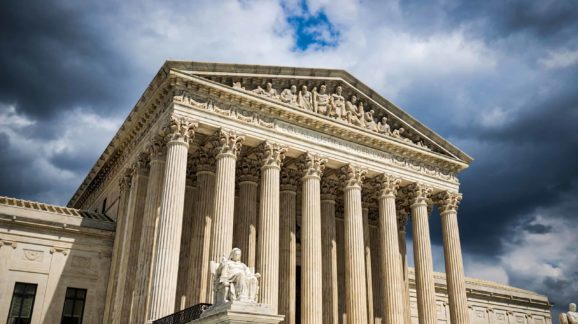
Photo Credit: Getty
This week, the Supreme Court heard oral arguments in one of the most consequential administrative law disputes of the century. Trump v. Slaughter challenges the Court’s long-standing precedent in Humphrey’s Executor v. United States (1935), which established that Congress could insulate the principal officers heading independent agencies from executive removal.
The Supreme Court has an opportunity to revisit and correct the doctrinal errors introduced by Humphrey’s Executor. This removal power is contained in Article II of the Constitution, and is most clearly implied through the “Take Care Clause.” According to this clause, the president must ensure that the laws are faithfully executed without undue obstruction. Additionally, the Constitution endows the president with the executive power, which as vested, allows for the removal of subordinate officers within his branch.
James Madison rightfully recognized in 1789 that the president’s removal power enabled him to control every aspect of his branch of government, extending to both leadership and rank-and-file officers. Executive officers wield their authority pursuant to the president’s Article II responsibilities, not independently from them.
Madison was clear in his warning against Congress’s inclination to statutorily limit the president’s removal power, stating, “they may, on that principle, exclude the president altogether from exercising any authority in the removal of officers; they may give it to the senate alone, or the president and senate combined.”
Under today’s flawed system, independent agencies like the Federal Trade Commission (FTC) protect their commissioners from removal except “for cause.” They hide behind precepts like “inefficiency, neglect of duty, or malfeasance in office,” that Congress deemed acceptable thresholds for removal under the FTC Act of 1914. This directly undermines Madison’s warning above regarding statutes that impair the president’s removal powers. It also validates Madison’s concern about a blended system in which Congress determines arbitrary standards for removing executive officials, which the president would otherwise be unaffected by if adhering strictly to his Article II authority.
The Article II removal power enables the president to exercise accountability over the misconduct of executive officials, just as Congress can hold the president responsible for perceived misconduct through impeachment. Since the president is democratically accountable to the people, his own officers cannot be unaccountable to him.
As a general matter, early precedent imposed few constraints on presidential removal power. Notions of “executive independence” grew from the New Deal’s bureaucratic expansionism. Madison and other Framers properly recognized that a chain of dependence must exist among executive officers to avert the dangers of the fourth branch of government we see today. This constitutional hierarchy authorizes the president to expeditiously hire and fire officials in his branch regardless of their rank or punitive reasoning.
The Framers knew that in order for the executive to function properly and faithfully enforce the laws, there could be no obstruction by Congress. Yet, Humphrey’s Executor does just that by establishing an artificial wall of separation within the executive branch to insulate the heads of independent agencies from the same removal consequences as executive departments and subagencies. Such a construct violates the separation of powers by blurring the lines over whether Congress or the president wields authority over independent agencies. Thanks to Humphrey’s Executor and the statutory provisions at issue, independent agency heads have grown accustomed to exercising powers that are isolated from presidential accountability.
I remain optimistic and even hopeful that today’s Supreme Court has the opportunity to correct the doctrinal confusion created by Humphrey’s Executor and its companion Morison v. Olsen (1988). As the US Solicitor General mentioned yesterday during oral arguments, the justices shouldn’t overlook the compelling precedent that defies for-cause removal protections. This can be seen in cases like Ex Parte Hennen (1839), Parsons v. United States (1897), and Shurtleff v. United States (1903). These decisions properly upheld the president’s authority to fire executive branch officials at whim, including those principal officials (like an FTC commissioner) confirmed by the advice and consent of the Senate.
In overturning Humphrey’s Executor and Olsen, I hope the Court officially strikes down the dual layer of removal protection for administrative law judges (ALJ) residing in Article II agency courts. Currently, ALJs benefit from the dual layers of for-cause removal protections. The Solicitor General argued that the president must retain the authority to remove ALJs, a question the Court left open in SEC v. Jarkesy (2024).
The Supreme Court should also consider whether the Solicitor General’s argument that the president possesses the authority to remove ALJs at will is distinct from his limited oversight of Article I Tax Judges. While the Court recently considered such removal protection in SEC v. Jarkesy (2024), it ultimately left this issue unresolved.
As with independent agency insulation, such a framework directly obstructs the president’s Article II removal authority. Additionally, ALJs are inferior officers who should be subject to at-will firing even by the heads of agencies themselves. Conferring such removal protection creates a nested exception for officials within an unaccountable, often “hidden” court system. As Justice Neil Gorsuch cautioned during oral arguments, “there are a lot of wolves around here, General. That one thing our Framers knew is that every political actor seeks to enhance its own power.”
Justice Gorsuch’s comments invoke the late Justice Antonin Scalia’s prescient warning about bureaucratic unaccountability from his dissent in Olsen, which reads, “Frequently an issue of this sort will come before the Court clad, so to speak, in sheep’s clothing: the potential of the asserted principle to effect important change in the equilibrium of power is not immediately evident… But this wolf comes as a wolf.”