Trump administration decision highlights disastrous Part D redesign

Photo Credit: Getty
The Trump administration recently announced the end of a demonstration project that was pulled together by the Biden administration as the Inflation Reduction Act (IRA) wreaked havoc on Medicare’s provision of prescription drugs. At the time, analysts warned that the chaos was predictable (just as commentators like my colleague Steve Swedberg have written about rent control and others have warned about the move to open city-owned grocery stores in New York City.
The IRA had a multitude of provisions covering environmental policy, IRS modernization, and also health care. The most prominent health care policy was granting Medicare the ability to “negotiate” drug prices. However, it also redesigned Medicare Part D, the branch of Medicare that covers prescription drugs.
Largely, it reconfigured who paid what for Medicare Part D plans. Medicare Part D was added in the 2003 Medicare Modernization Act. It expanded Medicare to cover prescription drugs. It used a market-oriented approach where Medicare beneficiaries could opt for a plan that was offered by a private company sponsor. They would pay a portion of the premium, and the government would subsidize the remainder. Essentially, it was designed such that beneficiaries covered 25.5 percent and the federal government contributed most of the remainder.
Once beneficiaries had the coverage, their out-of-pocket costs when purchasing drugs also varied based on how much they’d spent. The first spending came out of the beneficiary’s pocket, through the deductible. After that, the beneficiary paid about 25 percent of every dollar spent on prescription drugs until they reached their out-of-pocket maximum. Then, the beneficiary was responsible for only 5 percent of the cost for whatever drugs they purchased.
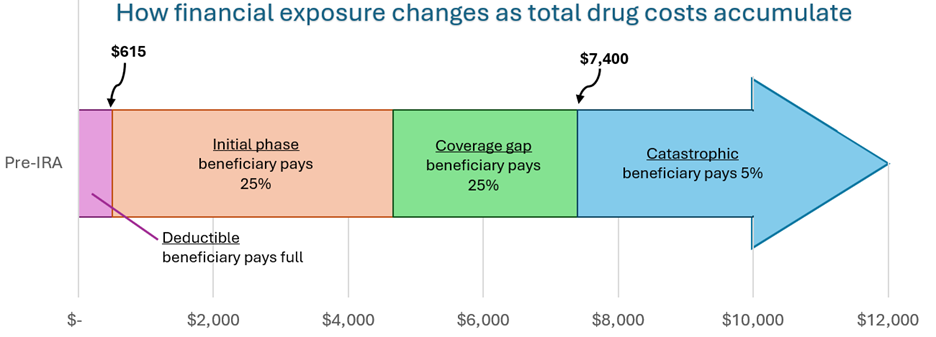
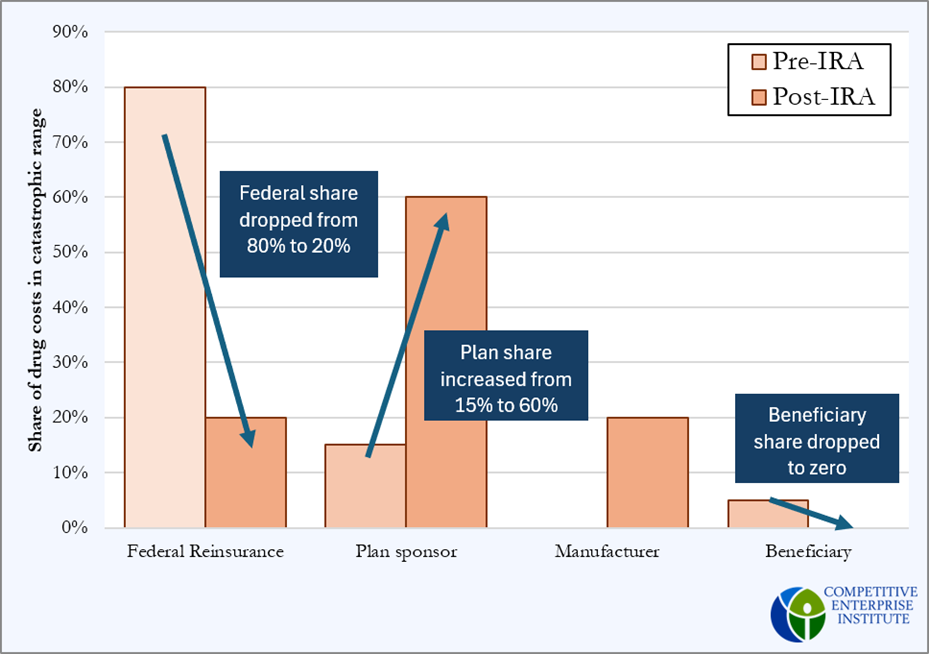
The IRA made several changes to the financing of plans and drugs. On the beneficiary side, it reduced the share of the costs beneficiaries had to cover in the catastrophic phase from 5 percent to zero. It also set a new Out-of-Pocket max, so beneficiaries reached the catastrophic range sooner where their financial exposure was removed entirely.
More important than the changes to the exposure of the beneficiaries, though, were the changes to the plans’ exposure. Prior to the IRA, 80 percent of the costs in the catastrophic range were assumed by the government. The plans were responsible for 15 percent. The IRA reduced the burden on the federal government to only 20 percent for brand drugs and 40 percent for generic drugs and raised the burden on the plans to 60 percent.
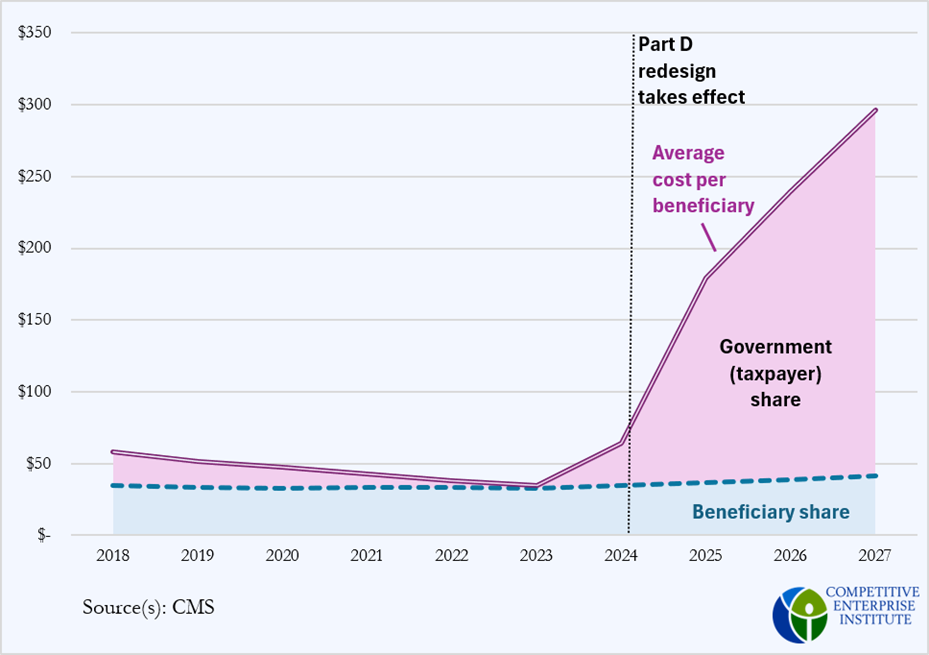
The result was an explosion in total costs, driven largely by the reduced incentives for cost control. Prior to the IRA, the average total cost of a Part D plan per beneficiary was falling from year to year, dropping from $57.93 in 2018 to a low of $34.71 in 2023. Then, after the IRA passed and started to take effect, the average cost jumped to $64 in 2024 and then exploded in the subsequent years.
Because of a ceiling on how quickly beneficiaries’ share of the premium could rise (the base beneficiary premium could increase no more than 6 percent per year), the large increase in average costs was borne not by the beneficiaries, but by the taxpayers.
As a consequence, government spending on Part D has exploded. Originally, the Congressional Budget Office (CBO) estimated that the cost of the redesign described above would be about $30 billion over ten years. CBO now believes that redesign will cost an additional $550 billion over the next ten years.
This latest failure in projections needs to be added to a long list of such failures. The original projections of the federal assumption of student debt, Center for Medicare & Medicaid Innovation, and the No Surprises Act are just a few of the examples where CBO got things stunningly wrong. CBO has a challenging task, some may say impossible, but its track record suggests that more skepticism is needed with its projections.
The demonstration project that is ending was an additional subsidy to beneficiaries, designed to keep their costs low and obscure the premium effects of the IRA’s Part D redesign on a structure that was working reasonably well at keeping costs contained. While the administration is allowing this demonstration project to end, the even better solution is to undo the true source of the failure — the Inflation Reduction Act.