Trump’s SOTU conundrum: Deregulation today, swamp tomorrow?
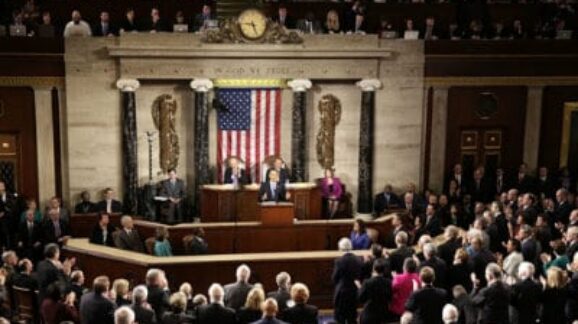
Donald Trump’s 2026 State of the Union (SOTU) address presents an opportunity to confront the federal spending, entitlement, and regulatory behemoth in a new way while it is still early in his term.
Trump should articulate a remedy for a tension that has defined his presidency from the start (including Trump 1.0): expanding rather than shrinking the federal enterprise despite frequent rhetoric to the contrary.
Trump has been appropriately lauded for pursuing genuine, unprecedented regulatory restraint and rollback: not merely pruning but bushwhacking rules (particularly in energy and the environment); freezing and cutting rule output; and forcing even independent agencies to acknowledge the costs they impose. These achievements warrant repeated emphasis during the SOTU.
He has also taken steps with far-reaching implications for discouraging dependency among able-bodied adults on the federal state — dependency that undermines economic growth and social stability, and that excuses or even induces political predation during economic shocks. Notably, the Trump Baby Accounts, which, in a more evolved form, could supplant Social Security, reflect themes of individualism, self-ownership, and responsibility. This is, after all, 2026 — America 250. The Framers fought for independence, not to “procure new masters.”
Those achievements were neither trivial nor inevitable. Yet the Trump agenda has always contained internal contradictions that not only undermine long-term limitations on government but feed the swamp creatures generous portions of raw meat. Too much of Trump’s agenda expands economic dependency on the federal government despite the deregulation flag hoisted at the front of the line.
The central problem is that Trump’s deregulation coexists with impulses that normalize, expand, and redirect federal power in ways that will outlast any single administration — and ultimately empower ideologies he opposes, including radical environmentalism.
Trade restrictions, extensively analyzed by my colleagues, remain perhaps the most visible example. Tariffs function as taxes, industrial policy, and regulatory intervention rolled into one — alongside talk of a “Tariff Check” program that would feed Universal Basic Income ambitions while undermining the premises underlying the Baby Accounts.
But that is only the beginning. Other interventions that progressives may attack rhetorically yet benefit from structurally include partial nationalizations and presidential jawboning of private company management decisions (such as weighing in on Netflix board membership). These actions increase uncertainty, distort investment, and invite future administrations to escalate intervention under new rationales — or simply revive familiar ones such as net-zero climate policy, coercive equity mandates, and centralized health care.
Industrial policy initiatives like partnerships, preferences, and subsidies add further layers of permanence to the regulatory state.
Antitrust activism and price-control proclivities carry similar risks. Calls to “look into” firms, markets, or mergers reinforce the progressive premise that government must constantly referee market size and structure. In the name of addressing private concentration, both parties distill federal power into something far more entrenched and dangerous.
Then there is spending. Regulatory reform cannot be separated from fiscal policy because spending itself — at $7 trillion annually — is unavoidably regulatory. Trillions in subsidies, grants, loan guarantees, and procurement entrench bureaucratic authority, warp innovation, and reshape industries. They also regulate through rule equivalents that rarely appear in the Federal Register.
None of this negates the value of Trump’s rule rollbacks. It does, however, highlight their fragility and relative limits (apart from the extraordinary rollbacks of Obama and Biden-era energy and environment rules). Executive-driven deregulation is inherently reversible, as demonstrated in 2021. Ominously, Trump’s own interventions are inherently expandable by future administrations.
The deeper lesson is that shrinking government requires more than freezing and cutting conventional rules. It requires resisting the normalization of new control mechanisms. Otherwise, the stealth infrastructure rising alongside today’s deregulatory gains becomes tomorrow’s scaffolding for expanded governance.
Obama and Biden SOTU addresses could often be summarized as “more spending, regulation, and dependency.”
Too much of the Trump agenda risks a similar trajectory, notwithstanding regulatory reforms that deserve enduring praise, replication, and codification.
To reorient, “less regulation and less dependency” should be the rallying cry for America 250 — one that avoids contradictions, ensures applause lines roll for the right reasons, and restores the cause of limited government.