Trump’s Unified Agenda of deconstruction: Writing rules to erase rules
Photo Credit: Getty
“It is the policy of my Administration to focus the executive branch’s limited enforcement resources on regulations squarely authorized by constitutional Federal statutes, and to commence the deconstruction of the overbearing and burdensome administrative state.”
—Executive Order 14219
President Donald Trump’s Diary of Deconstruction for the Administrative State has landed.
Well, it’s not quite that dramatic and it’s certainly no bestseller. More blandly, it’s the Spring 2025 edition of the biannual federal Unified Agenda of Federal Regulatory Actions, the first of Trump’s second term, that has landed. The Agenda surveys recently completed and forthcoming actions across dozens of agencies. True to form, the Spring Agenda arrives in the fall; deconstruction may be underway, but the paperwork recording it is still catching up.
Trump’s executive order “Unleashing Prosperity Through Deregulation” (E.O. 14192) directed agencies to eliminate 10 rules or guidance documents for every significant rule added to lower costs, compared to the first term’s “one-in, two-out” approach to freeze them. In commentary surrounding the Agenda’s release, the administration claimed 30-for-one success.
Trump’s first Agenda overlaps with leftover, but now beaten down Biden-era initiatives, and uniquely documents the ascendance of “the Unrule” as opposed to the traditional accretion of new burdens.
Where the Biden administration had used the Agenda to advance “whole-of-government” priorities—climate, equity, ESG mandates, economic controls, and custodianship of able-bodied adults—Trump’s Agenda catalogs rollbacks, rescissions and delays in fulfilment of E.O. 14219’s directive to “commence deconstruction.” Agencies have been closing offices, trimming staff and shrinking reporting burdens.
Even independent agencies like the Federal Trade Commission, Federal Communications Commission and financial regulators—long outside Office of Management and Budget regulatory review purview—are being swept in. Statements from SEC Commissioner Paul Atkins and CFTC Acting Chair Caroline Pham, for example, describe steps to end overreach and pursue “rightsizing.”
My initial deep dive in Forbes tells the story. The Spring Agenda lists 3,816 rules in the pipeline. Paradoxically, that’s higher than Biden’s Fall 2024 tally. But remember: this is the administrative state. The Administrative Procedure Act (APA) requires writing new rules to repeal old ones. Even Trump’s controversial use of the APA’s “good cause” exemption to bypass notice-and-comment on rollbacks—traditionally employed to add rules—still requires publishing a final rule.
In reality, rulemaking is at record lows. Even counting rules written to repeal old ones, just 1,767 rules have been finalized in 2025 as of today. On pace for about 2,570 by year’s end—that would mark the lowest ever recorded, beating Trump’s own first-term benchmark of 2,964 in 2019. Here’s a breakdown of the Agenda’s 3,816 entries:
- 2,098 entries are “active” (pre-rule, proposed, or final);
- 911 are completed actions—paradoxically up sharply from Biden’s last Agenda, but often consisting of removals, extensions and administrative updates;
- 807 are long-term items, many deregulatory in scope.
The baseline is shifting. After decades of regulatory expansion, Trump’s Agenda is documenting something novel: a federal government pulling back. If offices run out of rules to regulate, shuttering whole departments may move from unthinkable to obvious.
Before we get too excited, some caution is in order. Much remains outside the Agenda’s official scope. Agencies can continue to churn out regulatory “dark matter”—guidance documents, memos, FAQs and advisories that escape formal review. Some guidance rescissions are being reported on the Department of Government Efficiency’s (DOGE) website, but they are not yet systematically disclosed or classified alongside rules. A good first step here would be for Trump to reissue his first term’s E.O. 13891 creating guidance document portals. But unless Congress requires commonsense disclosure, starting with the Guidance Out of Darkness (GOOD) Act, sub-regulatory guidance can easily offset visible deregulation.
More ominously, and less appreciated in policy circles, notice and comment rulemaking as reflected in the Federal Register and the Agenda is increasingly no longer the primary vehicle for federal control. Beyond dark matter, antitrust manipulation, tariffs, subsidies and grants, contracting and procurement, and public-private partnerships now dominate the economic landscape. The liberty movement has failed to stop these incursions; Trump has taken the next “logical” step with partial nationalizations of private firms. These moves outweigh conventional deregulation, erecting new and bolder edifices of state power.
The Trump-era Agenda is therefore unique—it does signify bounded deconstruction along certain rulemaking lanes—but these do not capture the full scope of federal intervention anymore.
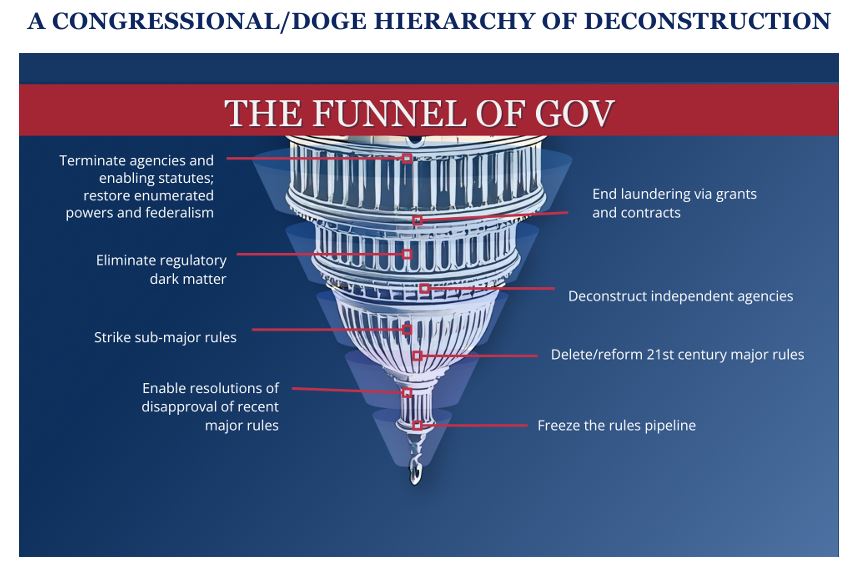
So a regrouping is necessary. The good news is that key elements seen at the lower level of our “Hierarchy of Deconstruction” pictured above are well underway. Biden’s proposed rules are out, more than a dozen congressional resolutions of disapproval of Biden rules have been enacted, and agencies are issuing “Unrules” rather than rules. All of these are unprecedented gains, but they occupy the base of the deconstruction hierarchy; it’s the easier wins. At the top sit the entrenched elements that often may not appear as conventional Federal Register rulemaking at all: subsidies, tariffs, antitrust interventions, price-setting, speech controls through federal funding—and now even federal ownership stakes in private companies. Tackling those would require a genuine separation of economics and state. Yet Trump, the leading advocate of many of these very interventions, shows no inclination to prune them.
Only when agencies have nothing left to regulate, and are accordingly terminated, will deconstruction be a permanent reality. Trump’s paradoxical empowerment of the federal state, even as he downsizes portions of its bureaucracy, leaves levers of power intact for the next progressive administration.
And as our founder Fred L. Smith Jr. always liked to say, “A pruned weed is a healthy weed.” Deconstruction alone won’t suffice. Pruning without uprooting only strengthens the weed. To prevent regrowth, the rubble of the administrative state must be hauled away, not left onsite with roots intact.
For more, see:
“Diary Of Deconstruction: Trump Releases Unified Agenda Of Federal Regulations,” Forbes