CEI’s Paige Lambermont testified this week before the House Science Subcommittee on policies driving U.S. AI growth
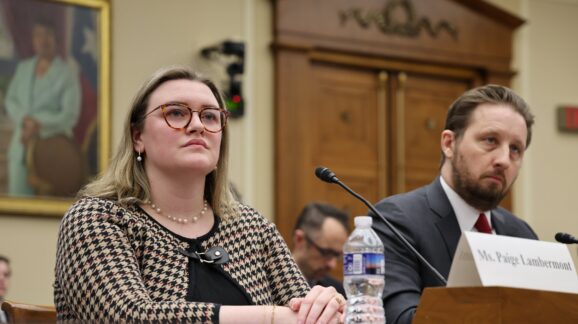
Chairman McCormick, Ranking Member Sykes, and distinguished members of the subcommittee, thank you for holding this hearing today and inviting me to testify.
My name is Paige Lambermont and I am a Research Fellow in the Center for Energy and Environment at the Competitive Enterprise Institute, a nonprofit, non-partisan public policy organization dedicated to free market, limited government principles with a focus on regulatory issues.
I am grateful for the opportunity to speak to you today about the importance of permitting changes and innovation to meet rising power demand.
I have three main points that I want to make in my testimony:
- Power scarcity has been created by policy decisions
- Permitting reform is essential to meet this challenge
- Now is the time for new and innovative solutions
Power Scarcity is a Policy Decision
For the last several decades, energy policy in general, and electricity policy in particular has focused on making do with less, curtailing demand, producing less power, and electrifying things like cars and appliances.
These policies have simultaneously created less reliable electricity, while also using government intervention to increase reliance on electricity. This was never a plan that was going to foster reliability, but now that demand has begun to rise for the first time in nearly two decades, the true folly of that approach has been revealed.
According to a DOE report, 104 GW of firm power capacity are set to retire by 2030.1 At the same time, demand growth by 2030 is projected to be between 35 and 108 GW.2 The delta between retiring capacity and new demand will require new reliable capacity to fill the gap.
Ideally, the permitting and policy ecosystem would favor the swift construction of new reliable power plants and the supply chains for building these plants would still be intact. In this hypothetical world new power demand from data centers would be an opportunity to generate electricity to solve complex problems and generate economic productivity.
But, on our broken power grid, where it is incredibly difficult to build new power plants, and the supply chain to build those power plants has broken down, this opportunity becomes a challenge.
The priority should be the formulation of policy that turns that challenge back into an opportunity.
We are more than capable of meeting growing power demand, but this will require removing regulatory barriers that impair the construction of new power plants and the reliability of the power grid. There are many policy changes that will contribute to this, but two of the most important actions will be comprehensive broad-based and technology neutral permitting reform, and removing obstacles to innovation.
Permitting Reform is Essential to Meet This Challenge
To help solve the current power supply issue, our federal permitting system must be reformed in ways that go beyond the National Environmental Policy Acy (NEPA). The Clean Water Act (CWA), Clean Air Act (CAA), Endangered Species Act (ESA), and other laws must be amended in parallel to remove overbroad, duplicative, and unnecessary requirements to secure permits.
This would help create a federal permitting process that allows new development to occur in a timely, predictable, and cost-effective manner while maintaining high standards.
Regulatory agencies also play a role in making it more difficult to build new power plants. So while the Environmental Protection Agency (EPA) is a primary culprit, another agency that’s been especially restrictive is the Nuclear Regulatory Commission (NRC). The ADVANCE Act helped to bring the mission of the NRC in line with the goal of stewarding rather than simply overseeing the nuclear industry.3 But improvement must go much further if nuclear power is going to play a role in meeting rising demand.
In China, the current timeline for a large reactor from start to finish is seven years and there are currently 27 reactors under construction. The last large reactors built in the US were Plant Vogtle Units 3 and 4 which took 14 and 15 years respectively and began construction in 2009.
The United States is not losing on quality of technology, or ability to innovate in this space. It’s losing on regulation, and that is entirely a policy choice. Ensuring that the regulatory structures that govern the development of new power plants of all types are reasonable, predictable, consistent, and scientifically based is essential to develop new power plants at the necessary speed to meet rising demand and remain globally competitive.
Now is the Time for New and Innovative Solutions
Another option to ease the bottleneck around getting new power on the grid is to enable innovation including off-grid utilities. Consumer Regulated Electricity (CRE) is an opportunity to create an alternative to the traditional grid pathway for new customers that are willing to pay for their own electricity. CRE would allow for privately financed, off-grid electric utilities to serve customers including data centers. These utilities would be physically islanded from the broader power grid.6 This would allow companies who want power quickly to avoid the traditional utilities queue, while bearing the costs of their own infrastructure.
CRE provides flexibility and speed to companies working on innovative projects, while providing cost insulation for ratepayers. For this to be possible, individual states would need to pass legislation exempting islanded utilities from their definition of a public utility. This policy innovation has already become law in New Hampshire and related legislation has been introduced in several other states. At the Federal level, the DATA Act, S.3585, introduced by Senator Tom Cotton (R-AR) would enable CRE by clarifying that CRE utilities are exempt from federal regulation as public utilities.
Conclusion
To meet growing demand and protect ratepayers, it is essential that we both reform our permitting system and remove government obstacles to allow new and innovative solutions. It is technologically possible to meet rising demand, and we can and should do so in a way that protects existing ratepayers while allowing for new development.
Thank you.