There are two main areas in which Congress can enact meaningful reform. The first is to rein in regulatory guidance documents, which we refer to as “regulatory dark matter,” whereby agencies regulate through Federal Register notices, guidance documents, and other means outside standard rulemaking procedure. The second is to enact a series of reforms to increase agency transparency and accountability of all regulation and guidance. These include annual regulatory report cards for rulemaking agencies and regulatory cost estimates from the Office of Management and Budget for more than just a small subset of rules.
In 2019, President Trump signed two executive orders aimed at stopping the practice of agencies using guidance documents to effectively implement policy without going through the legally required notice and comment process.
Featured Posts

Blog
The missing guardrail in crisis politics: Discipline
Modern American governance has developed a troubling pattern. Economic shocks like the 21st century’s financial panics and pandemic are often met with vast expansions of…

Blog
The week in regulations: Music royalties and avocado maturity
The Iran war continued to raise oil prices. The Trump administration took steps to raise tariffs under Section 301 of the 1974 Trade Act, but…
Blog
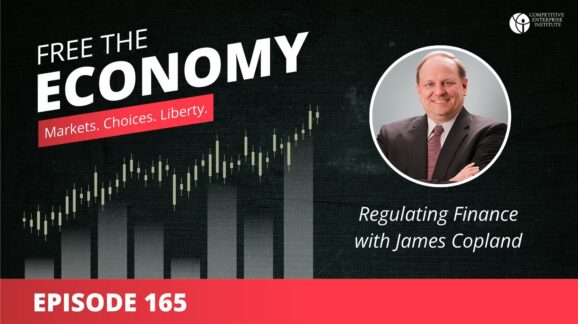
Free the Economy podcast: Regulating finance with James Copland
In this week’s episode we cover the 250th anniversary of Adam Smith’s Wealth of Nations, fighting fraud in broadband deployment, and cutting…
Search Posts
Blog
Congress decides, not agencies: The significance of the REINvented REINS Act
It’s been repeated a million times that in our constitutional republic, lawmaking power belongs to Congress. But over the years, this authority has increasingly shifted…
Washington Examiner
Congress needs to end regulation without representation
Taxation without representation is the antithesis of freedom and runs counter to the basic principles guiding our nation. So why is regulation without representation not…
News Release
‘Ten Thousand Commandments’ report on federal regulation exposes Washington’s big costs, little accountability
The Competitive Enterprise Institute today released its annual report on the federal regulatory state, Ten Thousand Commandments by Clyde Wayne Crews. Federal regulatory…
Products
Chapter 5: Regulatory dark matter: Executive orders and memoranda
Although executive actions ostensibly deal with the internal operations of the federal government, they increasingly can have binding effect and influence private behavior. Executive orders,…
Products
Chapter 6: More than 22,000 agency public notices annually
Along with the few dozen presidential memoranda and other proclamations are the thousands that issue from departments and agencies. Through various species of guidance documents,…
Products
Chapter 13: Needed: An agenda for rightsizing Washington
Rule counts regularly topped 4,000 in the 1990s. That is the wrong comparison for Biden’s lower rule counts. His fewer rules have higher costs, are…
Staff & Scholars

Clyde Wayne Crews
Fred L. Smith Fellow in Regulatory Studies
- Business and Government
- Consumer Freedom
- Deregulation

Ryan Young
Senior Economist and Director of Publications
- Antitrust
- Business and Government
- Regulatory Reform

Fred L. Smith, Jr.
Founder; Chairman Emeritus
- Automobiles and Roads
- Aviation
- Business and Government

Sam Kazman
Counsel Emeritus
- Antitrust
- Automobiles and Roads
- Banking and Finance

Marlo Lewis, Jr.
Senior Fellow
- Climate
- Energy
- Energy and Environment