There are two main areas in which Congress can enact meaningful reform. The first is to rein in regulatory guidance documents, which we refer to as “regulatory dark matter,” whereby agencies regulate through Federal Register notices, guidance documents, and other means outside standard rulemaking procedure. The second is to enact a series of reforms to increase agency transparency and accountability of all regulation and guidance. These include annual regulatory report cards for rulemaking agencies and regulatory cost estimates from the Office of Management and Budget for more than just a small subset of rules.
In 2019, President Trump signed two executive orders aimed at stopping the practice of agencies using guidance documents to effectively implement policy without going through the legally required notice and comment process.
Featured Posts
Blog
Here’s how one-in, ten-out is successfully cutting rules — but not draining the swamp
It’s October already, and while there’s no real fiscal year for federal regulation, the September 30 closing of the 2026 budgetary fiscal year marks…

Blog
The week in regulations: Drug prices and inedible almonds
Sen. Eric Schmitt (R-MO) learned the difference between the Atlanta Hawks and the Iowa Hawkeyes. President Trump rolled back some China tariffs and published…
Blog
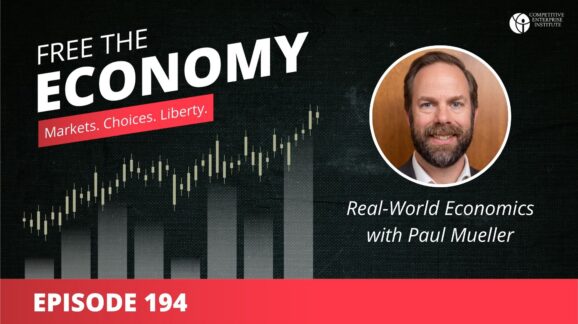
Free the Economy podcast: Real-world economics with Paul Mueller
In this week’s episode we cover spiraling health care costs, reforming state-level regulations, and how to keep asset managers accountable…
Search Posts
Forbes
Obama’s SOTU: A Campaign Speech That Erodes The Power Of The Citizenry
Every year legislators and bureaucrats disgorge new laws and regulations which discourage job creation. Clyde Wayne Crews of the Competitive Enterprise Institute has pointed to…
Blog
CEI Podcast For February 14, 2013: Dodd-Frank’s Constitutionality
CEI General Counsel Sam Kazman discusses a lawsuit in which CEI and two co-plaintiffs argue that portions of Dodd-Frank are unconstitutional.
Blog
An Unconstitutional Gift To Labor Unions
In the aftermath of Hurricane Sandy, the New Jersey Senate has only passed one bill associated with rebuilding storm-damaged public infrastructure. Sadly, if passed, the…
Blog
Obama Renews Call For Paycheck Fairness Act
In his State of the Union address last night, President Obama renewed his call for passage of the Paycheck Fairness Act, which would make it…
Blog
Payback? Government Targets S&P And Egan-Jones, Not Moody’s Or Fitch
Why not Moody's? Why not Fitch? Of all the questions raised about the U.S. government's strange case against Standard & Poor's—a lawsuit that actually asserts that…
Blog
Immigration Reform’s Economic Benefits
Comprehensive immigration reform is coming. For those that don’t speak D.C. doublespeak, that means more costly, useless, and privacy-invading border drones, more guards…
Staff & Scholars

Clyde Wayne Crews
Fred L. Smith Fellow in Regulatory Studies
- Business and Government
- Consumer Freedom
- Deregulation

Ryan Young
Senior Economist and Director of Publications
- Antitrust
- Business and Government
- Regulatory Reform

Fred L. Smith, Jr.
Founder; Chairman Emeritus
- Automobiles and Roads
- Aviation
- Business and Government

Sam Kazman
Counsel Emeritus
- Antitrust
- Automobiles and Roads
- Banking and Finance

Marlo Lewis, Jr.
Senior Fellow
- Climate
- Energy
- Energy and Environment