There are two main areas in which Congress can enact meaningful reform. The first is to rein in regulatory guidance documents, which we refer to as “regulatory dark matter,” whereby agencies regulate through Federal Register notices, guidance documents, and other means outside standard rulemaking procedure. The second is to enact a series of reforms to increase agency transparency and accountability of all regulation and guidance. These include annual regulatory report cards for rulemaking agencies and regulatory cost estimates from the Office of Management and Budget for more than just a small subset of rules.
In 2019, President Trump signed two executive orders aimed at stopping the practice of agencies using guidance documents to effectively implement policy without going through the legally required notice and comment process.
Featured Posts

Blog
The week in regulations: Deepwater port licenses and nuclear credit ratings
Voters made known their feelings about tariffs, gas prices, and corruption. The FAA announced that it still uses floppy disks for air traffic control…
Blog
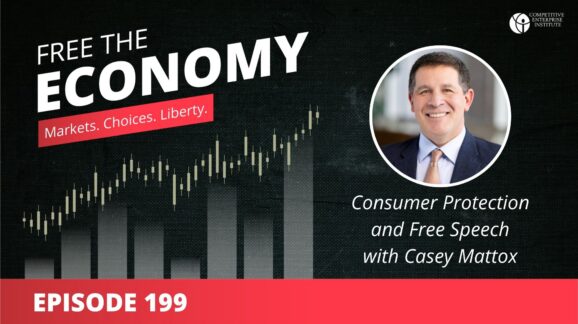
Free the Economy podcast: Consumer protection and free speech with Casey Mattox
In this week’s episode we cover the debt load of state and local governments, advances in nuclear waste storage, and hope…

News Release
Update in CEI’s case against Wisconsin’s unconstitutional rule barring voter participation in prediction markets
Yesterday, a District Court denied CEI’s motion for a preliminary injunction against Wisconsin’s rule denying voters the right to participate in election prediction market…
Search Posts
Products
Chapter 13: Federal Regulations Affecting State and Local Governments
Ten Thousand Commandments primarily emphasizes federal regulations imposed on the private sector. However, state and local officials’ complaints over federal mandates’ overriding their own…
Products
Chapter 1: Biden’s Regulatory “Modernization” Continues Whole-of-Government Pursuit of Coercive Progressivism
The 2022 edition of Ten Thousand Commandments extensively surveyed the Biden administration’s executive actions, rules, and memoranda that reversed the Trump regulatory policy and attenuated…
Products
Chapter 10: Analysis of “The Regulatory Plan and Unified Agenda of Federal Regulatory and Deregulatory Actions”
“The Regulatory Plan and Unified Agenda of Federal Regulatory and Deregulatory Actions” (the Unified Agenda) is the document in which agencies have outlined regulatory priorities…
Products
Chapter 8: Another Dimension of Regulatory Dark Matter: Over 22,000 Agency Public Notices Annually
Along with presidential proclamations are those of departments and agencies. These are numerous and sweeping. Through various kinds of guidance documents, notices, and policy statements,…
Products
Chapter 15: Regulation without Representation: The “Unconstitutionality Index”—13 Rules for Every Law
Administrative agencies, not Congress, do most U.S. lawmaking, despite Article I of the Constitution stipulating otherwise. Congress is to blame here, as it routinely enacts…
Products
Chapter 4: The Unknowable Costs of Regulation and Intervention and a $1.939 Trillion Estimate
The federal government undertakes little review of federal regulation to ensure that regulations individually do more good than bad each year, and it performs no…
Staff & Scholars

Clyde Wayne Crews
Fred L. Smith Fellow in Regulatory Studies
- Business and Government
- Consumer Freedom
- Deregulation

Ryan Young
Senior Economist and Director of Publications
- Antitrust
- Business and Government
- Regulatory Reform

Fred L. Smith, Jr.
Founder; Chairman Emeritus
- Automobiles and Roads
- Aviation
- Business and Government

Sam Kazman
Counsel Emeritus
- Antitrust
- Automobiles and Roads
- Banking and Finance

Marlo Lewis, Jr.
Senior Fellow
- Climate
- Energy
- Energy and Environment