There are two main areas in which Congress can enact meaningful reform. The first is to rein in regulatory guidance documents, which we refer to as “regulatory dark matter,” whereby agencies regulate through Federal Register notices, guidance documents, and other means outside standard rulemaking procedure. The second is to enact a series of reforms to increase agency transparency and accountability of all regulation and guidance. These include annual regulatory report cards for rulemaking agencies and regulatory cost estimates from the Office of Management and Budget for more than just a small subset of rules.
In 2019, President Trump signed two executive orders aimed at stopping the practice of agencies using guidance documents to effectively implement policy without going through the legally required notice and comment process.
Featured Posts
Blog
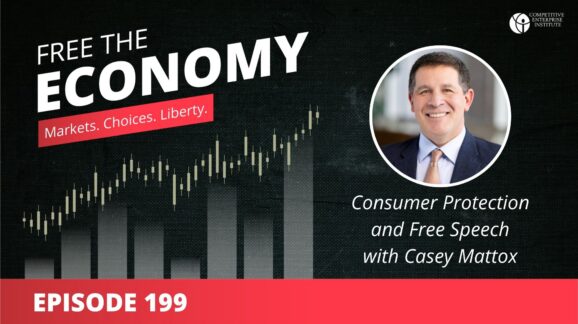
Free the Economy podcast: Consumer protection and free speech with Casey Mattox
In this week’s episode we cover the debt load of state and local governments, advances in nuclear waste storage, and hope…

News Release
Update in CEI’s case against Wisconsin’s unconstitutional rule barring voter participation in prediction markets
Yesterday, a District Court denied CEI’s motion for a preliminary injunction against Wisconsin’s rule denying voters the right to participate in election prediction market…

Blog
The regulatory dark matter beyond Washington’s graveyard of rules: 83,141 ghosts and counting
The clocks have turned back, the days are growing darker, and Washington’s regulatory shadows lengthen. Washington’s policy ghouls are waking up to the fact…
Search Posts
Washington Examiner
Fed’s transparency playbook changing under Warsh
CEI’s Ryan Young was cited by the Washington Examiner relating to the Federal Reserve. Even with the forward guidance under Powell, Ryan…
Blog
The week in regulations: Peach diversion programs and nuclear packages
The Federal Reserve kept interest rates the same, and an increase may be on the way. Economic growth remained below average, and inflation remained…
Study
Permitting Reform for a Freer and More Prosperous Nation
Contents Special Advisors The Importance of Permitting Reform Part 1: 11 Principles for Permitting Reform Part 2: Statute-by-Statute Analysis for Permitting…
Blog
The week in regulations: Carbon nanotubes and colored sausage casings
President Trump enacted new tariffs against more than 60 countries. Some of the Canada tariffs invoke a never-used statute from the 1930 Smoot-Hawley Tariff…
Washington Examiner
Upward pressure on gas prices isn’t just Iran, but a mandate closer to home
CEI’s Ben Lieberman was cited by the Washington Examiner relating to renewable fuel standards. Critics have compared the program to Calvinball, the…
Blog
Free the Economy podcast: Founder’s Fire with Arthur Herman
In this week’s episode we cover Social Security reform, what’s fueling state migration, and whether using prediction markets could impact…
Staff & Scholars

Clyde Wayne Crews
Fred L. Smith Fellow in Regulatory Studies
- Business and Government
- Consumer Freedom
- Deregulation

Ryan Young
Senior Economist and Director of Publications
- Antitrust
- Business and Government
- Regulatory Reform

Fred L. Smith, Jr.
Founder; Chairman Emeritus
- Automobiles and Roads
- Aviation
- Business and Government

Sam Kazman
Counsel Emeritus
- Antitrust
- Automobiles and Roads
- Banking and Finance

Marlo Lewis, Jr.
Senior Fellow
- Climate
- Energy
- Energy and Environment