There are two main areas in which Congress can enact meaningful reform. The first is to rein in regulatory guidance documents, which we refer to as “regulatory dark matter,” whereby agencies regulate through Federal Register notices, guidance documents, and other means outside standard rulemaking procedure. The second is to enact a series of reforms to increase agency transparency and accountability of all regulation and guidance. These include annual regulatory report cards for rulemaking agencies and regulatory cost estimates from the Office of Management and Budget for more than just a small subset of rules.
In 2019, President Trump signed two executive orders aimed at stopping the practice of agencies using guidance documents to effectively implement policy without going through the legally required notice and comment process.
Featured Posts
Blog
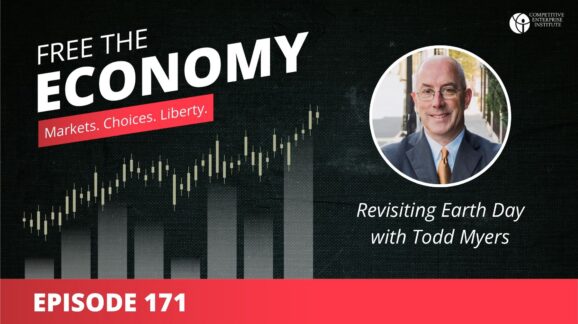
Free the Economy podcast: Revisiting Earth Day with Todd Myers
In this week’s episode we cover the dwindling number of US public companies (via Todd Zywicki of George Mason University), a pro-consumer…

Blog
The week in regulations: Drone settlements and gambling losses
The 2026 Federal Register topped 20,000 pages. President Trump got into a feud with the Pope. Agencies issued new regulations ranging from mail standards to…

Blog
Free the Economy podcast: How to Get What You Want with Josh Bandoch
In this week’s episode we cover AI development in China, how large investors recycle homes, and why permitting reform needs to…
Search Posts
Blog
How a New President Can Roll Back Bureaucracy, Part 8: Transparency Report Cards
Improving disclosure and transparency for regulatory output and trends is one area where a new president can unambiguously undertake unilateral initiatives without statutory regulatory reform.
Blog
How a New President Can Roll Back Bureaucracy, Part 7: Track Regulatory Accumulation
This is the seventh entry in a series on how the next president can reduce the scope of bureaucracy. Earlier installments have addressed a freeze on…
Blog
This Week in Ridiculous Regulations
Agencies issued more than six dozen new final regulations last week, ranging from minerals to dates.
Blog
How a New President Can Roll Back Bureaucracy, Part 6: Enhance Disclosure in ‘Unified Agenda’
There are rules, and then there are rules. Agencies are supposed to alert the public to their priorities in the semi-annual “Regulatory Plan and Unified…
Washington Post
How Trump would stimulate the U.S. economy
The Washington Post highlights Wayne Crews's calculated cost of federal regulations from his anual Ten Thousand Commandments report. Beyond trade, America’s Gulliver economy…
Blog
How a New President Can Roll Back Bureaucracy, Part 5: Scrutinize Informal ‘Guidance’ Documents
When a new president scrutinizes agency rules as we have called for in this series, he or she also needs to bring “guidance documents” under…
Staff & Scholars

Clyde Wayne Crews
Fred L. Smith Fellow in Regulatory Studies
- Business and Government
- Consumer Freedom
- Deregulation

Ryan Young
Senior Economist and Director of Publications
- Antitrust
- Business and Government
- Regulatory Reform

Fred L. Smith, Jr.
Founder; Chairman Emeritus
- Automobiles and Roads
- Aviation
- Business and Government

Sam Kazman
Counsel Emeritus
- Antitrust
- Automobiles and Roads
- Banking and Finance

Marlo Lewis, Jr.
Senior Fellow
- Climate
- Energy
- Energy and Environment