The Beauty of Regulatory Sunsets
Lessons from Idaho’s zero-based regulation

Introduction
In 2019, Idaho pioneered zero-based regulation (ZBR), an orderly approach to statewide regulatory reform. Like zero-based budgeting, ZBR starts with the presumption that existing regulations may be unnecessary and therefore they must be periodically re-justified and compared with other jurisdictions to determine the optimal level of stringency. ZBR contrasts with traditional regulatory models in which executive branch agencies add incremental regulations periodically over time with little incentive to review and eliminate those regulations that are no longer necessary or for which the costs exceed the benefits.
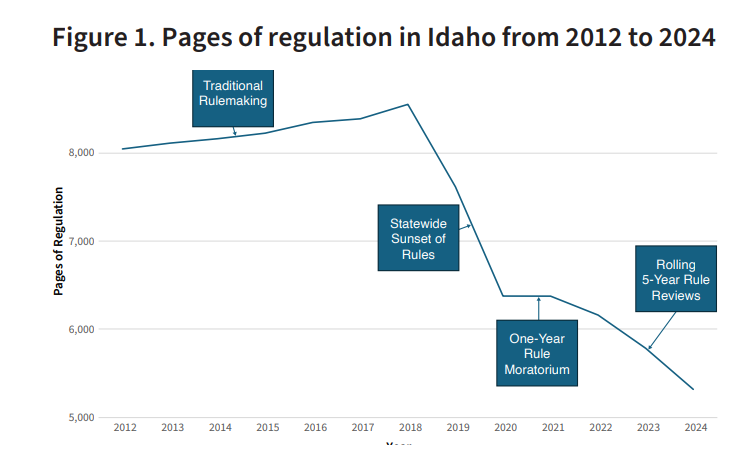
Idaho’s ZBR process combined intentional design with some accidental elements (Figure 1). It began in earnest in 2019 with a statewide sunset date of June 30, 2019. All regulations automatically expired on this date unless executive branch agencies acted to re-promulgate the regulation in accordance with the state’s own Administrative Procedure Act. This placed the onus on state agencies to determine which regulations were worth the effort to re-justify. Scores of obsolete and unnecessary regulations were allowed to expire passively by agencies.
Given the magnitude of this statewide sunset effort in a short period of time, Gov. Brad Little issued a regulatory moratorium for a year to let this effort settle and create business certainty, though he allowed several offramps for new regulations that were necessary to comply with court orders or statutory deadlines. Regulatory action in Idaho ground to a halt for a year, with a net change of just one page in regulations from 2020 to 2021.
This regulatory moratorium was followed by a five-year regulatory review cycle. Each agency must now review its regulations on a five-year basis and use a standardized regulatory impact analysis to guide and justify its policy choices by leveraging cross-jurisdictional comparisons. If Idaho’s proposed regulation is more stringent than any of the comparison jurisdictions, the Idaho agency must describe the evidence base or unique circumstances that justify the enhanced requirement in Idaho or otherwise default to the less stringent requirement. Further, to create a more stable regulatory environment, agencies are generally encouraged to amend their regulations only once every five years in concert with the cyclical review, unless pressing circumstances exist.
Through these combined efforts, ZBR has transformed the regulatory environment in Idaho, leading to the elimination of 3,235 pages of regulation by 2024, a 38 percent statewide decrease from the peak volume observed in 2018.
While ZBR can create the conditions for reform by establishing an orderly process for agency review of regulations, its ultimate success will be determined by the collective action of executive branch agencies, some of which may be initially skeptical or believe that their current regulations are already optimal. For example, many states have statewide sunset reviews that have become essentially checkboxes. The states simply reauthorize regulations as they previously existed with little effort expended to determine the appropriate level of regulation or make suitable comparisons to similarly situated jurisdictions.
Thus, the most important ingredient for success with ZBR is activating state agencies as partners in the reform process. After all, rulemaking is vested in the agencies, and this authority is widely decentralized across state government.
In the review period (2012 to 2024), 60 different Idaho agencies had rulemaking authority, including cabinet-level agencies, constitutional officers elected separately from the governor, and a diverse group of boards (e.g., the Board of Nursing) and commissions (e.g., the Rangeland Resources Commission). At the 2018 peak, these agencies collectively oversaw 8,553 pages of regulation, with a range of four pages to 1,487 pages.
The success of executive branch agencies as partners in regulatory reform will thus make or break the implementation of ZBR. Suggestions to achieve this are presented later in the report. This paper presents data from Idaho on the number of pages of regulation by agency in the six-year period prior to ZBR implementation (2012 to 2018) as compared to the six-year period after ZBR implementation (2018 to 2024). This data is used as the basis for sharing lessons learned that may inform other states on how to implement statewide regulatory reform efforts similar to ZBR.
Most agencies need outside pressure
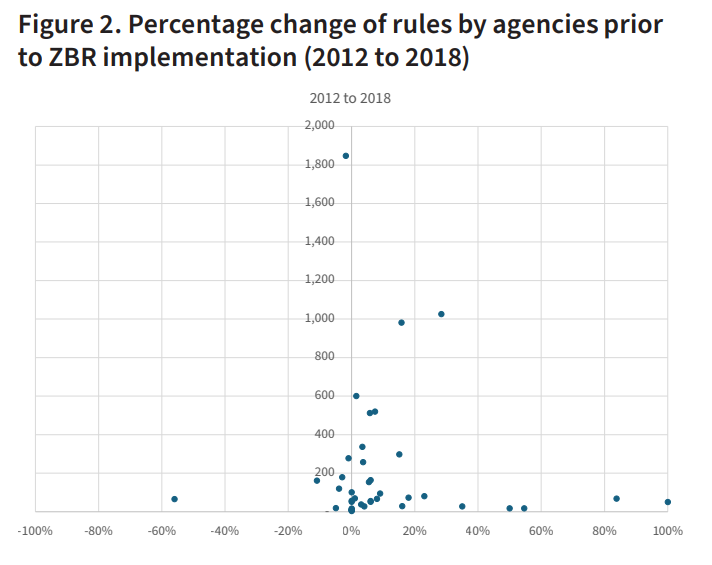
It is unsurprising that agency regulatory behavior varies given how many agencies have rulemaking authority. Prior to ZBR implementation, the collective pages of regulation increased by a net of 506 pages through 2018, a 6 percent statewide increase in regulation from 2012. Thus, the general default was to increase regulations under a traditional regulatory model.
Most agencies (60 percent) increased regulations, with a percentage increase ranging from 1 percent to 100 percent. By contrast, 24 percent of agencies had no change in regulation, and only 16.7 percent of agencies decreased regulations during the control time period. Thus, some agencies will organically decrease regulations even in the absence of a statewide regulatory reform effort, but these agencies are among the minority. In fact, the majority of agencies will increase regulations (see Figure 2).
How ZBR changed Idaho agencies
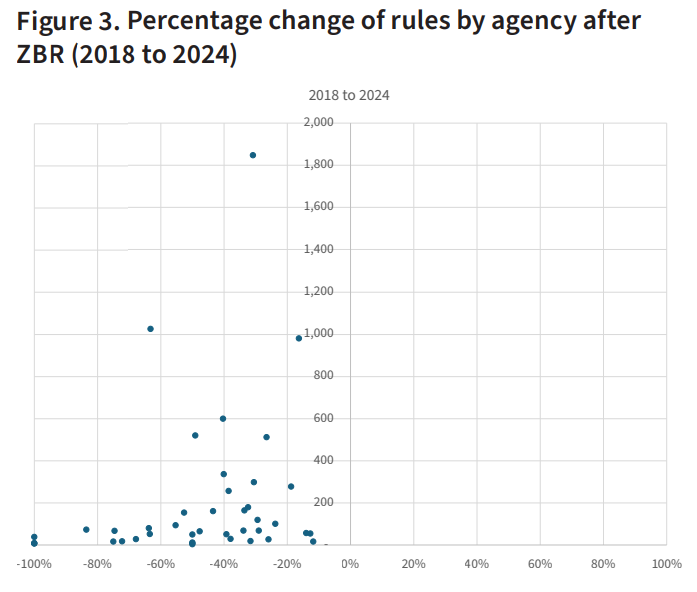
After implementation of ZBR, agencies collectively eliminated 3,235 pages of regulation through just 2024, a 38 percent statewide decrease from 2018. All agencies had a net decrease in regulation, with a range of -12 percent to -100 percent (see Figure 3). Further, large percentage cuts were not limited to just low-volume regulatory agencies. The two agencies with the largest volume of regulatory pages in 2018 saw cuts of 30.8 percent and 63.3 percent, respectively.
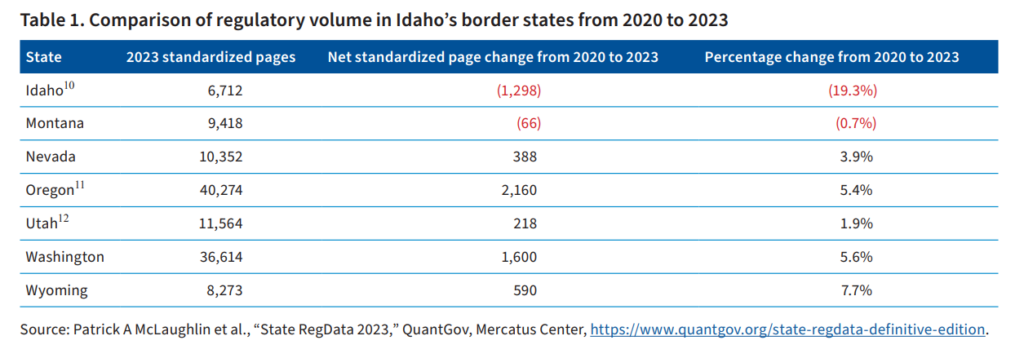
Other states provide useful comparisons to determine if rulemaking naturally slowed or declined during the global coronavirus pandemic, or if Idaho’s ZBR implementation uniquely changed the trajectory of rulemaking. Table 1 provides a comparison of regulatory volume changes for Idaho and its six border states from 2020 to 2023, the years for which data is available through QuantGov.
Only Idaho and Montana decreased their net pages of regulation (-19.3 percent and -0.7 percent, respectively), whereas the remaining states increased page count by a range of 1.9 percent to 7.7 percent. Thus, decreased regulation was not the default following the pandemic, except in the states with targeted regulatory reform efforts. Montana, like Idaho, has a governor who prioritized regulatory reform, created a Red Tape Relief Advisory Committee by executive order in 2021, and listed reducing unnecessary regulations as a key goal.
Departments ripe for reduction
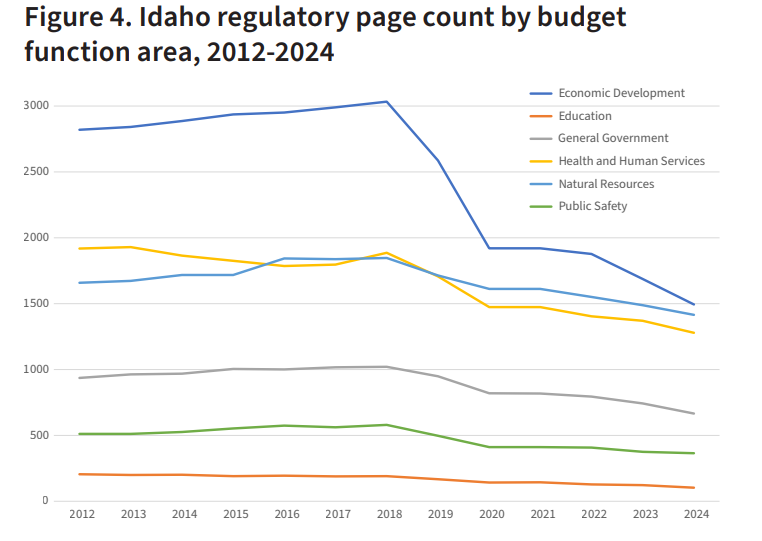
Figure 4 shows the regulatory burden over the study period by budget function area. Economic development represented the area with the most regulations (3,032 pages in 2018, or 35 percent of the total), followed by natural resources (1,842 pages, 22 percent), and health and human services (1,838 pages, 21 percent).
It stands to reason that the agencies making up the economic development functional area would represent the ripest opportunity for regulatory reform, and this proved to be the case in Idaho. While the number of regulation pages grew by 7.6 percent for economic development agencies from 2012 to 2018, it had the steepest decline (-50.7 percent) in regulatory pages from 2018 to 2024. All budget function areas saw declines in pages following the implementation of ZBR, with natural resources having the smallest decline (-23.3 percent) despite having the second largest volume of pages.
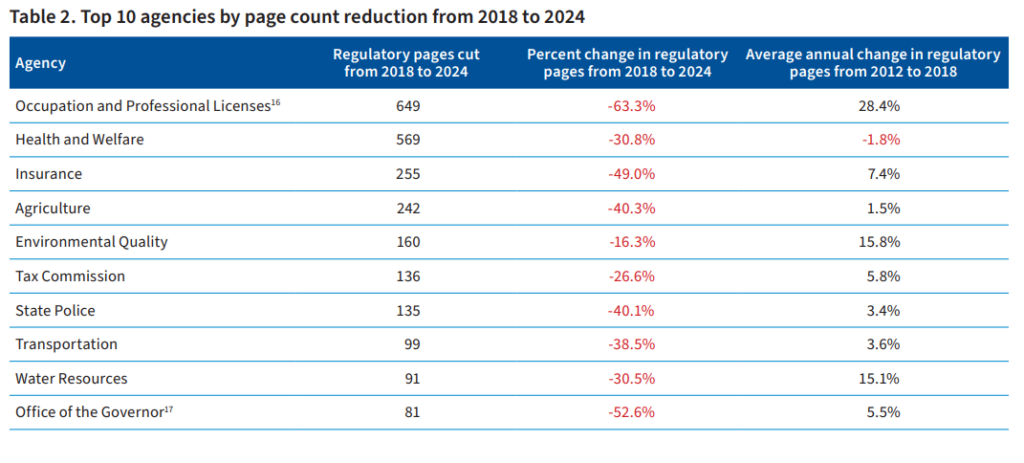
Table 2 reviews the individual agencies with the largest page count reductions following ZBR implementation. The largest turnaround was with the Division of Occupational and Professional Licenses, an umbrella agency that issues more than 40 types of licenses. Regulations at this agency grew by 28.4 percent from 2012 to 2018, but were reduced by 63.3 percent, or 649 pages, following ZBR implementation. In fact, cuts within this agency represented 20.1 percent of the total number of regulations eliminated statewide.
Given the primacy of states in regulating occupational licensing, this reduction may not be surprising. It may also spotlight why occupational licensing reform has been a major nationwide target of regulatory reform efforts at the state level. Examples of such cuts include reducing barriers to entry, broadening telehealth opportunities, expanding ratios of midlevel professionals who may be overseen by physicians, and expanding professional scope of practice, among others.
Exemptions from ZBR?
States decentralize rulemaking across many agencies, boards, and commissions. Given the diversity of agency missions, powers, and duties, it is not unusual to find some agencies who think their case is unique and should therefore be exempt from ZBR. But as Figure 3 demonstrated, every single agency in Idaho cut regulations under ZBR, with the floor being about 12 percent. Even the agencies that had a net reduction in regulations from 2012 to 2018 found more regulations to cut following the implementation of ZBR. Thus, there does not seem to be a credible argument to exempt any agency from participating in ZBR.
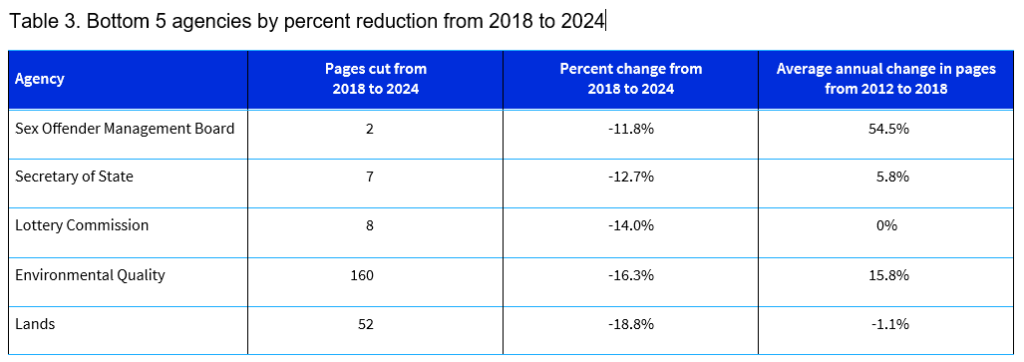
Table 3 reviews the five agencies that had the smallest percent reduction in regulatory pages following ZBR, ranging from 11.8 percent to 18.8 percent cuts, well below the statewide average reduction of 37.8 percent. Two of the agencies are either constitutional officers (Secretary of State) or have a governing board made of constitutional officers (Lands). Given that the ZBR executive order could not apply to separately elected constitutional officers, this outcome is then likely of little surprise.
The Sex Offender Management Board (SOMB) had the smallest net reduction (-11.8 percent). Given the nature of its work, it is unlikely that there is much public demand for widespread deregulation. In fact, the primary reduction at SOMB was a removal of time-limited language that had since passed and was therefore obsolete.
Lastly, the Department of Environment Quality (DEQ) appears in both this table and in Table 2, which reviewed the agencies with the most page count reductions. That means DEQ cut a large number of pages (160) relative to other agencies, but given its overall volume, the agency decreased regulatory page count by just a modest percentage (16.3 percent).
This gap is likely explainable by the agency’s mission, which is to regulate air pollution, water quality standards, drinking and wastewater systems, and related topics. These are topics that are also regulated federally, and states can partially preempt federal law by having minimum state standards. Thus, there is a baseline regulatory burden that is expected for state agencies, lest the regulatory authority default back to the more distant, and often more disciplinary-focused, federal government. Nonetheless, DEQ was still able to reduce a significant number of regulatory pages while maintaining state primacy of environmental regulations.
Pressure washing and Spring cleaning
Idaho set a target reduction goal of 20 percent as part of the governor’s executive order, and most agencies (88 percent) exceeded this. Agencies averaged a 38 percent cut statewide and most (60 percent) agencies still exceeded this threshold. Thus, it is reasonable for states to set a 20 percent or larger goal for most agencies, while preserving some flexibility for a minority of agencies to come in under this goal in explainable instances.
Given that Idaho was already one of the least regulated states prior to ZBR implementation, 20 percent may even represent a lower bound of what is a reasonable target for states with heavier baseline regulatory burdens. Still, agencies should be encouraged to exceed this goal, given that there were larger scale reductions in agencies like occupational licensing (-63 percent).
Idaho’s ZBR took place in two phases, with a statewide sunset to pick the low-hanging fruit (e.g., a “pressure washing”) followed by a routine cycle of five-year reviews (e.g., a “Spring cleaning”). It is therefore worthwhile to look at how each of these steps decreased regulatory burden.
The pressure washing step decreased regulatory page count by 2,176 pages from 2018 to 2020, reflecting a net reduction of 25 percent. The Spring cleaning has reduced a total of 1,059 pages to date, or 17 percent from 2020, though this step is only partially completed. Only three of the five cyclical review years have been completed through 2024, and as a result, this percentage will continue to grow over time. Thus, the pressure washing step rapidly reduces unnecessary and obsolete regulations, whereas the spring cleaning takes a more deliberate review to carefully cull additional restrictions over time.
Regulation and statute reduction
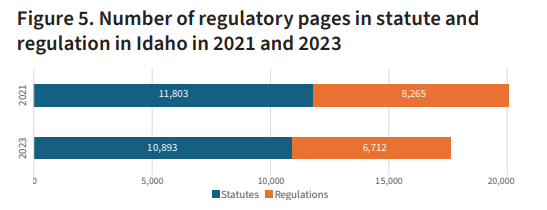
Figure 5 shows the number of pages in both statute and regulation in Idaho in 2021 and 2023, the earliest and latest years for which statutory data is available from QuantGov. It shows that Idaho statutes and regulations both decreased during this time period by 8 percent and 19 percent, respectively. Thus, eliminated regulations were not simply moved to statute, as some critics have charged.
Idaho had a concerted effort, albeit to a lesser degree, to eliminate obsolete statutes in addition to eliminating unnecessary regulations. Moreover, regulatory pages as a percentage of Idaho’s total pages of law (statute and regulation) shrank from 41 percent in 2021 to 38 percent in 2023, shifting more policy decisions to elected lawmakers and away from unelected executive branch representatives.
One other concern about state-level regulatory reform is that agencies may simply incorporate by reference (IBR) material published elsewhere, like a federal law or industry standard (e.g., national building code), by linking to an external document rather than re-publishing all of the standards in the administrative code. If an agency uses IBR it could create the false appearance of reducing regulations by cutting word count while actually adding legally enforceable provisions.
Under ZBR, the number of regulatory incorporations by reference decreased by 22 percent statewide (from 512 IBRs to 398). The number of agencies with an IBR also decreased by 41 percent (from 32 agencies to 19). Thus, Idaho also reduced IBRs, and therefore the total number of pages reported as eliminated under ZBR underreports the total regulatory reduction observed in the state.
Taking Idaho’s reforms to other states
While the work of regulatory reform will ultimately be conducted by agencies, the system in which agencies operate will be set by either the governor or legislature. Either entity must construct an orderly process that combats the regulatory status quo that bends towards increased regulation at most agencies. Thus, to accomplish change in regulatory behavior across state agencies, the Idaho experience suggests several critical strategies to facilitate agency engagement.
Clear expectations: The governor or legislature must set clear expectations for regulatory reform that are both meaningful and achievable. In Idaho, agencies were nudged to cut at least 20 percent of their regulations by word count, an expectation outlined in executive order, and reinforced in multiple outlets such as requiring agencies to track progress toward this goal in their statutorily required annual performance measurement reports. The expectations must be regularly reinforced through cabinet meetings or legislative hearings. Establishing the baseline year for measurement (2018 in Idaho’s case) and tracking progress towards the targeted goal should be accomplished by the governor’s office or legislature. Ultimately, most Idaho agencies exceeded this 20 percent goal.
States will undoubtedly encounter individuals who say the focus should be on quality, not quantity, but these are not mutually exclusive. ZBR establishes a process whereby the quality of regulations is optimized through cross-jurisdictional comparisons while simultaneously reducing quantity, the latter of which is easier to measure across diverse agencies.
Internal agency accountability: Idaho required each agency to designate a Rules Review Officer (RRO) to provide oversight within each agency and keep the agency on track towards the target established in the executive order. RROs were not newly hired positions, and instead were existing employees designated to serve in this capacity as the agency’s singular point of accountability.
RROs had responsibility for establishing the five-year review schedule for their agency and were entrusted with carrying this review out successfully. These officers coordinated with all programs within their agency and would often provide suggestions for reductions or edits that would be consistent across program areas. Lastly, RROs helped curb the “regulate-first” mindset and made agencies much more deliberate about how and when they regulate.
External agency oversight: Federally, the Office of Information and Regulatory Affairs (OIRA) within the Office of Management and Budget (OMB) provides an independent regulatory review to ensure the regulatory work of disparate agencies aligns with presidential priorities. Idaho tasked its budget office as its OIRA-style independent review agency. Key roles for this office included providing training to agencies on the governor’s expectations for regulatory reform, nudging agencies to make targeted regulatory changes, coordinating with the governor’s office on reviewing regulations to ensure conformity with administration priorities, and establishing benchmarks and tracking progress at agencies toward articulated goals.
Having a statewide oversight mechanism is a necessary element of ensuring the work of regulatory reform happens consistently across agencies and keeps agencies externally accountable for meeting progress towards the established expectations. It is important to facilitate and reinforce strong agency performance, and deter negative agency performance, prioritizing substance over style or format in rulemaking submissions.
Celebrate strong performance: Recognizing state agencies for their performance, such as awarding a “Golden Scissors” trophy to the top performing agencies, can foster a spirit of friendly competition across the executive branch. By publicly celebrating agency efforts, it reinforces the importance of regulatory reform within government, and provides recognition for which agencies can strive.
Conclusion
Under ZBR in Idaho, all agencies in Idaho reduced regulations from 2018 to 2024, up from just 16.7 percent of agencies cutting regulations prior to ZBR implementation in 2012 to 2018. Collectively, Idaho agencies eliminated 3,235 pages of regulation, a 38 percent statewide decrease from 2018, with agencies exhibiting a range of cuts from 12 percent to 100 percent. Idaho outpaced its neighboring states in regulatory cuts, with all but one contiguous state increasing regulations. Given that most agencies exceeded a 20 percent page count reduction, setting a targeted regulatory reduction at least at this level is reasonable. Targeted efforts should be made to further reduce occupational licensing, with Idaho achieving its largest regulatory reductions in this area.
Thus, an external push through an orderly regulatory reform process like ZBR has proven to be successful in changing agency regulatory behavior. Critical elements of success in engaging agencies as a regulatory reform partner include setting clear expectations for agencies and enhancing accountability for this expectation within each agency. Lastly, setting up a central oversight mechanism like the role that OIRA plays federally is a critical piece of ensuring statewide oversight of the regulatory reform effort and driving results towards the goals established by either the governor or legislature.
About the author
Alex J. Adams served as Administrator of Idaho’s Division of Financial Management for more than five years, during which he played a leading role in designing and implementing the state’s zero-based regulation strategy and oversaw all state regulations. Building on that foundation, he was appointed Director of the Idaho Department of Health & Welfare in mid-2024, steering major reforms in child welfare and fiscal policy. Adams holds a Doctor of Pharmacy and a bachelor’s degree from the University of Toledo, where he graduated as valedictorian, and earned a Master of Public Health from the Johns Hopkins School of Public Health.