Toward a Renewed and Improved USMCA
Trade policy should be free, simple, and stable

Cross-border trade in North America has been an engine of prosperity for the United States, Mexico, and Canada. But the agreement governing the trading relationships is in flux.
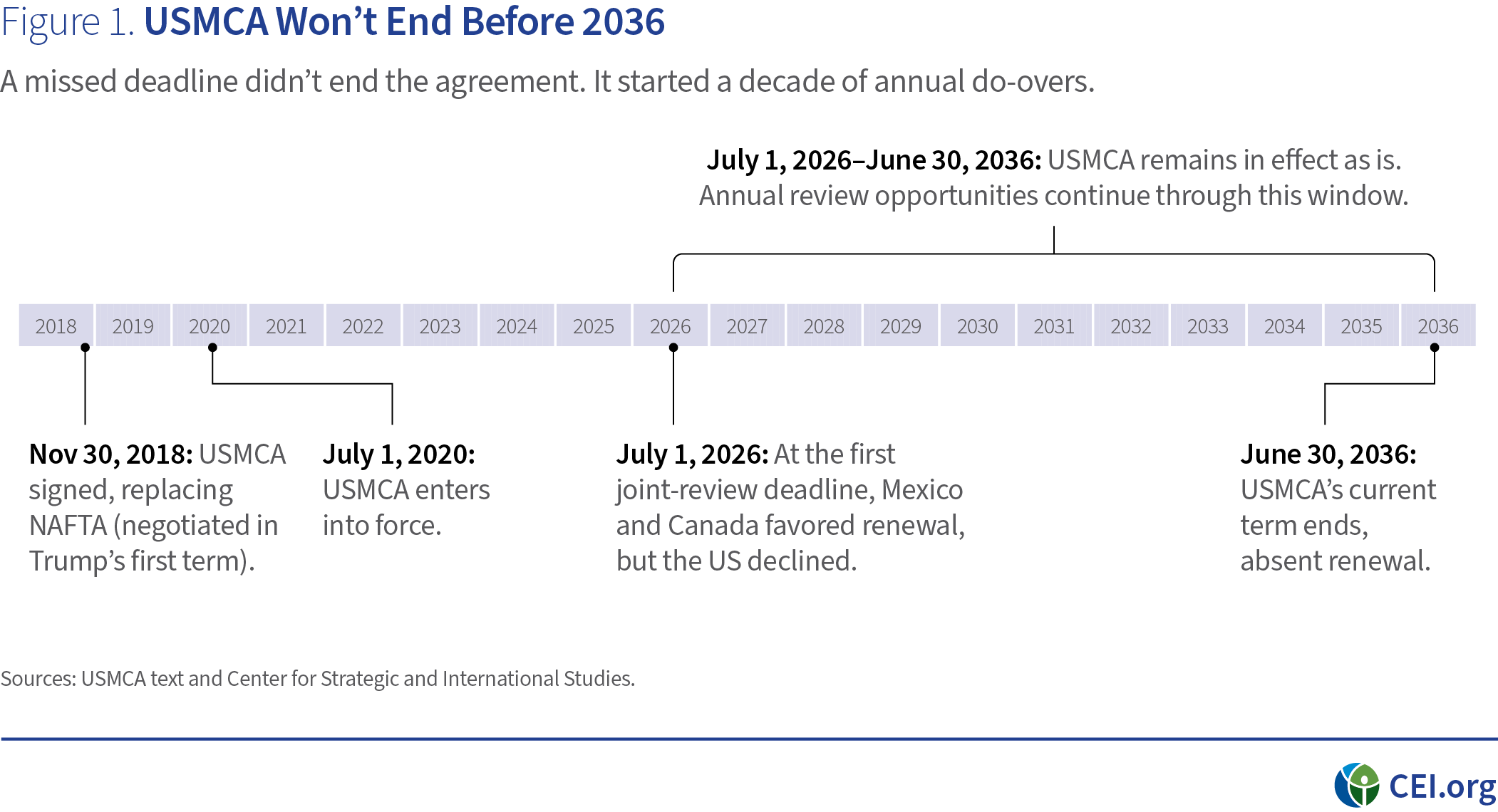
President Trump negotiated the United States–Mexico–Canada Agreement (USMCA) in his first term to replace the 1994 North American Free Trade Agreement (NAFTA). Unlike NAFTA, which was permanent, the USMCA has built-in expiration dates. One deadline for all three countries agreeing to renew the USMCA was July 1, 2026. Mexico and Canada favored renewal, but the United States declined.[1] Although this deadline has passed, the USMCA is scheduled to remain in effect as-is through June 30, 2036, with similar annual review opportunities until then. While the USMCA’s demise is not imminent, its future is uncertain. This paper’s purpose is to guide USMCA negotiators, other trade officials, and people affected by the USMCA toward trade policies that will benefit all member countries, regardless of the USMCA’s fate.
Those policies are based on three principles. The first is that trade agreements should expand free trade rather than adopt managed trade policies. Trade is win-win for consumers and producers alike on all sides of the borders. The second principle is that to the extent possible, trade agreements should stick to trade. Separate issues should be negotiated separately. Simpler trade agreements are easier to negotiate, easier to comply with, and less prone to special interest interference. The third principle is that trade policy should be stable and predictable. Without stability, producers have difficulty planning their operations and making future investments in new production.
Trump’s goal in declining to renew his own agreement is, apparently, to give himself leverage in other negotiations. For the same reason, he will likely also decline similar annual renewal opportunities for the rest of his term.
Regardless of whether this tactic yields the desired leverage, it is already creating uncertainty for two of America’s largest trading partners. This uncertainty will discourage long-term investments in industries ranging from autos to agriculture. Trump’s approach also gives Mexico and Canada an incentive to strengthen their trading relationships with China and weaken those with the United States. Such a move would threaten US national security as well as the US economy.
Even if USMCA renewal ultimately fails, the three principles of free, simple, and stable trade policy can still guide policymakers in all three countries toward constructive long-term trading relationships without a formal agreement.
One of us (Young) opposed the USMCA when it was first negotiated in 2019.[2] The USMCA, while similar to NAFTA, moved the trade relationships away from free trade toward managed trade—using protectionism to limit the consequences of free trade. This shift applied to policies as diverse as rules of origin for auto parts, manufacturing wage requirements in Mexico, and dairy farming regulations for the United States and Canada.
In the NAFTA era, trade-unrelated labor and environmental issues were addressed in side agreements. The USMCA addressed those issues directly. NAFTA also made trade policy predictable. American trade policy since the USMCA has been unpredictable, mainly because of the Trump administration’s policies, not the USMCA. The move from NAFTA to the USMCA violated all three of our sound trade policy principles. While NAFTA was imperfect, it was preferable to the USMCA.
Despite that earlier opposition, this paper favors USMCA renewal. In the current political context, the most likely USMCA alternative is not NAFTA. It is an expansion of the Trump administration’s protectionist, complex, and erratic trade policy approach. That approach has already done enormous economic and diplomatic damage to America and its allies. In August 2026, for example, Trump unilaterally raised tariffs on Canada. Canada retaliated in kind, leading to yet another escalation on Trump’s end. This escalation could raise prices on an estimated $80 billion of goods such as cars, energy, and steel.[3]
This paper does not examine every provision in the two-thousand-page USMCA. Instead, we look at five of its most important policy areas and give recommendations guided by the sound policy principles of free trade, simplicity, and stability. These areas are tariffs, labor and environmental provisions, rules of origin requirements, agriculture provisions, and trade remedies.
Tariffs
NAFTA’s biggest accomplishment was establishing a nearly tariff-free relationship between the United States, Mexico, and Canada. The USMCA largely preserved this policy. A renewed USMCA would presumably keep it as well.
In several steps across both of his terms, President Trump imposed tariffs as high as 50 percent on steel, aluminum, copper, and other goods from Mexico and Canada. These tariffs appear inconsistent with the USMCA, but the administration may invoke article 32.2’s essential-security exception. The Trump administration cites section 232 of the 1962 Trade Expansion Act, which allows the president to impose tariffs on national security grounds. The scope and reviewability of such security exceptions remain legally contested.
Other Trump tariffs that do not cite national security may be more difficult to reconcile with the USMCA. These include 50 percent tariffs on goods such as wine, hockey sticks, and cement. The administration cites section 338 of the 1930 Smoot-Hawley Tariff Act, which allows the president to use tariffs to retaliate against countries that discriminate against US exports.[4] The administration has also imposed a 10 percent blanket tariff, citing section 301 of the 1974 Trade Act.[5] That provision gives the president the authority to use tariffs to retaliate against countries for violating trade agreements. In this instance, the Trump administration alleges that Canada and Mexico use forced labor.[6]
The USMCA is not an absolute bar to unilateral tariffs. International law rests in part on the principle of pacta sunt servanda: countries are expected to honor their agreements.[7] In this sense, international agreements operate partly on an honor system, but compliance is also in each country’s interest.
A country that routinely breaks its trade commitments risks encouraging its trading partners to do the same, undermining the broader system of rules on which its own exporters depend. Trade agreements therefore rely on both legal obligations and the political and economic costs of violating them.
The USMCA imposes meaningful costs on a government that breaks its commitments, but those costs might not always be enough to deter breaking the agreement.
The USMCA contains binding obligations, dispute settlement mechanisms, and enforcement procedures. These add costs to violating the USMCA and help to restrain bad behavior. But if one party is willing to bear those costs, enforcement mechanisms may not be enough to deter a violation. Indeed, these mechanisms have not restrained the Trump administration, though the USMCA may still have value in restraining future US administrations from unilaterally enacting tariffs against Mexico and Canada.
The World Trade Organization illustrates a broader limitation of enforcement mechanisms. Both the Obama and Trump administrations blocked the reappointments of some WTO Appellate Body members. This left the Appellate Body without the quorum necessary to hear appeals in 2019. Without a functioning Appellate Body, WTO members can appeal panel decisions but cannot obtain final rulings, which weakens the system’s ability to enforce its rules.[8]
Ultimately, USMCA renewal should focus on restoring and maintaining zero-tariff relationships and lowering other trade barriers. If negotiators make any changes to existing language, those changes should make raising tariffs more difficult.
Retaliatory tariffs rarely convince other countries to lower tariffs. Negotiators should instead focus on other methods of freeing trade. One possibility is creating bureaucratic hurdles and waiting periods that slow tariff increases. Another is removing frictions to, or providing incentives for, lowering tariffs. Yet another is requiring violating countries to compensate injured businesses or cover challengers’ costs of bringing successful disputes.[9]
Labor and environmental provisions
Trade-unrelated provisions are the most significant trend in post-NAFTA trade agreements.[10] Trade agreements from the 1947 General Agreement on Tariffs and Trade (GATT) up until NAFTA in 1994 focused mostly on tariffs and other trade barriers. NAFTA itself focused primarily on tariff liberalization. But labor unions and environmental advocacy groups pressed for separate side agreements addressing trade-unrelated labor and environmental issues.[11]
These side agreements aimed to harmonize labor and environmental standards across countries. Proponents of labor and environmental provisions often use a race-to-the-bottom argument. Under this thinking, producers in countries with weaker labor or environmental regulations enjoy artificial cost advantages. This regulatory competition discourages companies from doing business in countries like the United States that have stricter regulations.[12]
Rich countries, the argument goes, then lower their regulatory standards to prevent capital flight to low-income countries. Incorporating labor and environmental obligations into free trade agreements (FTAs) is seen as a way to prevent this regulatory competition among member countries.[13]
Proponents of trade-unrelated provisions argue that these provisions are intended to strengthen labor rights,[14] improve environmental stewardship,[15] and increase public support for trade liberalization by addressing concerns that freer trade comes at the expense of workers or environmental quality.[16]
Thus, the agreements created commissions, monitoring systems, and dispute processes to govern labor and environmental practices. Trade-unrelated side agreements gradually became more prominent in subsequent US trade agreements.[17]
Addressing labor and environmental issues through separate agreements is not the problem. Rather, putting those issues into trade agreements is the problem. Including those issues makes compliance with non-trade obligations a condition of maintaining trading rights.
The USMCA continued this trend by folding NAFTA’s trade-unrelated side agreements into the main text. The USMCA also added new provisions such as the Rapid Response Labor Mechanism (RRM). The RRM ties preferential tariff rates to compliance with certain labor obligations at individual covered facilities. Specifically, it establishes a facility-specific enforcement mechanism for complaints alleging denials of freedom of association and collective bargaining rights.[18]
In addition to holding governments accountable for their labor commitments, the RRM allows trade penalties to be imposed on individual covered facilities where a denial of rights is found. Environmental provisions are likewise integrated into binding dispute settlement procedures governing trade rights and obligations.
The problem is that these provisions undermine the benefits free trade produces for everyone. Labor and environmental provisions weaken FTAs because they shift the agreements away from free trade and toward regulatory coordination. The economic case for trade liberalization does not depend on harmonized policy environments.
Nobel laureate Paul Krugman observed that gains from trade arise from differences in relative prices across countries, regardless of their underlying source.[19] Differences in labor and environmental standards contribute to a country’s comparative advantage. Attempts to equalize such standards may therefore reduce potential gains from trade by constraining beneficial specialization.[20]
Including trade-unrelated provisions leads to mission creep. Once trade agreements incorporate domestic regulatory commitments, they become more vulnerable to political pressures that shift them away from liberalization and toward negotiated outcomes shaped by domestic special interests.[21]
Have labor and environmental provisions improved trade outcomes, or have they introduced new distortions and sources of conflict? A growing body of evidence suggests the latter.
One major study examined what happens when strict labor rules are added to trade agreements.[22] It found that when developing countries sign trade deals with few or no labor restrictions, their exports to wealthy nations rise significantly. However, when strict and enforceable labor rules are included, that export growth does not happen.
This shows that forcing rich-country work standards onto developing partners can greatly diminish their comparative advantage, a concern CEI analysts have raised since at least 1995.[23]
For labor advocates, this is a feature rather than a bug. Reducing the competitive advantage created by lower labor costs is precisely the point of such provisions. From a free-trade perspective, however, deliberately reducing that advantage can constrain beneficial specialization.
Proponents of environmental provisions often assume that stricter obligations in trade agreements will improve environmental outcomes. However, these provisions come with tradeoffs.
Labor and environmental commitments in FTAs reduce foreign direct investment flows among trading partners.[24] Harmonizing standards means raising the regulatory obligations associated with investment in countries with previously low standards. That potentially steers investment away from those countries.[25]
Differences in labor and environmental standards reflect underlying variation in income levels, institutional capacity, and policy preferences. These differences are already reflected in relative prices that guide market outcomes.
Imposing enforceable standards through trade agreements can reduce export growth and discourage foreign direct investment. This can weaken the channels through which trade promotes economic development. Over time, more economic development gives countries greater resources to devote to environmental protection.
By increasing compliance costs, expanding political discretion, and distorting investment decisions, these provisions can make it harder for developing countries to develop. Governments in richer countries may nevertheless support such provisions because they can use them to protect or advantage domestic producers.
Labor and environmental provisions do not belong in FTAs. Adding them to NAFTA as side agreements was a mistake, and including them in USMCA’s main text was worse. While side agreements are preferable to direct inclusion, both approaches stray from trade policy’s proper focus on trade liberalization.
The USMCA went further by incorporating NAFTA’s labor and environmental provisions into the main text and making them subject to the agreement’s enforcement mechanisms. Instead, a renewed USMCA or any agreement that replaces it should focus on liberalizing trade and allowing market forces to determine economic outcomes. In trade policy, as in so many other things, simplicity is beautiful.
Rules of origin requirements
Rules of origin (ROOs) determine whether a product qualifies for preferential tariff treatment under a trade agreement. ROOs are typically minimum thresholds of regional content or transformation that products must meet to qualify for preferential treatment under an FTA.[26] For example, the USMCA requires 75 percent of a car’s parts to be made in North America for the finished vehicle to avoid tariffs.
Advocates of ROOs typically portray them as technical necessities in administering preferential trade agreements. Because FTAs grant tariff preferences only to goods from member countries, governments argue ROOs are needed to prevent non-member countries from routing exports through the lowest-tariff partner to gain unwarranted access to the agreement.[27]
ROOs take several forms. One is regional value content requirements, which specify a minimum share of value added within the FTA region. Another is change-in-tariff-classification rules, which require non-originating inputs to shift tariff codes through processing. A third category consists of rules requiring specific manufacturing or processing steps to take place within the region.[28]
The automobile rules in the USMCA best illustrate how these requirements can transform a free trade agreement into a system of managed trade. The USMCA significantly tightened the rules of origin governing automotive trade compared to NAFTA.
Under NAFTA, passenger vehicles generally qualified for preferential tariff treatment if at least 62.5 percent of their content originated in North America. The USMCA increased this threshold to 75 percent.[29]
The USMCA also introduced labor-value-content requirements tied to wage levels and mandated that key inputs, such as steel and aluminum, be sourced within North America.[30] These rules determine eligibility for preferential tariff treatment and require firms to meet multiple overlapping conditions related to sourcing, production location, and input composition.
Under the USMCA, automotive firms operating in North America must structure supply chains to satisfy regulatory thresholds, not just cost and efficiency considerations. The Federal Reserve found that ROOs in the USMCA imposed costs on importers equivalent to paying an additional 1.4 percent to 2.5 percent tariff.[31]
ROOs have additional unintended costs. Because firms must demonstrate that their products meet the agreement’s content requirements, they must devote additional resources to documenting compliance and verifying the origin of inputs. Many manufacturers changed their supply chains to satisfy the agreement’s content requirements, potentially raising costs and increasing instability as firms became more dependent on sourcing arrangements designed to meet specific regulatory thresholds.
The US International Trade Commission found that 52.6 percent of auto-related firms considered the ROOs when making sourcing decisions for new vehicle models and reported that the rules factored into their investment and supply chain planning.[32] These firm-level responses suggest that ROOs operate less as administrative requirements and more as constraints on production decisions.
ROOs affect how firms organize production and supply chains across North America. In some cases, it is cheaper to pay most-favored-nation duties than to comply with ROO requirements.[33]
The textile industry under NAFTA shows how ROOs raise prices and distort markets. Following the implementation of NAFTA, roughly one-third of the estimated increase in the border price of Mexican apparel exports was attributable to the cost of complying with ROOs. NAFTA also raised the price of US intermediate textile inputs exported to Mexico, including fabric and yarn, by 12 percent, with downstream ROOs accounting for about a third of that increase.[34]
ROOs also contributed to trade diversion. Between 1992 and 1998, Mexico gained US import market share in textiles and apparel at the expense of suppliers from outside NAFTA, consistent with firms shifting sourcing toward suppliers that could satisfy NAFTA’s preferential requirements.[35] Such diversion in effect substitutes high-cost producers for low-cost producers, ultimately raising prices for consumers.
ROOs come with high administrative and documentation costs.[36] They also distort sourcing decisions. ROOs in NAFTA reduced imports of affected intermediate inputs from countries outside of the agreement by approximately 45 percent.[37]
ROOs are difficult to reconcile with the idea of FTAs. They manage trade rather than free it, while adding complexity. If a renewed USMCA includes ROOs at all, they should have lower and more flexible thresholds.[38]
Agricultural provisions
American agriculture depends on international trade. Bread at the local grocery store might be made from American wheat grown with Canadian fertilizer, then transported by trucks with Canadian, Mexican, or American parts and powered by gasoline made from Mexican oil. The finished product is more affordable than it would be if its entire supply chain had to be sourced in just one country. Specialization and comparative advantage yield gains for everyone.
When the United States has open agricultural markets, farmers grow more crops,[39] shoppers pay less,[40] and economic growth is faster.[41] NAFTA and the USMCA have created policy stability that enabled new production chains to form,[42] intra-regional trade and investment to grow, and diplomats to better cooperate on shared priorities like stopping criminal gangs.[43]
Disputes will still happen. When they do, the USMCA provides value by setting dispute-settlement methods.[44] With the World Trade Organization in a diminished state, the USMCA’s dispute settlement rules are even more important for North American trade.
Agricultural policy is more protectionist than most other sectors, despite NAFTA and the USMCA—or in part because of them.
Even without trade agreements, farmers get substantial special privileges. Periodic US farm bills give farmers cash subsidies, loan guarantees, and discounted insurance. Farmers harmed by President Trump’s first-term tariffs received $28 billion in bailouts.[45] In his second term, they have received another $12 billion.[46]
Farmers have higher average incomes than other Americans. US farm policy effectively subsidizes wealthy landholders and large agribusinesses. This treatment is ripe for fraud.[47] Larger producers are incentivized to spend their profits not on reinvestment but on lobbying for additional privileges.[48]
NAFTA and the USMCA put zero tariffs on most agricultural goods. However, protectionist groups still managed to insert exceptions for poultry, peanuts, sugar, and, notoriously, dairy.[49] FTA negotiations face an uphill battle against politically influential farming lobbies in the United States and Canada. Where FTAs make exceptions, they essentially lock in these unfair advantages.
FTAs do not prevent national policies that distort agricultural trade, like quotas and price floors. They may even encourage farmers to change production methods in ways that create new demands for trade restrictions. But USMCA dispute settlement processes led Canada to eliminate tariff-rate quotas on dairy and Mexico to lift a restriction on genetically modified corn.[50]
Agricultural protectionism is politically powerful. Special government privileges for farmers are an American tradition dating back to the Founding. The New Deal grew those privileges to an industrial scale. Farmers were able to preserve their privileges in both NAFTA and the USMCA and will certainly not give them up now.
USMCA renewal should roll back Trump’s tariffs and the related retaliations. It should also reduce agricultural quotas, subsidies, and price supports. Ideally, the trade-unrelated aspects of agricultural policy will be addressed separately from trade agreements.
Trade remedies
Although the USMCA largely preserves zero tariff rates on North American trade, chapter 10 preserves each member government’s authority to apply its domestic antidumping, countervailing-duty, and safeguard laws to imports from the other parties. Chapter 10 also establishes procedures that constrain how those laws are administered. These include binational panel reviews of antidumping and countervailing-duty determinations.[51]
These trade remedies continue to affect a wide range of products. Recent uses have involved Canadian softwood lumber,[52] Mexican mattresses,[53] winter strawberries from Mexico,[54] and solar panels from Canada.[55]
Trade remedies are often presented as a necessary safeguard against unfair trade. This is like arguing that two wrongs make a right. Antidumping duties target imports allegedly sold at a price domestic producers do not want to compete with.
Countervailing duties offset foreign government subsidies that make imports more affordable for American consumers. And safeguard measures temporarily protect domestic producers from import surges that might benefit consumers.[56] These policies are frequently justified not on the economic merits, but as compromises that make trade liberalization politically acceptable.[57]
Instead of allowing firms and consumers to benefit from competition and comparative advantage, trade remedies enable governments to selectively shield favored industries from market forces. As a result, they undermine the predictability and openness that free trade agreements are intended to achieve. Trade remedies therefore conflict with the principles of free and stable trade policy, even though they address trade-related issues directly.
One of the most prominent examples of the limitations of trade remedies is the long-running dispute over fresh tomatoes imported from Mexico. The tomato dispute has persisted in various forms since the 1990s, with periodic suspension agreements and renewed investigations shaping market access for Mexican growers.[58]
Chapter 10 keeps Mexican tomatoes vulnerable to protectionist restrictions despite the USMCA’s nominal commitment to free trade. In July 2025, the US Department of Commerce (DOC) withdrew from the 2019 suspension agreement on fresh tomatoes from Mexico.[59] This resulted in an antidumping duty of 17.09 percent on most tomato imports from Mexico.[60]
While the DOC claims that the suspension agreement “has failed to protect US tomato growers from unfairly priced Mexican imports,” this influx of tomatoes is not due to Mexican exploitation. Mexico has both a comparative and an absolute advantage in tomato production. Mexican farmers supply roughly 90 percent of US tomato imports,[61] which themselves account for about 70 percent of US consumption.[62]
Mexico has a broad range of climates that allow year-round tomato production, whereas the US climate is too cold for winter production.[63] Mexican growers have also invested in greenhouse tomato production to increasingly cultivate varieties in high demand, like cherry and grape tomatoes.[64]
Mexico’s proximity to the US market also reduces transportation time and spoilage risk for highly perishable fresh tomatoes.[65] These advantages explain why Mexican tomatoes are highly competitive in the US market. Efforts to offset them through trade remedies mainly cause higher costs for consumers.
Tomato prices increased by roughly 23 percent from April 2025 to April 2026.[66] Best available estimates suggest that the antidumping duty alone raised fresh tomato prices by about 7 percent.[67] That is a significant increase attributable to a single policy change. The remaining increase reflected multiple factors beyond the antidumping duty. These include the winter freeze that affected Florida tomato crops[68] and the increased shipping and fuel prices stemming from the United States–Iran war.[69]
A key distinction exists between these cost drivers. Weather shocks temporarily disrupt supply and then dissipate as production cycles normalize. Energy-related cost increases caused by wars are more volatile but also temporary.
Tariff-induced price increases last as long as the antidumping order remains in effect, including through successive sunset reviews. Trade remedies therefore raise consumer prices for the duration of the order, even after short-run supply shocks have normalized.
In addition to higher prices, tariffs coincided with tomato imports to the US declining by roughly $500 million.[70] Faced with higher prices, consumers bought fewer tomatoes.
The tomato market shows that trade remedies raise prices and restrict the flow of goods across borders. Although multiple factors affected the tomato market during this period, the antidumping duty contributed to higher costs for consumers and reduced the gains from mutually beneficial trade.
The tomato case study is not an anomaly. Research on US agricultural trade remedies finds that antidumping and countervailing duties often shift rather than stop imports. As imports from targeted countries fall, imports from non-targeted countries frequently rise. These shifts can begin as soon as an investigation is opened, even before any duties are imposed.[71]
US antidumping duties against China between 1998 and 2016 were found to cost 1.8 million US jobs in industries that used the protected imports as inputs without significantly adding jobs in the protected sectors themselves.[72]
That figure is strikingly close to the roughly 2.4 million jobs that the widely debated “China shock” was estimated to have displaced between 1999 and 2011,[73] even though the antidumping estimate covers just one form of trade protection.
The comparison between the China shock and antidumping duties suggests that protection can impose employment costs on American industries comparable in magnitude to those attributed to increased import competition, while also raising the cost of imported inputs. The duties resulted in lower employment, wages, sales, and investment among firms that used the protected products.
The effects of antidumping duties can outlast the duties themselves. One study found that trade between the importing country and the targeted exporter remained about 27.5 percent below pre-duty levels even after antidumping measures were revoked. This finding indicates that trade relationships may not fully recover once disrupted.[74]
Trade remedies are a durable source of protectionism within nominally liberalized markets. That protectionism harms American consumers and workers. These trade remedies should not be included in free trade agreements or a renewed USMCA.
Conclusion
The USMCA, despite its flaws, deserves renewal because it is better than the alternative of President Trump’s protectionist and erratic trade approach. This holds true under all three goals this paper advocates: free, simple, and stable trade.
Trump will likely leave USMCA renewal up in the air for the remainder of his presidency to give himself perceived leverage in future negotiations. Whether USMCA renewal happens under Trump or the next president, negotiations should move the agreement away from managed trade and toward free trade. The five issues covered in this paper follow a principles-based approach that could also work for many of the other issues addressed in the USMCA’s 34 chapters and roughly two thousand pages.
About the authors
Ryan Young is the Senior Economist and Director of Publications at the Competitive Enterprise Institute.
Steve Swedberg was a finance and monetary policy analyst at the Competitive Enterprise Institute.
Justin Liu is a former research associate at the Competitive Enterprise Institute.
Notes
[1] Diego Marroquín Bitar, Kellie Meiman Hock, Eric Miller, Juan Carlos Baker, and William Alan Reinsch, “The United States Has Opted Not to Extend the USMCA,” Center for Strategic and International Studies, July 2, 2026, https://www.csis.org/analysis/united-states-has-opted-not-extend-usmca.
[2] Iain Murray and Ryan Young, “Competitive Enterprise Institute Opposes USMCA Trade Agreement,” OpenMarket (blog), Competitive Enterprise Institute, December 12, 2019, https://cei.org/blog/competitive-enterprise-institute-opposes-usmca-trade-agreement.
[3] Matina Stevis-Gridneff and Ana Swanson, “From ‘Fortress North America’ to All-Out Trade War: How the U.S.-Canada Talks Collapsed,” New York Times, August 25, 2026, https://www.nytimes.com/2026/08/25/world/canada/trump-carney-trade-war-tariffs.html.
[4] The White House, “Fact Sheet: President Donald J. Trump Imposes Additional Tariffs on Canada,” July 20, 2026, https://www.whitehouse.gov/fact-sheets/2026/07/fact-sheet-president-donald-j-trump-imposes-additional-tariffs-on-canada.
[5] Office of the United States Trade Representative, “USTR Takes Action in Forced Labor Section 301 Investigations,” news release, July 23, 2026, https://ustr.gov/about/policy-offices/press-office/press-releases/2026/july/ustr-takes-action-forced-labor-section-301-investigations.
[6] Ryan Young, “The Forced Labor Fig Leaf,” OpenMarket (blog), Competitive Enterprise Institute, July 27, 2026, https://cei.org/blog/the-forced-labor-fig-leaf.
[7] Anthony Aust, “Pacta Sunt Servanda,” Max Planck Encyclopedias of International Law (Oxford University Press, February 2007), https://opil.ouplaw.com/display/10.1093/law:epil/9780199231690/law-9780199231690-e1449.
[8] Nina M. Hart and Brandon J. Murrill, “The World Trade Organization’s (WTO’s) Appellate Body: Key Disputes and Controversies,” CRS Report R46852, Congressional Research Service, 2021, https://www.congress.gov/crs-product/R46852.
[9] Gary Clyde Hufbauer et al., Payoff from the World Trade Agenda 2013 (Peterson Institute for International Economics, 2013), p. 54, https://www.piie.com/sites/default/files/publications/papers/hufbauerschott20130422.pdf.
[10] Jagdish Bhagwati, Termites in the Trading System: How Preferential Agreements Undermine Free Trade (Oxford University Press, 2008).
[11] Iain Murray, “Trading Away Freedom: How Non-trade Elements Came to Dominate Trade Agreements,” in Free Trade in the Twenty-First Century: Economic Theory and Political Reality, ed. Max Rangeley and Daniel Hannan (Springer, 2025), pp. 509–510, https://link.springer.com/chapter/10.1007/978-3-031-67656-7_27.
[12] International Labour Organization, “Can Trade Liberalization and Social Progress Go Hand-in-Hand?” November 12, 2013, https://www.ilo.org/resource/article/can-trade-liberalization-and-social-progress-go-hand-hand.
[13] International Labour Organization, Labour Provisions in G7 Trade Agreements: A Comparative Perspective (International Labour Organization, 2019), p. 1, https://www.ilo.org/sites/default/files/wcmsp5/groups/public/%40dgreports/%40ddg_p/documents/publication/wcms_719226.pdf.
[14] Kevin Kolben, “Chapter 7: Labor Standards,” in USMCA Forward 2023 (Brookings Institution, 2023), https://www.brookings.edu/articles/usmca-forward-2023-chapter-7-labor-standards.
[15] Christopher A. Casey and Richard K. Lattanzio, “Environmental Provisions in Free Trade Agreements (FTAs),” CRS In Focus IF10166, Congressional Research Service, September 1, 2023, https://www.congress.gov/crs-product/IF10166.
[16] Layna Mosley and B. Peter Rosendorff, “A Domestic Political Economy of Package Treaties,” World Trade Review 23, special issue 5 (2025), pp. 1–20, https://www.cambridge.org/core/journals/world-trade-review/article/domestic-political-economy-of-package-treaties/07CD85F0AC6D5CE7E0467D4943861701.
[17] Murray, “Trading Away Freedom,” p. 514.
[18] Chad P. Bown and Kathleen Claussen, “The Rapid Response Labor Mechanism of the US-Mexico-Canada Agreement,” Working Paper 23-9, Peterson Institute for International Economics, October 2023, p. 14, https://www.piie.com/publications/working-papers/2023/rapid-response-labor-mechanism-us-mexico-canada-agreement.
[19] Paul Krugman, “What Should Trade Negotiators Negotiate About?” Journal of Economic Literature 35, no. 1 (1997), pp. 113–120, https://ielp.worldtradelaw.net/content/files/~noy/362texts/Krugman-negotiations.pdf.
[20] Iain Murray, “USMCA Sets a Worrying Precedent,” National Review, October 12, 2018, https://www.nationalreview.com/corner/usmca-sets-worrying-precedent.
[21] Murray, “USMCA Sets a Worrying Precedent.”
[22] Jacopo Timini, Nicola Cortinovis, and Fernando López Vicente, “The Heterogeneous Effects of Trade Agreements with Labour Provisions,” The World Economy 45, no. 9 (2022), p. 2838, https://www.bde.es/f/webpi/SES/staff/timinijacopo/Files/heterogeneous.pdf.
[23] James M. Sheehan, Two Years After NAFTA: A Free Market Critique and Assessment, Competitive Enterprise Institute, December 1, 1995, p. 5, https://cei.org/studies/two-years-after-nafta-a-free-market-critique-and-assessment.
[24] Mattia Di Ubaldo and Michael Gasiorek, “Non-Trade Provisions in Trade Agreements and FDI,” European Journal of Political Economy 75 (2022), art. 102208, https://www.sciencedirect.com/science/article/pii/S0176268022000246.
[25] Shixiong Liu and Jian Han, “Environmental Provisions in Trade Agreements and Outward Foreign Direct Investment: Investment from China,” Journal of International Money and Finance 165 (2026), https://www.sciencedirect.com/science/article/pii/S0261560626000756.
[26] International Trade Administration, “Identify and Apply Rules of Origin,” accessed July 13, 2026, https://www.trade.gov/identify-and-apply-rules-origin.
[27] Office of the United States Trade Representative, “Rules of Origin,” accessed July 13, 2026, https://ustr.gov/trade-agreements/wto-multilateral-affairs/wto-issues/customs-issues/rules-origin.
[28] World Trade Organization, “Technical Information on Rules of Origin,” accessed July 13, 2026, https://www.wto.org/english/tratop_e/roi_e/roi_info_e.htm.
[29] Kyla H. Kitamura and Liana Wong, “USMCA: Automotive Rules of Origin,” CRS In Focus IF12082, Congressional Research Service, December 6, 2024, updated June 23, 2026, p. 1, https://www.congress.gov/crs-product/IF12082.
[30] Kitamura and Wong, “USMCA: Automotive Rules of Origin,” p. 1.
[31] Spencer Bowdle and Fariha Kamal, “Trade Compliance at What Cost? Lessons from USMCA Automotive Trade,” FEDS Notes, Board of Governors of the Federal Reserve System, July 18, 2025, https://www.federalreserve.gov/econres/notes/feds-notes/trade-compliance-at-what-cost-lessons-from-usmca-automotive-trade-20250718.html.
[32] US International Trade Commission, USMCA Automotive Rules of Origin: Economic Impact and Operation, 2025 Report, publication 5642 (June 2025), p. 118, https://www.usitc.gov/publications/332/pub5642.pdf.
[33] US International Trade Commission, USMCA Automotive Rules of Origin, pp. 114–115.
[34] Oliver Cadot et al., “Market Access and Welfare under Free Trade Agreements: Textiles under NAFTA,” World Bank Economic Review 19, no. 3 (2005), https://openknowledge.worldbank.org/server/api/core/bitstreams/1101d5d8-e350-5619-b23a-d4425cc58ea0/content.
[35] Kyoji Fukao, Toshihiro Okubo, and Robert M. Stern, “An Econometric Analysis of Trade Diversion under NAFTA,” The North American Journal of Economics and Finance 14, no. 1 (2003), pp. 3–24, https://www.sciencedirect.com/science/article/abs/pii/S1062940802001183.
[36] Dzmitry Kniahin and Jaime de Melo, “A Primer on Rules of Origin as Non-Tariff Barriers,” Journal of Risk and Financial Management 15, no. 7, (2022), p. 286, https://www.mdpi.com/1911-8074/15/7/286.
[37] Paola Conconi et al., “From Final Goods to Inputs: The Protectionist Effect of Rules of Origin,” American Economic Review 108, no. 8 (2018), pp. 2335–2365, https://conconi.ulb.be/RoO.pdf, https://www.aeaweb.org/articles?id=10.1257/aer.20161151.
[38] Simon Lester, “Rules of Origin, Regulatory Cooperation, and the Alternative Architecture for Transatlantic Trade,” Cato Institute Online Forum, Cato Institute, September 22, 2015, https://www.cato.org/cato-online-forum/rules-origin-regulatory-cooperation-alternative-architecture-transatlantic-trade.
[39] Between 2013 and 2022, more than 20 percent of US agricultural products were exported. Economic Research Service, “U.S. Agricultural Trade at a Glance,” US Department of Agriculture, April 7, 2026, https://www.ers.usda.gov/topics/international-markets-us-trade/us-agricultural-trade/us-agricultural-trade-at-a-glance.
[40] The USDA calculated in 2021 that Americans would effectively earn $3.5 billion if all tariffs on agriculture were removed. Since then, tariffs have climbed even higher. Jayson Beckman and Sara Scott, “How the Removal of Tariffs Would Impact Agricultural Trade,” Amber Waves, US Department of Agriculture, June 7, 2021, https://www.ers.usda.gov/amber-waves/2021/june/how-the-removal-of-tariffs-would-impact-agricultural-trade.
[41] In 2022, “every $1.00 of U.S. agricultural product exported generated a total of $2.09 of domestic economic activity, on average.” Wendy Zeng, Megan Husby, and Fengxia Dong, “U.S. Agricultural Exports Contributed $412 Billion to the U.S. Economy in 2022,” Charts of Note (blog), Economic Research Service, US Department of Agriculture, May 16, 2024, https://www.ers.usda.gov/data-products/charts-of-note/109178.
[42] Ian Sheldon and Kari Heerman, “Refining USMCA to Strengthen Integration of North American Agricultural Sector,” Brookings Institution, March 4, 2026, https://www.brookings.edu/articles/refining-usmca-to-strengthen-integration-of-north-american-agricultural-sector.
[43] Diego Marroquín Bitar, Christopher Hernandez-Roy, and Earl Anthony Wayne, “USMCA Review 2026,” Center for Strategic and International Studies, August 18, 2025, https://www.csis.org/analysis/usmca-review-2026.
[44] Aleks Schaefer and Christopher A. Wolf, “Trade Protection via Tariff Rate Quota Administration,” Food Policy 131 (2025), p. 11, https://doi.org/10.1016/j.foodpol.2025.102801.
[45] Jeff Daniels and Christina Wilkie, “Trump Administration Unveils $16 Billion Bailout to Farmers Hurt by China Trade War,” CNBC, May 23, 2019, https://www.cnbc.com/2019/05/23/trump-to-give-16-billion-to-farmers-hurt-by-trade-war-sonny-perdue.html.
[46] US Department of Agriculture, “Farmers First,” accessed July 14, 2026, https://www.usda.gov/farmers-first.
[47] Chris Edwards, “Cutting Federal Farm Subsidies,” Cato Briefing Paper 162, Cato Institute, August 31, 2023, pp. 2–3, https://www.cato.org/sites/cato.org/files/2023-08/briefing-paper-162.pdf.
[48] Ryan Young, “Three Reasons Tariffs Don’t Work,” OnPoint 308, Competitive Enterprise Institute, May 20, 2026, p. 3, https://cei.org/studies/three-reasons-tariffs-dont-work; Gabriella Beaumont-Smith, “The Produce Cartels,” Cato at Liberty (blog), Cato Institute, December 21, 2021, https://www.cato.org/blog/produce-cartels; Scott Lincicome, “How to Destroy a Multibillion-Dollar Industry at Lobbyists’ Request,” The Dispatch, November 19, 2025, https://thedispatch.com/newsletter/capitolism/congress-hemp-ban-thc-seltzers.
[49] Office of the United States Trade Representative, “United States–Mexico–Canada Trade Fact Sheet Agriculture: Market Access and Dairy Outcomes of the USMCA Agreement,” accessed July 14, 2026, https://ustr.gov/trade-agreements/free-trade-agreements/united-states-mexico-canada-agreement/fact-sheets/market-access-and-dairy-outcomes.
[50] Maria L. Pagan, “The USMCA Dispute Settlement Mechanism Has Been Successful,” Brookings Institution, March 4, 2026, https://www.brookings.edu/articles/the-usmca-dispute-settlement-mechanism-has-been-successful.
[51] United States–Mexico–Canada Agreement, ch. 10, signed November 30, 2018, entered into force July 1, 2020, https://ustr.gov/sites/default/files/files/agreements/FTA/USMCA/Text/10_Trade_Remedies.pdf.
[52] US International Trade Commission, “USITC Makes Determinations in Five-Year (Sunset) Reviews Concerning Certain Softwood Lumber Products from Canada,” November 30, 2023, https://www.usitc.gov/press_room/news_release/2023/er1130_64615.htm.
[53] US Department of Commerce, “Mattresses from Mexico: Initiation of Circumvention Inquiry on the Antidumping Duty Order,” Federal Register 91, no. 27 (February 10, 2026), p. 5904, https://www.federalregister.gov/documents/2026/02/10/2026-02636/mattresses-from-mexico-initiation-of-circumvention-inquiry-on-the-antidumping-duty-order.
[54] US International Trade Commission, “Fresh Winter Strawberries from Mexico,” accessed July 13, 2026, https://www.usitc.gov/fed_reg_notices/antidumpingcountervailing_duty_701731/fresh_winter_strawberries_mexico_123125.htm.
[55] US International Trade Commission, “Crystalline Silicon Photovoltaic Cells (Whether or Not Partially or Fully Assembled into Other Products): Extension of Action,” accessed July 13, 2026, https://www.usitc.gov/investigations/safeguard/2021/crystalline_silicon_photovoltaic_cells_whether_or/extension.htm.
[56] World Trade Organization, “Anti-Dumping, Subsidies, Safeguards: Contingencies, etc.,” in Understanding the WTO, accessed July 13, 2026, https://www.wto.org/english/thewto_e/whatis_e/tif_e/agrm8_e.htm.
[57] Renee Bown and J. Lawrence Broz, “The Domestic Political-Economy of the WTO Crisis: Lessons for Preserving Multilateralism,” NBER Working Paper 27914, National Bureau of Economic Research, October 2020, https://www.nber.org/papers/w27914.
[58] Sheldon and Heerman, “Refining USMCA to Strengthen Integration of North American Agricultural Sector.”
[59] US International Trade Administration, “U.S. Department of Commerce Announces Intent to Withdraw from 2019 Suspension Agreement on Fresh Tomatoes from Mexico,”April 14, 2025, https://www.trade.gov/press-release/us-department-commerce-announces-intent-withdraw-2019-suspension-agreement-fresh.
[60] US International Trade Administration, “U.S. Department of Commerce Announces Withdrawal from 2019 Suspension Agreement on Fresh Tomatoes from Mexico,” July 14, 2025, https://www.trade.gov/feature-article/us-department-commerce-announces-withdrawal-2019-suspension-agreement-fresh.
[61] Catherine Weber and Wilma V. Davis, “Greenhouse Tomatoes Fuel U.S. Import Growth in Fresh Tomatoes,” Charts of Note, Economic Research Service, US Department of Agriculture, June 20, 2024, https://www.ers.usda.gov/data-products/charts-of-note/chart-detail?chartId=109371.
[62] US Department of Agriculture, Economic Research Service, “Vegetables and Pulses Data: Vegetables and Pulses Yearbook Tables,” table 41 (Tomatoes), accessed July 14, 2026, https://www.ers.usda.gov/data-products/vegetables-and-pulses-data/vegetables-and-pulses-yearbook-tables.
[63] Arlette Sijmonsma, “Potential 21 Percent Anti-Dumping Duty Already Affects Tomato Market,” HortiDaily, May 29, 2025, https://www.hortidaily.com/article/9736727/potential-21-percent-anti-dumping-duty-already-affects-tomato-market.
[64] Travis Minor, Sarah Basking, and Jennifer K. Bond, “Imported Greenhouse Tomatoes from Mexico Illustrate the Growing Diversity in Fresh-Market Tomatoes,” Amber Waves, Economic Research Service, US Department of Agriculture, May 1, 2019, https://www.ers.usda.gov/amber-waves/2019/may/imported-greenhouse-tomatoes-from-mexico-illustrate-the-growing-diversity-in-fresh-market-tomatoes.
[65] Claire Zoellner et al., “Microbial Dynamics in the Postharvest Supply Chain of Fresh Tomatoes from Mexico to the USA,” International Journal of Food Microbiology 238 (2016), pp. 202–207, https://www.sciencedirect.com/science/article/abs/pii/S0168160516304858.
[66] Joseph W. Glauber, Evaluating the Impact of Tariffs on US Agriculture a Year After Liberation Day, American Enterprise Institute, April 15, 2026, https://www.aei.org/research-products/report/evaluating-the-impact-of-tariffs-on-us-agriculture-a-year-after-liberation-day.
[67] Jacob Jensen, “The Cost of a Tomato Tariff,” American Action Forum, July 8, 2025, https://www.americanactionforum.org/research/the-cost-of-a-tomato-tariff.
[68] Florida Department of Agriculture and Consumer Services, “Commissioner Wilton Simpson Announces Recent Freezes Caused Over $3 Billion in Estimated Losses to Florida Agriculture,” news release, February 20, 2026, https://www.fdacs.gov/News-Events/Press-Releases/2026-Press-Releases/Commissioner-Wilton-Simpson-Announces-Recent-Freezes-Caused-Over-3-Billion-in-Estimated-Losses-to-Florida-Agriculture.
[69] Joint Economic Committee, “New: Americans Have Now Paid $56.4 Billion More for Gas Since Start of Iran War,” news release, July 13, 2026, https://www.jec.senate.gov/public/index.cfm/democrats/2026/7/new-americans-have-now-paid-56-4-billion-more-for-gas-since-start-of-iran-war; Lisa Baertlein, “Iran War Anxiety Sends Global Container Shipping Rates Soaring,” Reuters, June 10, 2026, https://www.reuters.com/business/energy/iran-war-anxiety-sends-global-container-shipping-rates-soaring-2026-06-10.
[70] Glauber, Evaluating the Impact of Tariffs.
[71] Colin A. Carter and Sandro Steinbach, “Trade Diversion and the Initiation Effect: A Case Study of U.S. Trade Remedies in Agriculture,” NBER Working Paper 24745, National Bureau of Economic Research, June 2018, https://www.nber.org/papers/w24745.
[72] Chad P. Bown, Paola Conconi, Aksel Erbahar, and Lorenzo Trimarchi, “Trade Protection along Supply Chains,” CESifo Working Paper 8812, CESifo, 2020, https://www.ifo.de/en/cesifo/publications/2020/working-paper/trade-protection-along-supply-chains.
[73] David H. Autor, David Dorn, and Gordon H. Hanson, “The China Shock: Learning from Labor Market Adjustment to Large Changes in Trade,” NBER Working Paper 21906, National Bureau of Economic Research, January 2016, p. 29, https://www.nber.org/system/files/working_papers/w21906/w21906.pdf.
[74] Magdalene Silberberger et al., “The Aftermath of Anti-Dumping: Are Temporary Trade Barriers Really Temporary?” Open Economies Review 33, no. 4 (2022), pp. 677–704, https://link.springer.com/article/10.1007/s11079-021-09639-1.