Darklore Depository 2025: An unofficial inventory of guidance documents and other regulatory dark matter

Photo Credit: Getty
Halloween can remind policy wonks that some of the ghastliest regulatory chills come not from ordinary notice-and-comment regulation buried in the daily Federal Register, but from something murkier and more frightening: federal agency guidance documents.
Guidance wears many spooky costumes: memoranda, circulars, advisory letters, FAQs, policy statements, even blog posts. These instruments of regulatory dark matter can steer business behavior—regulating, that is—without going through formal notice-and-comment rulemaking.
They aren’t published in the Federal Register or codified in the Code of Federal Regulations, yet they can bind in a bureaucratic crypt all the same.
There’s not even an official online portal for guidance documents, since Joe Biden tossed the requirement that Donald Trump set up in his first term into a grave.
This year’s update of my Darklore Depository unearths 70,401 guidance documents haunting agency websites, down from 108,023 a year ago.
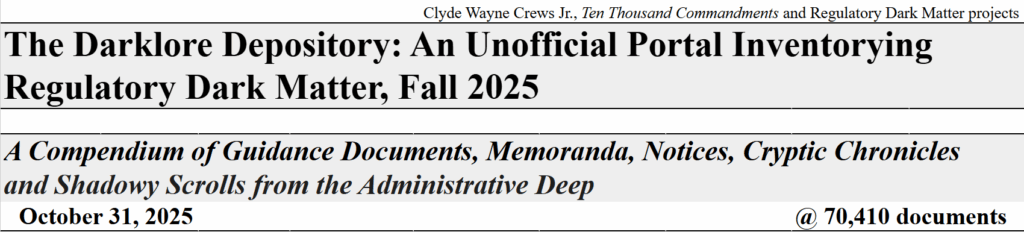
The apparent decline stems largely from purges within the Department of Health and Human Services, where the Centers for Medicare & Medicaid Services alone removed tens of thousands of entries. The Environmental Protection Agency’s portal vanished under Biden, but has risen from the crypt with more than 10,000 entries.
Yet the numbers remain highly uncertain, and the actual volume of guidance is more shadow-shrouded than many realize. Many agencies list none at all, while others provide partial databases, and some documents lurk under “Resources” or “Legal Opinions” pages, rather than the far simpler “www.[agencyname].gov/guidance” convention that Trump attempted to establish.
President Trump’s 2019 Executive Order 13891 temporarily lifted the veil, at one point pushing disclosure above 100,000 documents. Today, much of that transparency is unraveling like a windblown mummy.
The case for reanimating an official guidance document portal is strong. Guidance mimics or even effectuates lawmaking without Congress, and the first step toward accountability is sunlight. Even where totals exist, questions remain—does one “handbook” count as one guidance document or dozens? Trump should reinstate his order, standardizing agency portals that display active, rescinded, and superseded guidance.
Even more importantly, the Senate should pass the Guidance Out of Darkness (GOOD) Act to make such transparency permanent. The House already did so earlier this year—it just needs to crawl across Trump’s desk.
For more, see:
“Washington’s Hidden Rulebook: The 2025 Darklore Depository And The Case For Guidance Document Reform,” Forbes