Misalignment by design: How AI could become the operating system of the administrative state (Part 2)

Photo Credit: Getty
Read Part 1 here.
The AI deregulatory alternative: Liberalize networks and what flows through them
This is where the warnings of CEI founder Fred L. Smith Jr. matter enormously. Smith emphasized the long-term institutional consequences of the progressives’ success in the transformation of American economic life more than a century ago. One of progressivism’s great “victories” was not merely regulating products and services; it was gaining influence over the underlying institutions and networks through which markets would otherwise operate: utilities, transportation, communications, finance, and other essential infrastructure and services.
If AI is the next great network technology, we should remember what happened when government captured the networks of the last century. The data centers, computing resources, electricity supplies, transmission systems, communications networks, and other infrastructure essential to AI are becoming candidates for politicization, management, rationing, strings-attached subsidization, and allocation of generated wealth according to political priorities. Infrastructure readily becomes a choke point for everything built upon or flowing across it. As illustrated in the Capitol Control Quotient (CCQ) below, political intervention in foundational economic infrastructure displaces free enterprise far more than many likely suspect.
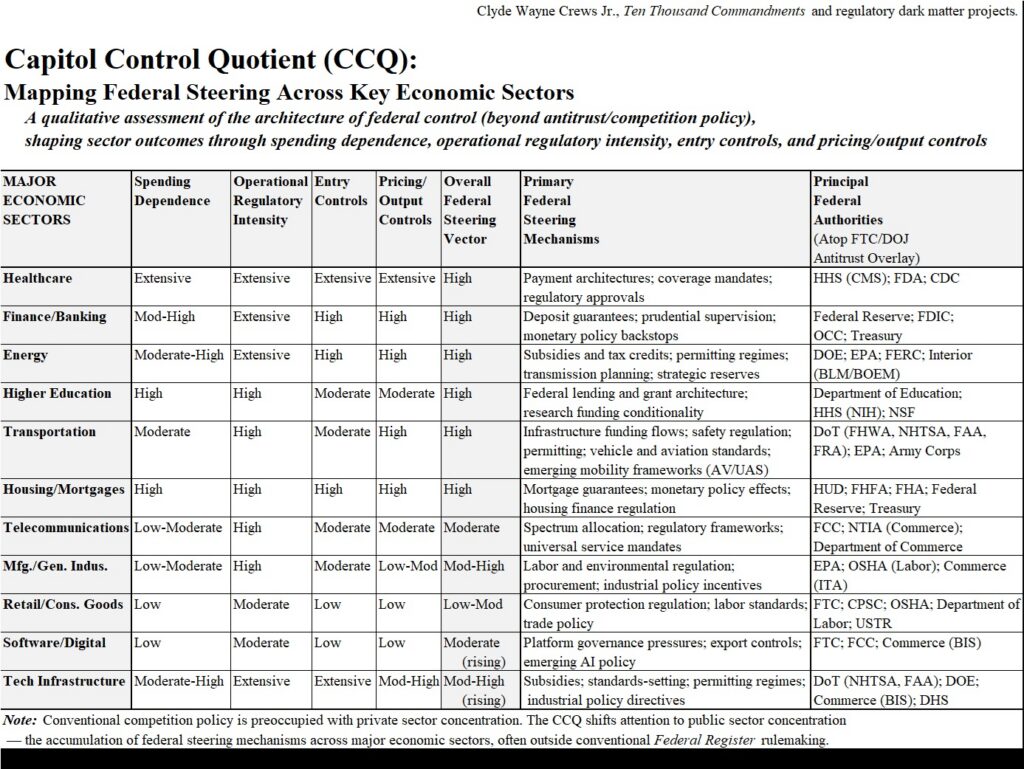
We appear poised to compound these errors implied in the CCQ with AI, as Washington promotes infrastructure banks and regional tech centers, centralized funding schemes, national research strategies, and the like. The appropriate agenda, of which AI is only one component, is not merely to deregulate the goods and services that flow over networks, but to liberalize the networks themselves, enabling cross-fertilization among them rather than the perpetuation of siloed capture under designated federal department and agency control. We need freedom in what flows across grids: electricity, information, water, vehicles, drones, and more. But we also need freer roads, grids, transmission systems, communications networks, and other infrastructure through which such goods and services move.
Instead, with AI we are witnessing the re-escalation of regulation at both levels: the networks and the flows over them. This legacy “crumbling infrastructure” approach is a formula for compounding scarcity, bottlenecks, and political control. The positive agenda should instead be the liberalization of the many physical and institutional infrastructures that make AI and much else possible, unleashing an explosion of experimentation and private infrastructure wealth. That includes allowing new forms of ownership and development, including genuinely private and decentralized smart cities and other innovations that are not creatures of top-down political planning.
Capitalism, after all, is still young in important respects. We have something of a “John Locke” for relatively short, fat, tangible forms of property. We have never fully developed comparable institutional protections for the long, thin, complex, ephemeral, and networked technologies upon which an increasingly advanced society depends. The unfortunate governance trajectory of AI now is, in many respects, the culmination of that shortfall.
Infrastructure deregulation means permitting reform and enabling energy abundance, more generation, and more transmission as the generic debate emphasizes, but it means much more. It means moving beyond the 20th century model of regulated monopoly, exclusive franchise, and politically defined universal service. It means privatization, user ownership, cross-sectoral ownership, and experimentation with a broad range of institutional and property-rights arrangements.
The answer to AI’s enormous demand for computing power and electricity cannot be the same central planning that has left us with subpar infrastructure in so many areas, from tap water to airports. Tomorrow’s networks need to be bigger, more resilient, more innovative, and more competitive as well as overlapping and reinforcing. That requires evolving novel property rights regimes rather than political control. The regulatory state that repeatedly hinders capacity and generates scarcity, then proposes to manage the scarcity it has helped create, should be allowed to do so no more.
The pattern must not be replicated in AI. The very prospect of government-controlled AI infrastructure embedded throughout daily life should be treated as a red line. We should be liberalizing infrastructure and expanding private wealth and ownership innovations within it, not constructing new political chokepoints at the foundation of the next technological era.
Beware the bipartisan temptation for coercive ‘shared prosperity’
The greatest political risk may be the bipartisan pursuit of some vision of “shared prosperity.” There is a growing impulse, not simply on the progressive left and among figures such as Bernie Sanders, but increasingly visible across the political spectrum, including Trump, OpenAI (with its Industrial Policy for the Intelligence Age), and others, to treat AI-generated productivity gains as a collective resource that government must somehow manage, capture, and redistribute. This is fundamentally hostile to a positive agenda of infrastructure wealth, individual independence, property rights, and the expansion of human agency.
There are efforts underway to use AI not to expand human independence, but to cement the Progressive “gains” of the 20th century into a new 21st century entitlement state for able-bodied adults. The emerging argument appears to be that AI will make society so productive that work will become unnecessary for many people, but that government must therefore guarantee income, distribute technological gains, and provide new forms of economic security. If that project succeeds, the losses to liberty could be profound and politically very difficult to reverse. That irreversibility is doubtless why control is sought with such fervor and passion.
Technological progress expands the capacity for independence. It should enable people to escape the drudgery and scarcity under which previous generations lived. It should make more goods and services affordable, reduce the amount of labor necessary to secure a decent standard of living, and expand the range of choices available to ordinary people. Instead, we increasingly encounter UBI-style thinking that would convert technological progress into a rationale for permanent income distribution to able-bodied adults, transforming private technological achievement into political patronage.
The question should not be how government will distribute the gains from AI and use AI to enlarge an already bloated welfare and entitlement state. It should be how to preserve a society in which innovation generates opportunities, cheaper goods and services, and increased independence without requiring political redistribution. Markets spread prosperity by expanding opportunities, lowering costs, creating new products, and enabling people to pursue their own purposes with dollars that buy more over time. Today’s luxuries become tomorrow’s affordable necessities. Politics, by contrast, spreads “benefits” through dependency and discretion. Markets expand agency. Politics expands the power of those who decide who gets what. There are, of course, many dimensions to the AI debate, but preventing the exploitation of AI in this manner is paramount.
Government funding and industrial policy are not alternatives to regulation
The new OSTP materials emphasize industrial policy, and earlier this year we witnessed the convergence of Trump, OpenAI, and others around various versions of government-supported AI development. It should be obvious, but something apparently not yet established clearly enough needs to be said: Government funding and industrial policy are not free-market alternatives to regulation. They are forms of regulation, and often among the most consequential kinds.
A government that finances AI will inevitably seek to shape AI. Subsidies, grants, public-private partnerships, procurement mandates, national strategies, memoranda, guidance, and more are themselves forms of control. Much of that control will occur through regulatory equivalents that do not necessarily appear in the Federal Register or the Unified Agenda as typical notice-and-comment regulation.
This is regulatory dark matter: government intervention that may not appear as a conventional regulation but nevertheless shapes markets, directs investment, determines eligibility, and influences the behavior of private institutions and the public. On the current path, government can increasingly shape the entire AI sector without necessarily acknowledging the resulting control as regulation. That is precisely why counting regulations, important as that exercise remains, can never tell the whole story of the full federal burden.
We should also be particularly wary of the proposition that America must adopt the logic of industrial policy to compete technologically overseas. The US did not become the world’s technology leader because government planners reliably anticipated the next general-purpose technology. If anything, we should “cynically” encourage other nations to spend heavily subsidizing their preferred technological racehorses while we improve the regulatory track upon which technologies compete. Let them try to pick winners, which policymakers otherwise recognize as a lost cause. We should instead remove the barriers that prevent entrepreneurs from running fast and unhindered.
America’s comparative advantage should not be feigned government omniscience. It should be institutional humility: the capacity to allow experimentation, the freedom to fail, and the ability of unexpected technologies and business models to emerge without first receiving political approval and political funding.
Conclusion: AI must expand liberty, not the administrative state
The right framework for AI remains competitive federalism, experimentation, liability norms, property rights, and ordinary law, not preemptive national command-and-control. And most emphatically, the answer is not a new entitlement state at the precise moment that dismantling the welfare state inherited from the 20th century should be the task at hand.
The conventional AI debate seems obsessed with the possibility that AI will become too powerful. Political power is the more pressing concern. The answer to each of the following questions should not automatically be the government:
- Who controls the infrastructure?
- Who finances the technology?
- Who establishes the standards?
- Who decides which AI applications are permitted?
- Who owns or controls the data?
- Who distributes the productivity gains?
- And who gains the capacity to monitor, manage, and govern everyone else through the technology?
The central question is not simply how government will control artificial intelligence. It is whether artificial intelligence will become the next, and potentially most pervasive, technology through which government controls society. The standard debate asks how to make AI safe and how to respond to job disruption. The deeper debate is whether AI will expand not just competitive markets but also human agency or become the operating system of a more entrenched and destructive administrative state.
That administrative state could be built through new national strategies, federal funding, industrial policy, surveillance and data gathering, control of new computing infrastructure and data centers, control of preexisting networks, expanded agencies and programs, proliferating government use cases, and, most importantly, new entitlement regimes. As emphasized, the great vulnerability is not primarily that AI will replace human judgment. It is that government will use AI to scale its own judgment and its all-too-often consequential and all-but-irreversible errors beyond anything previously possible.
The question we should be asking is whether, by the time we finally recognize the vast political edifice being built around AI under the auspices of White House plans, federal initiatives, and legislative schemes, the machine will already belong to the people who intend to use it not to liberate us, but to govern us.