Best books of 2025: Johan Norberg’s Peak Human
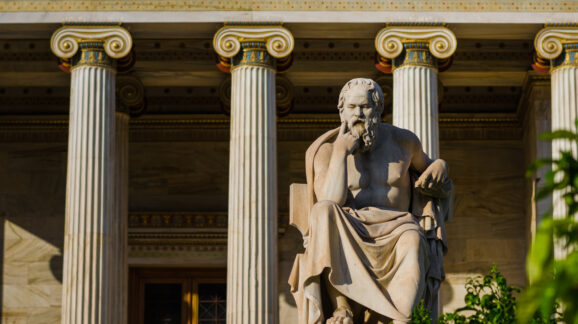
Photo Credit: Getty
Johan Norberg’s latest book, Peak Human, is a history of golden ages. After starting in Ancient Greece and then Rome, Norberg tours the Abbasid Caliphate in the Middle East, Song Dynasty China, Renaissance Italy, and the Dutch Golden Age of the 1600s. He ends with the post-1800 wealth explosion that began in England and continues today.
Today’s golden age differs from its predecessors in two ways. It has lasted longer, and it is global. Norberg’s project is to understand why that happened, and how to keep the process going. For all that the current Great Enrichment has already done to fight global poverty, there is still more work to do.
Roughly 8 percent of the world’s population still lives in extreme poverty, defined as making no more than $2.15 per day. This is both the lowest proportion in all of human history, and still far too high. This century’s defining project will be getting that number as close to zero as possible.
Liberalism and markets are the tools for the job, but only if political leaders and popular sentiments allow them to emerge. This is unlikely in the current moment, with illiberal populism on the rise on both the left and especially on the right.
Norberg provides another useful service by debunking mistaken theories about golden ages. On page 10, he argues that “golden ages are not dependent on geography, ethnicity, or religion, but on what we make of these circumstances.” In other words, golden ages are about ideas.
Openness is the most important of those ideas. Openness to strangers and foreigners, to different languages and different religions, openness to commerce, and openness to new technologies and new ways of life are all important golden age ingredients.
Peaceful interactions tend to be positive-sum. When two people trade with each other, they both make the other better off, otherwise they would not agree to a deal in the first place. This is different from war, conquest, and status, which are at best zero-sum. With trade, everyone can have more.
In order for one society to have more territory, another must have less. In order for one person to gain social status, another must have less. With commerce, everyone can be better off, even if they speak different languages or worship different gods. Commerce incentivizes people to help each other instead of fight each other, and to build on each other’s achievements in a process of continuous improvement. Every golden age in Norberg’s book provides its own proof. Golden ages happen when people find positive-sum ways to cooperate, and reject zero-sum conflicts as best they can.
This will sound familiar to readers of Norberg’s 2020 book Open, which I reviewed here. Where that book was more about philosophy and economics, Peak Human is a history book, grounded in stories about real people and events.
Norberg argues that population density is another golden age ingredient. This is an overlooked point, although Julian Simon emphasized population density in his work, and Marian Tupy and Gale Pooley explore it in great detail in their book Superabundance. Even so, the benefits of a large, dense, and growing population tend to get overlooked in a post-Paul Ehrlich Population Bomb world.
The denser the population, the more likely that diverse ideas will collide, compete, cooperate, multiply, and evolve. They will also spawn whole new ideas. This is why efflorescences only happened in societies with cities. Jericho, the world’s oldest known city, is only about 6,000 years old, compared to humanity’s 200,000-year history. For the vast majority of humanity’s time on Earth, golden ages were impossible. There were too few people, and they were not connected enough.
Density alone is not enough. There must also be cultural values that favor freedom. If innovators are shunned by society, few people will want to innovate. Any innovations that do occur will not be widely adopted. So culture matters, too.
That is why the oldest known golden age, Periclean Athens, is only about 1 percent of the way back in humanity’s history. If that 200,000 year history were a year-long calendar, Athens’s efflorescence wouldn’t happen until after Christmas. Since that golden age only lasted about 50 years, Socrates, Sophocles, Pericles, and all the other Greek golden age figures would have existed for just a few hours on that year-long calendar.
Seen in proper context, all of the cultural achievements, technology, and mass prosperity that we take for granted today are very, very recent. Even agriculture wouldn’t show up until December on this calendar.
Golden ages are precious things. But they cannot be forced. One of Norberg’s most important observations is that golden age cultural values must emerge from the bottom up, not be imposed from the top down.
Political and religious leaders tend to dislike disruption and dissent, and will clamp down on it when they can. Even positive cultural values tend not to stick in a society if they are seen as imposed from above by outsiders. They must emerge organically from within. This lesson was most recently learned from American foreign policy adventures in nation-building after 9/11.
One reason golden ages tend not to last is that there is a natural tendency for bottom-up cultures to ossify into top-down dictatorships that preserve the status quo. Athens’s greatness lasted for about two generations. While the Roman state lasted more than two millennia, from Rome’s mythical 753 BC founding, through its split into Eastern and Western halves, the West’s fall in 476 AD. The Eastern half survived as the Byzantine Empire until Constantinople’s fall to the Ottomans in 1453 AD, its golden age was only about a tenth of that, roughly from Augustus’s accession in 27 BC until Marcus Aurelius’s 180 AD death.
After that, Roman civilization declined due to a combination of causes that historians are still debating. The decline in political cultural openness that Norberg emphasizes was very much part of the story.
Fortunately, the Roman Empire’s neighbors in the Middle East were ready to pick up the baton it dropped. This is where Peak Human gets really interesting.
The Abbasid Caliphate that ruled large parts of Arabia and Persia preserved Greek philosophers such as Plato and Aristotle that were becoming forgotten in Europe. Abbasid culture valued the life of the mind, and encouraged its own geniuses in philosophy, medicine, and science. Baghdad emerged as the greatest city in the world. The English words for algebra, alcohol, alchemy, chemical, and gibberish are all loan words from this period.
Averroes, Al-Jabr, and a number of great thinkers were active in this period. Its citizens prospered from long-distance trade with peoples throughout Asia and Africa. But in the end, a growing rejection of openness led to the end of the Abbasid golden age. The Middle East has yet to recover.
Song Dynasty China offers similar lessons. Its rulers, who reigned from 960-1279 AD, allowed trade and commerce and let new technologies flourish. The result was the world’s richest society. But they hunkered down in response to Mongol invaders who eventually took power as the Ming Dynasty. Despite creating beautiful pottery made possible in part through Song-era prosperity, Ming rulers destroyed ocean-worthy Song ships and banned nearly all foreigners in the name of security.
If not for Ming isolationism, the New World would likely have been discovered by Chinese explorers rather than Columbus. The price of this security was mass poverty and the end of a golden age.
The centuries of stagnation that followed meant that China fell behind the rest of the world, leading to the Century of Humiliation China endured that Xi Jinping seeks to avenge today.
It would be more than a century until the next Golden Age, which happened a continent away in Italy. A growing interest in openness to new ideas led to a rediscovery of classical thought, a renewal of trade and commerce led initially by Venice and then by Florence, and a tolerance of eccentric geniuses such as Leonardo da Vinci and Michelangelo, who in earlier ages might have been shunned or ostracized.
Brunelleschi’s dome in Florence was a triumph of innovation in math, engineering, and architecture. It also nearly never happened due to public skepticism of Brunelleschi’s then-radical architectural ideas. Eventually, though, vested political and church interests won out. The Renaissance fizzled, as golden ages tend to do.
The Dutch nearly kicked off the world’s first sustained golden age in the 1600s. While the rest of Europe was embroiled in wars of religion, the Dutch practiced toleration, which made their lands a destination for thinkers and inventors from Locke to Spinoza.
They embraced innovation and permissiveness in science and engineering, if only out of necessity. Since most land in the Low Countries is below sea level, the Dutch were in a constant battle to build and maintain a network of levees and dikes to survive.
They also turned to trade, specializing in making connections and creating value for people around the world. Dutch art might look mundane, with its household scenes and portraits of ordinary people doing ordinary things. But this signaled a sea change in both values and prosperity. The very ocean the Dutch kept at bay was also the source of their prosperity and cultural achievements.
Art was traditionally controlled by political and religious authorities. This is why most medieval art is of kings, battles, and religion. The Dutch golden age was wealthy enough for artists to make a living without powerful patrons.
For the first time, regular people could afford to have their portraits painted. Artists could paint the world around them, rather than glorifying the state.
All of these golden ages provide lessons for today’s Great Enrichment. One is their fragility. They utterly depend on cultural values like openness. These values are always under attack from those in power, special interests who want to preserve their cozy arrangements, and popular fears of change and disruption.
Is our golden age different? It still has the same opposing forces, whether it’s populist political movements who want to roll back cultural and economic changes, the politicians who pander to them, or the eternal popular nostalgia for simpler times.
Norberg has one nostalgia-related argument that is true for both supporters and opponents of progress. The first rule of romanticizing the past is, don’t romanticize the past.
Not everything about golden ages was golden. Athens and Rome had brutal slavery, as did the other golden ages. The Abbasid Empire was not a golden age for women’s rights. Even Renaissance Italy allowed only so much dissent, as Machiavelli found out the hard way. Dutch trade was paired with a brutal imperialism that violated what would come to be called human rights across hemispheres.
Let us not romanticize these aspects of golden ages. But we can use them as lessons for how to make today’s golden age even better and more sustainable. We still have serious social problems such as racism, sexism, anti-Semitism, and poverty. Just as national conservatives are mistaken to point back to a fictional idealized version of 1950s America, progress-minded liberals must not overlook the darker sides of golden ages, including our own.
People have accomplished great things in the last 2,000 years, with most of them coming in just the last 200 years. Norberg makes this very clear in Peak Human’s tour of history. But he is just as clear that there is more to do, and there are pitfalls to avoid. For the world to continue improving, people need to believe in the values that enabled our current state of prosperity: openness, progress, and liberalism.