Diary of deconstruction: White House releases 2026 Unified Agenda of Federal Regulations

Photo Credit: Getty
Since 1983, the often-tardy semiannual Unified Agenda of Federal Regulatory and Deregulatory Actions (the Agenda) has surveyed recently completed and forthcoming rulemaking priorities across dozens of federal departments and agencies.
The Trump administration quietly released a 2026 edition over Independence Day weekend, the first since the lone 2025 volume last September. Since this edition carries the “Regulatory Plan” label traditionally associated with the fall Agenda, it is likely to be the only edition issued this year.
A brief preamble celebrates the Declaration of Independence, “American greatness,” and salutes Trump’s “unmatched deregulatory record.” But instead of fireworks, this new Agenda received the damp-squib treatment, which is unfortunate. Its rule tallies are consistent with continued success in the administration’s one-in, ten-out campaign touted in December.
During the first Trump administration, the Regulatory Plan was accompanied by extensive year-end updates on the success of one-in, two-out initiative, complete with detailed breakdowns of dollar savings. Even last year, press releases accompanying the Agenda emphasized the streamlining campaign, invoking “overreach” and the need to “rightsize” government. This time there is a reference to an anticipated $1.5 trillion in regulatory cost savings, but without supporting detail or agency boasting. The deconstruction energy is just not there.
In any event, the Unified Agenda catalogs recently completed rules, proposed and final rules, and planned rules in the pipeline. The 3,954 entries in the new edition, curiously enough, represent the highest count since 2012. Counterintuitively, that too could have been celebrated. A rule cannot simply be eliminated in pursuit of deregulation; under the Administrative Procedure Act, a replacement rule typically must be drafted. The elevated rule count reflects, at least in part, a substantial number of streamlining-oriented actions such as rescissions, withdrawals, de-prioritizations, and enforcement relaxations.
Despite the Agenda’s large pipeline, final rulemaking is not actually expanding. There have been only 1,519 final rules published so far in the Federal Register, meaning the administration remains on track for another of the lowest annual rule counts on record. The net count is even lower, since many of those rules are deregulatory. The table below breaks the Agenda’s entries down by stage and level of economic significance.
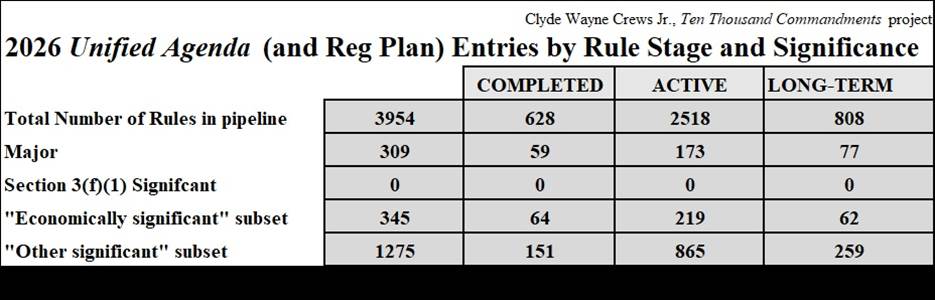
Active rulemakings (Pre-rule, proposed, and final): 2,518 of 3,954
Active rulemaking actions include pre-rule documents and proposed and final rules anticipated or prioritized for the near future. The active rule count of 2,518 is up from 2,098 in last year’s edition.
Rules often linger across multiple Agenda editions before completion. In the 2026 edition, 893 active entries appear for the first time — similar to last year but substantially more than the 680 appearing across the spring and fall Agendas during Biden’s final year. Trump’s elevated number of new entries partly reflects reversals and rollbacks that add to the rule count even as conventional notice-and-comment regulation has slowed.
Completed actions: 628 of 3,954
Completed actions are those finalized since the prior Agenda, typically covering the previous six months (until the publication schedule became derailed under Trump). In any event, the tally of 628 compares with 911 in Trump’s lone 2025 Agenda and with Spring 2024’s 689, when Biden was issuing rules at a rapid pace.
A cursory review of completed actions on the Unified Agenda website indicates that dozens are streamlining-oriented, although not all are necessarily deregulatory:
- 18 “removal of” entries.
- 14 “extension” entries.
- 3 administrative simplifications.
Notably, 126 completed actions (down from 183 last year) appear in the Agenda for the first time, compared with just 45 in Fall 2024. Such completions without prior notice may be less surprising now that Trump’s executive orders prioritize speed and encourage use of the Administrative Procedure Act’s “good cause” exemption to remove rules — although not to the degree some had hoped — rather than its traditional use for adding them.
Long-term actions: 808 of 3,954
Long-term priority rulemakings — those anticipated beyond a 12-month horizon — stand at 808, roughly unchanged from last year and above Biden’s fall 2024 total of 645. The Department of the Interior alone accounts for 143 of these. Overall, 100 long-term actions appear in the Agenda for the first time.
345 high-dollar economically significant rules
Economically significant rules in the pipeline (those with at least $100 million in economic effect) have jumped to 345 from 243 in last September’s edition, but as we surveyed at mid-year, a significant number of the administration’s significant rules are deregulatory in nature and tend to offset one another in apples-to-apples comparisons, leaving ample opportunity for less-significant rules and guidance matter to pick up the slack for purposes of the one-in, ten-out objective.
Other criteria, such as raising novel legal or policy issues, can also classify a rule as major, as shown in the table above. But economic significance continues to receive the greatest attention.
Diary of deconstruction
Overall, the Trump era, as reflected in the Unified Agenda, may be remembered as one of America’s premier chronicles of getting things undone — a period in which a federal government doing less became an explicit governing objective.
But bureaucracy is sticky. The Agenda and the Regulatory Plan still do not point toward eliminating entire departments such as Education. Plenty of conventional, albeit less significant, rulemakings continue apace, and they remain burdensome in their own right. And in the final analysis, a future progressive administration would be able to resume conventional regulation with the same vigor seen under Joe Biden or Barack Obama.
Moreover, regulation encompasses far more than notice-and-comment rulemaking. Trump’s interventions — including tariffs, industrial policy initiatives, government equity stakes in private firms, and other rule equivalents — can offset or even overwhelm gains achieved through streamlining conventional regulation. It is also unfortunate that the administration has not returned the Unified Agenda to its legally contemplated, twice-yearly publication schedule.
Independence Day was a fitting occasion to release another chapter in the story of regulatory deconstruction. Whether the administration writes the next chapter with greater enthusiasm remains to be seen.