Mid-year 2026: Is Washington actually deregulating?

Photo Credit: Getty
It’s June 30, mid-year 2026 — almost America’s birthday. In terms of conventional issuance of rules and regulations in the Federal Register, the Trump administration continues to set records for “inactivity” and pursue a value of principled federal neglect.
The year-to-date reductions aren’t as striking as during 2025 — the first year of Trump 2.0 and the first year of the administration’s “one-in, ten-out” regulatory operating mode — but the results remain notable and are to be encouraged.
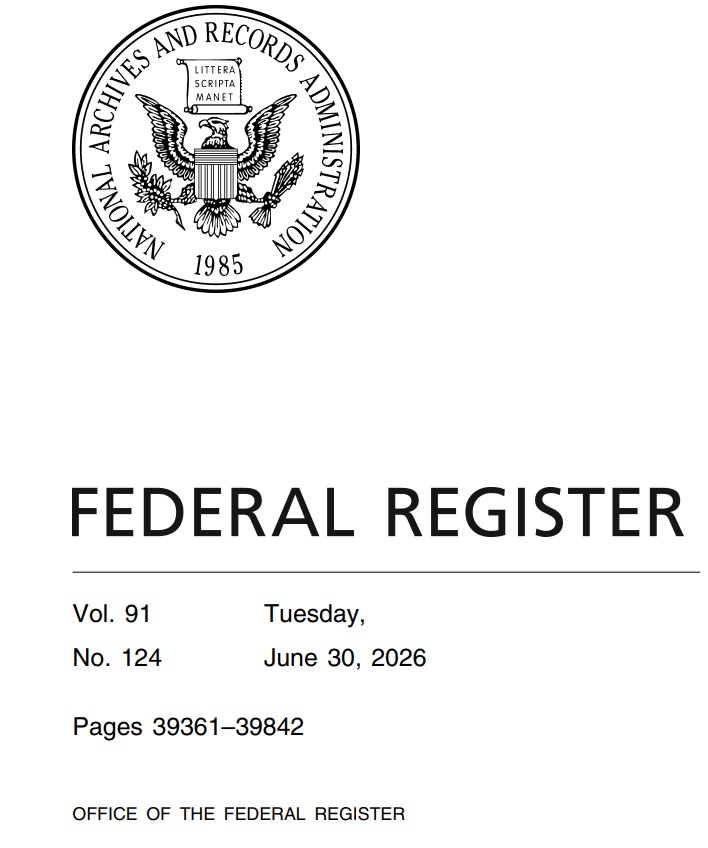
Today’s Federal Register tops out at 1,454 final rules, on track to land at fewer than 3,000 rules at year-end, which has happened only twice before in history, both times under Trump. Many rules are intended to be deregulatory under this administration, leading to a lower effective net tally. (By comparison, at the midpoint of 2025, the Register contained only 1,255 rules across a notably slender 28,799 pages.)
Incongruently, today’s volume — 39,769 pages — appears headed toward one of the highest page counts on record. However, deregulatory rules — repeals, withdrawals, postponements and effective-date delays, technical corrections, rescissions, removal of requirements, streamlining measures, fee reductions, and sunset provisions — can increase page counts even as they reduce regulatory burden. Unwinding older mandates often generates significant Federal Register activity, particularly as more complex regulatory regimes are targeted.
For purposes of the administration’s “one-in, ten-out” campaign, while 110 of the 1,454 final rules are deemed “significant” under Executive Order 12866 (meaning they carry at least $100 million in anticipated annual economic effects), 59 (more than half) appear deregulatory, as the preliminary tally below indicates.
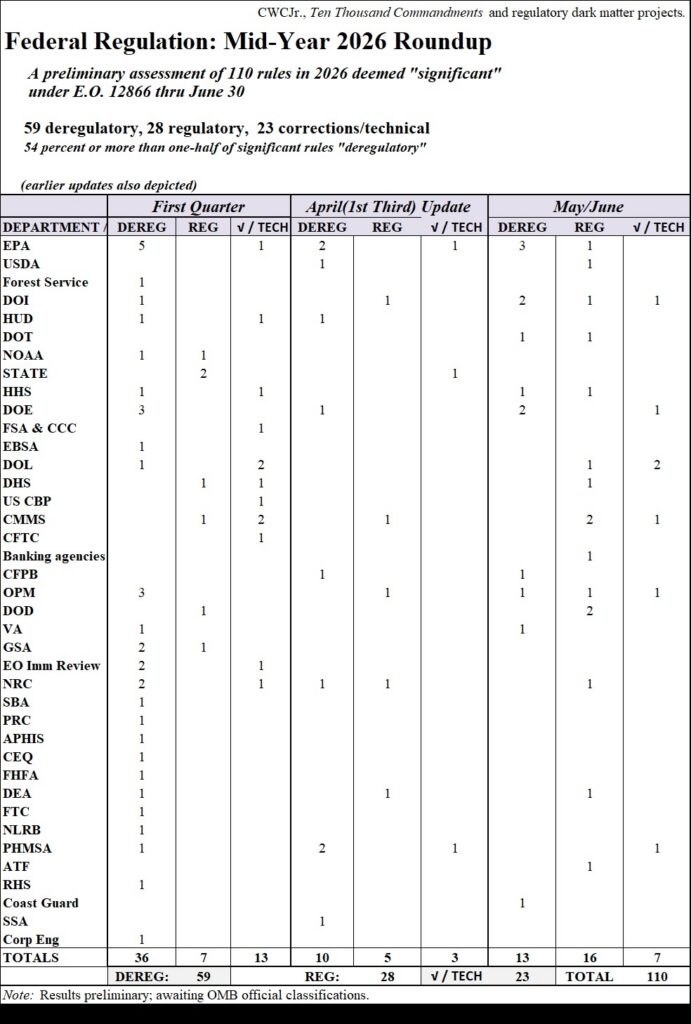
Twenty-eight of 2026’s significant rules appear more conventionally regulatory, while the remaining 23 consist of corrections, clarifications, and technical adjustments. Under the one-in, ten-out policy, these 28 significant regulatory actions must be offset. Those offsets need not come exclusively from other significant rules; minor rules and deregulatory guidance documents not captured in this chart also contribute to the total.
Even so, these 28 conventionally regulatory rules — on an apples-to-apples basis — are already offset two-to-one by significant deregulatory measures. Whether the full “one-in, ten-out” target materializes across all rule categories remains to be seen, but the direction is unmistakable: agencies are spending more time undoing than doing.
The takeaway is that the executive order is having real effects, with gross rule counts at historic lows and a substantial share of actions being deregulatory in character.
Complicating this picture are Trump administration interventions outside conventional rulemaking — such as tariffs, antitrust actions, price-related interventions, and, most notably, industrial policy and partial nationalizations of private firms. These swamp dynamics can function as rule-equivalents even when they do not appear in Federal Register tallies. Sub-regulatory guidance and statutory mandates likewise shape regulatory burdens beyond what formal rule counts or “one-in, ten-out” accounting captures.
At the year’s midpoint, the Spring 2026 Unified Agenda of Federal Regulatory and Deregulatory Actions — formally outlining agency priorities and progress — has yet to appear. The most recent edition remains Spring 2025, released late last year. When a new Agenda or other formal update is released, this preliminary tally can be refined.
As it stands, significant deregulatory or likely deregulatory actions since our last update on April 30 include: reduced incident-reporting burdens from the Coast Guard; simplified electric export authorization and the insertion of sunsetting provisions in certain Department of Energy rules; streamlined vetting procedures by the Office of Personnel Management; streamlined migratory bird hunting rules and certain endangerment designations from the Fish and Wildlife Service; an EPA site-specific hazardous waste treatment variance and extended compliance timelines and installation flexibility for refrigeration systems; streamlined National Environmental Policy Act procedures at the Department of Veterans Affairs; removal of obsolete vehicle safety requirements by the National Highway Traffic Safety Administration; and rescission of land use planning regulations by the Bureau of Land Management.
Deregulatory actions — through repeals, withdrawals, delays of effective dates, technical corrections, rescissions, requirement eliminations, streamlining initiatives, fee reductions, sunset provisions, and more — remain a defining feature of the Trump 2.0 regulatory agenda. Taken together, these actions reflect an experiment in administrative restraint. The “one-in, ten-out” framework continues to reshape the character of rulemaking itself.
The first half of 2026 reinforces a lesson that first became apparent in 2025: reducing the volume of federal regulation has not produced administrative chaos. It produces the kind of liberty that will be widely celebrated this weekend.
For further detail on Trump’s deregulatory actions in 2026 in lieu of an official Unified Agenda, see:
“Federal regulation 1st quarter 2026 report: Bureaucracy on the back foot,” Competitive Enterprise Institute
“Deregulation by the numbers: One-third into 2026 — a rulebook rewrite?” Competitive Enterprise Institute