Halfway through the 119th Congress, CEI’s Agenda is turning into action

Photo Credit: Getty
As the 119th Congress reaches its halfway mark, it is a good time to look back on what lawmakers have done in the past year.
At the start of each Congress, CEI publishes a pro-growth agenda for Congress to serve as a governing roadmap for lawmakers. The most recent edition lays out concrete recommendations across more than a dozen policy areas, including restoring congressional control over independent agencies, repealing costly climate and energy mandates, and clearing out regulatory barriers that hold back growth.
With a new governing trifecta in Washington, the 119th Congress began with a historic opportunity to enact real change. One year in, how have lawmakers performed?
So far this term, Congress has introduced nearly 11,000 legislative items, of which 68 have been signed into law. Against that backdrop, how does CEI’s Agenda for Congress stack up at the halfway point? Here are the topline findings from our progress report:
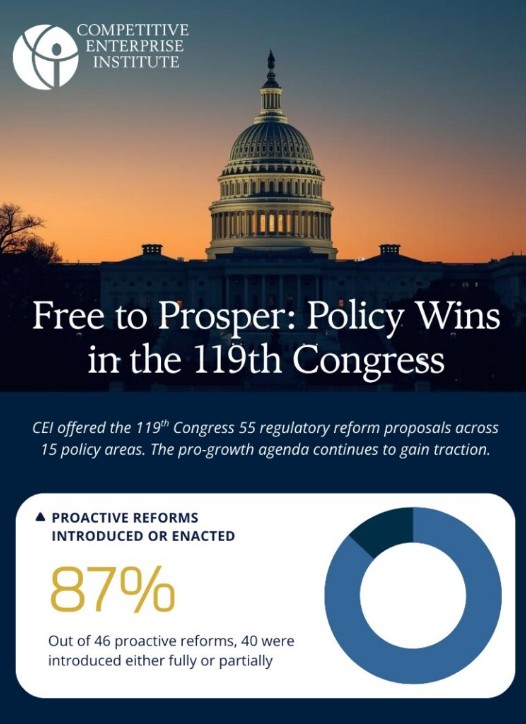
- 87 percent of CEI’s proactive policy recommendations have been introduced or enacted.
- 40 of 46 proactive reforms have been introduced in full or in part.
- 26 reforms were introduced as full reforms and another 14 were introduced as partial reforms.
- 4 of these reforms passed Congress and were signed by the president.
- Of the handful of policies we warned Congress against pursuing, zero have been enacted.
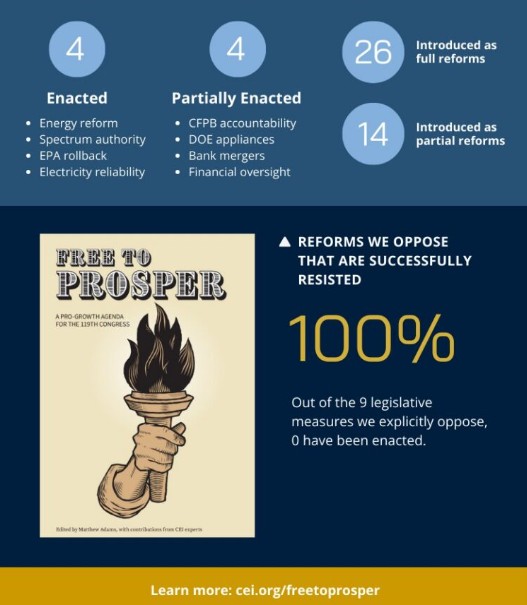
For clarity, we classify a policy recommendation as enacted in full when a measure matches the Agenda’s proposal and we classify a recommendation as partial if Congress advanced the core goal but fell short on some elements.
Behind the topline numbers are several clear policy wins.
First, lawmakers have begun unwinding the Inflation Reduction Act’s (IRA) energy and climate agenda by enacting significant rollbacks of IRA era green energy spending, including provisions in the One Big Beautiful Bill Act aimed at clawing back and repealing key green subsidies, which CEI highlighted. Congress can still go further, but this represents substantial progress toward reversing the Biden administration’s Green New Deal agenda.
Second, Congress has begun pushing back on costly climate regulation by using the Congressional Review Act (CRA) to overturn many climate related regulatory actions, including moving to nullify the Biden era DOE rule that effectively targeted gas fired tankless water heaters, an effort CEI supported through a coalition letter urging passage of the CRA resolution. These reversals remove specific mandates and make it harder for agencies to simply reissue substantially similar rules without new authorization.
Third, Congress has taken a concrete step toward reasserting control over the Consumer Financial Protection Bureau (CFPB) by changing the bureau’s funding limits through enacted law.
Specifically, H.R. 1, known as the One Big Beautiful Bill Act, lowered the CFPB’s funding cap from 12 percent to 6.5 percent of the Federal Reserve’s operating expenses, a reform CEI supported. Lawmakers also advanced CRA disapproval resolutions to overturn specific CFPB rules, including S.J. Res. 18 (disapproving the CFPB overdraft lending rule) and S.J. Res. 28 (disapproving the CFPB digital payment apps larger participants rule). It is not yet a full return to appropriations style oversight, but it is meaningful movement toward restoring accountability to an agency designed to operate at arm’s length from Congress.
Overall, this midpoint snapshot shows a strong conversion of CEI’s policy agenda into real legislative action. In a Congress where most proposals never become law, it is worth noting that so many CEI recommendations have been introduced and that a meaningful share have already been enacted.
Still, Congress has a long way to go, and the clock is ticking. The second half of the 119th Congress is where lawmakers can turn momentum into durable reform by moving introduced bills across the finish line. The reforms laid out in CEI’s Agenda are not wishful thinking, but practical policies Congress can pass today. If Congress wants to get serious about fixing the problems faced by Americans, CEI’s Agenda for Congress is a good place to start.