Medicaid enrollment has returned to Pre-Covid levels

Photo Credit: Getty
During the pandemic, not surprisingly, Medicaid, the government-administered insurance program for low income Americans, enrolled more Americans than ever before. While some growth would be expected during an economic upheaval caused by a health crisis, a less organic source of growth was Congress’ continuous enrollment requirement. Based on the Families First Coronavirus Response Act of 2020, states were prohibited from removing Medicaid enrollees from Medicaid, even if they had an alternative source of insurance.
Consequently, the Medicaid rolls grew throughout 2021 and 2022. They peaked in April of 2023, at nearly 95 million, more than one in four Americans. On the eve of the pandemic, Medicaid enrollment was less than 72 million.
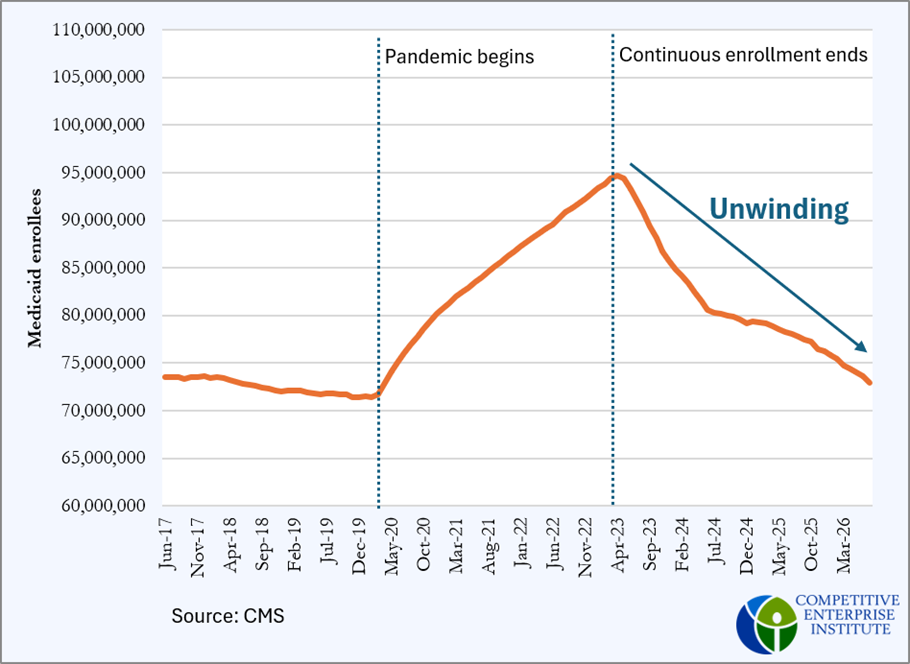
The unwinding took place in two phases. In the initial phase, the continuous enrollment requirement gradually phased out for states. But after the phase-out, there were still some waivers and exemptions for children that continued to reduce enrollment. In addition to that, improved economic conditions further shrank Medicaid.
As of May of 2026, the percentage of Americans on Medicaid fell below its pre-pandemic level, and has continued to decline since then.
It is somewhat surprising that enrollment has continued to fall, particularly since several states have expanded their Medicaid programs since the onset of the pandemic. The relatively small size of Medicaid might speak to the strength of the economy, low unemployment (the longest stretch of sub-4.5percent unemployment in history), and employers’ generosity in compensation.
Notably, too, the work requirements from the 2025 One Big Beautiful Bill don’t explain much of the change. They were not set to go into effect until January 1, 2027, but CMS recently announced they would allow states to delay implementation until July 2027. A handful of states have already begun implementation, but the data in the graph above is not yet recent enough to take that into account.
This disenrollment has largely gone unnoticed outside of Medicaid experts. The big health care debate of last year involved the extended subsidies for the Obamacare plans. Few have pointed out this significant (22 million) shift in insurance coverage over the past several years. According to the Census Bureau, between 2023 and 2025, the uninsured rate went from 8.0 percent to 7.9 percent, a 0.1 percentage point drop.
The incoming Congress has put repealing work requirements at the top of its agenda, but recent experience shows that Medicaid can be shrunk with few adverse consequences. Public insurance programs are problematic in many ways, and this disenrollment trend shows that the market can provide solutions as well or better.