RCP8.5: Climate establishment officially retires extreme scenario (Part II)
Photo Credit: Getty
Part I can be found here.
Victim of its own success?
Perhaps to save face or even boast of being right all along, some climate researchers claim RCP8.5 started out plausible but then motivated policymakers to subsidize renewables and enact emission reduction targets, rerouting the global economy to lower forcing trajectories. Pielke, Jr. recently wrote an entire column rebutting such claims.
As noted above, a scenario in which the world burns through 2.6 times proved fossil reserves by 2100 was always implausible. Moreover, it was hydraulic fracturing, not climate policy, that falsified RCP8.5 assumptions about surging demand for coal-to-liquids and coal gasification.
According to a recent Science magazine study, only 63 out of 1,500 climate policies implemented between 1998 and 2022 were successful. Those interventions collectively reduced global CO2 emissions by between 0.6 and 1.8 billion metric tons — between 0.07 and 1.8 percent of the 810 billion tons of CO2 emitted by fossil fuels and industry during that period. That is nowhere near enough to affect estimates of RCP8.5’s plausibility.
Was RCP8.5 a scam?
In principle, no; in practice, yes. RCP forcing trajectories are ostensibly selected not for their plausibility — information of primary interest to policymakers — but for analytic purposes of primary interest to researchers. For example, running climate models with a standardized set of forcing trajectories helps researchers compare climate models and understand how they differ.
In addition, models run with high forcing levels might reveal potential effects not seen when the models are run with more realistic pathways. Conversely, when models run with RCP8.5 do not project changes in, for example, fire weather, tropical cyclones, and river floods by 2100, scientists should be skeptical of studies claiming to detect such effects at today’s much lower forcing levels.
However, RCP8.5’s misapplication as a reference (baseline) scenario was as predictable as its propaganda value was obvious, and the seeds of RCP8.5’s conversion from forcing trajectory to socioeconomic projection were planted early. Although Riahi et al. (2011) do not call RCP8.5 the baseline scenario, they repeatedly refer to it as a baseline — a term they never use in connection with RCP2.6, RCP4.5, or RCP6.0.
AR5 also does not expressly call RCP8.5 a baseline or reference scenario. However, the entire analysis is structured around four RCPs: “one mitigation scenario leading to a very low forcing level (RCP2.6), two stabilization scenarios (RCP4.5 and RCP6), and one scenario with very high greenhouse gas emissions (RCP8.5).” The most natural inference is that RCP8.5 is what happens when governments do not implement any of the policy scenarios. After all, RCP8.5 is the analytic baseline against which the policy scenarios and their associated climate effects are compared and measured.
Nor is that all. In the AR5 Working Group III report on climate change mitigation, the range of baseline emission scenarios clearly encompasses RCP8.5.

NCA4 more pointedly fostered the misinterpretation of RCP8.5 as a plausible reference case by repeatedly advising policymakers to mitigate RCP8.5 emissions down to RCP4.5 levels (see, especially, NCA4, Volume II, Chapter 29).
Indeed, NCA4 reproduced a chart from Hsiang et al. (2017) in which RCP8.5 increases global mean surface temperatures by 8°C, depressing US GDP by 10 percent during 2080-2099. That became the key takeaway from The New York Times’ review of NCA4.

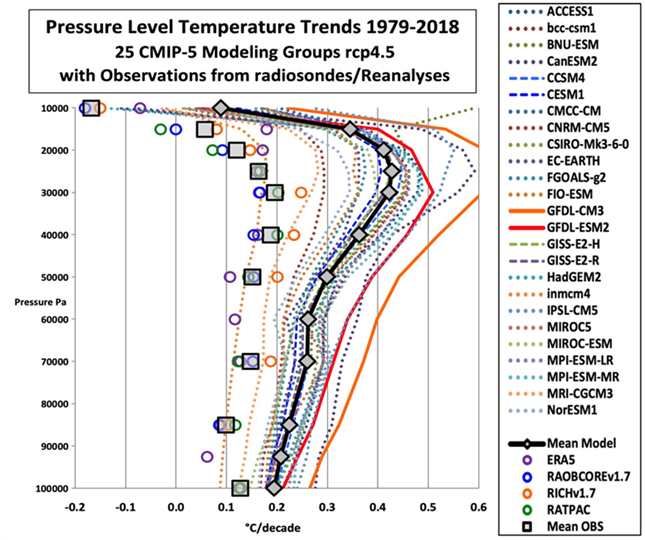
NCA4 did not mention that the CMIP5 models used to project RCP8.5 climate effects and economic damages repeatedly overshoot observed warming in the tropical bulk atmosphere.
Worse, NCA4 did not reproduce Hsiang et al.’s chart estimating the probabilities of RCP8.5-generated warming. See Figure 1A.
Even when warm-biased RCP8.5 is run with warm-biased models, global warming reaches 8°C in only 1 out of 100 simulations, an “exceedingly unlikely” outcome. Neither NCA4 nor The New York Times shared that information with the public.
An even more brazen example of RCP abuse was the Environmental Protection Agency’s June 2015 Benefits of Global Action report presenting the Obama administration’s scientific case for the Paris Agreement. The report specifically identifies an emissions scenario as hot as RCP8.5 as the business-as-usual reference case.
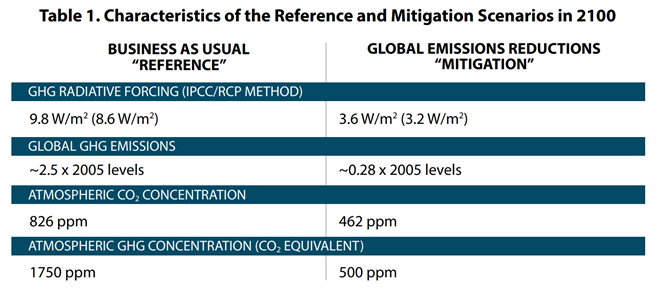
The report claims that by 2100, business-as-usual (8.6 W/m2) leads to 12,000 additional and preventable US annual heat-stress deaths and 57,000 additional and preventable US annual air pollution deaths. Those estimates have no credibility, as explained here.
What about the high-end SSPs featured in AR6? In AR6, the IPCC no longer beats around the bush, labeling SSP3-7.0 and SSP5-8.5 as reference scenarios and describing the latter as “A high-reference scenario with no additional climate policy.”
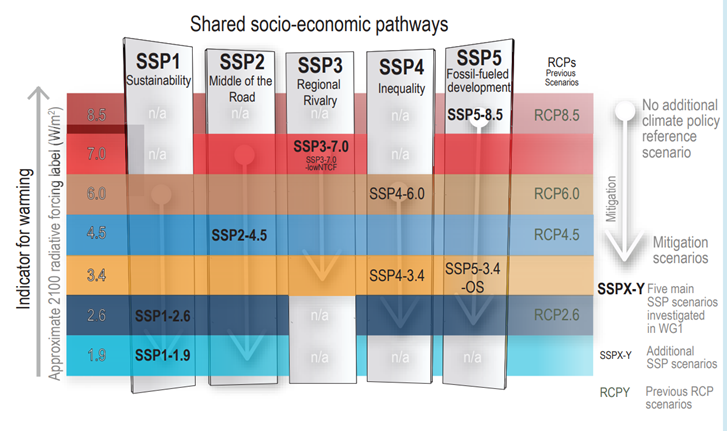
To sum up, although in theory researchers could innocently use RCP8.5 and SSP5-8.5 in “if-then” experiments to examine how different assumptions drive model outputs, the climate establishment has misused those scenarios as baseline projections, exaggerating the magnitude and certainty of climate change risks.
Conflicted science
By anchoring its assessment reports in implausible baseline scenarios, the IPCC orchestrated “the very literature that its main function was simply to assess,” Pielke, Jr. observes. The resulting alarmist tilt served the IPCC’s and USGCRP’s organizational interests, since those entities’ budgets, prestige, and influence critically depend on public perception of a climate crisis.
More broadly, RCP8.5-based analyses fueled demands for climate solutions requiring governments to tax more, regulate more, and spend more.
The conflicted nature of intergovernmental climate science largely explains why official acknowledgement of RCP8.5’s implausibility was so long in coming, and why the fight for scientific integrity in climate research is far from won.