RCP8.5: Climate establishment officially retires extreme scenario (Part I)

Photo Credit: Getty
Thanks to the scholarship, courage, and perseverance of a handful of independent researchers, notably Roger Pielke, Jr., Justin Ritchie, and Hadi Dowlatabadi, the UN-centric climate science establishment could no longer ignore the implausibility of RCP8.5, a high-end greenhouse gas (GHG) emissions scenario misleadingly portrayed over the past 15 years as a business-as-usual projection of impending climate disaster.
Many supporting actors contributed to this victory including contrarian blogs such as Watts Up With That and Climate ETC and free-market groups such as CEI and Heartland Institute.
For readers unfamiliar with this topic, RCP stands for “Representative Concentration Pathway.” The number 8.5 stands for the pathway’s estimated warming pressure (technically, “radiative forcing”) calibrated in Watts per square meter (W/m2). More on that below.
What happened?
Last month, the scientific committee that evaluates emission scenarios for the forthcoming Seventh Assessment Report (AR7) of the Intergovernmental Panel on Climate Change (IPCC) declared that RCP8.5 has “become implausible, based on trends in the costs of renewables, the emergence of climate policy and recent emission trends.” As discussed below, RCP8.5 was always an implausible projection of 21st century carbon dioxide (CO2) emissions. The committee also pulled the plug on SSP5-8.5, an even more unrealistic emissions pathway, as well as another upper-end scenario called SSP3-7.0.
This is a big deal. RCP8.5 underpins tens of thousands of peer-reviewed climate change impact studies, the climate “crisis” narrative, and numerous costly climate-themed regulations, some of which may now be more vulnerable to rollback or repeal.
Many miles to go
Pop the champagne bottles, but don’t get complacent — our liberties are not safe yet. The new AR7 high-end scenario still projects significantly higher emissions than credible recent forecasts. The research community still relies on climate models that persistently overshoot observed temperatures. Mankind’s remarkable capacity for adaptation, which has reduced global weather-related deaths by an order of magnitude every 50 years since the 1870s, never receives its due in official climate change risk assessments.
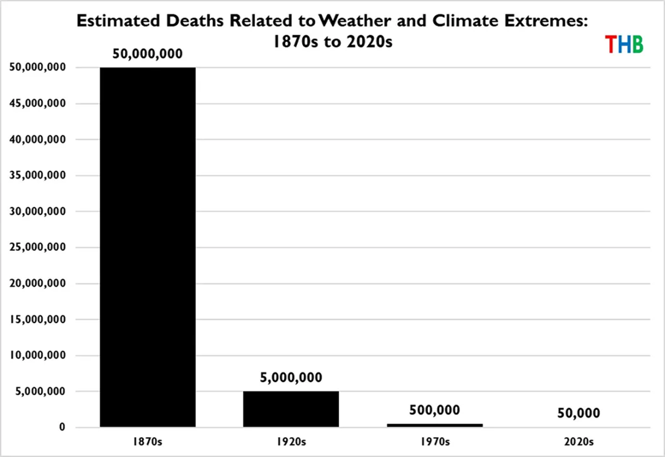
So, despite RCP8.5’s official retirement, intergovernmental climate science will continue to exaggerate both the physical effects of global warming and the harmfulness of those effects.
Background: RCPs, SSPs, radiative forcing, and GHGs
RCP8.5 is the high-end (and most frequently cited) emission scenario in the IPCC’s 2013-2014 Fifth Assessment Report (AR5) and the 2017-2018 Fourth National Climate Assessment (NCA4) of the US Global Change Research Program (USGCRP). SSP5-8.5 is the high-end (and most frequently cited) scenario in the IPCC’s 2021 Sixth Assessment Report (AR6) and the USGCRP’s 2023 Fifth National Climate Assessment (NCA5).
The “8.5” in each scenario refers to its radiative forcing, a key concept in climate science. Radiative forcing is an estimate, in watts per square meter (W/m2), of how an externally-imposed perturbation — such as a change in total solar irradiance, Earth’s albedo (reflectivity), or atmospheric composition — alters Earth’s energy balance.
Positive radiative forcing occurs when the Earth absorbs more energy than it emits back to space, which tends to warm the planet. Negative radiative forcing occurs when the Earth emits more energy than it absorbs, which tends to cool the planet. Greenhouse gas emissions are positive forcing agents. They absorb and reradiate some of the longwave infrared heat from Earth’s surface and atmosphere that would otherwise directly escape to space.
An RCP is an emissions and concentration scenario used to provide climate change impact models with a prescribed trajectory of radiative forcing. RCPs are called “representative” because their forcing levels in 2100 — 2.6, 4.5, 6.0, and 8.5 W/m2 — cover the range of published model-based projections (called integrated assessments) linking economic activity, energy use, emissions, and climate effects.
A Shared Socioeconomic Pathway (SSP) is a scenario describing how the global economy might develop over the 21st century and beyond, in the absence of climate policies. AR6 and NCA5 used five main storylines. Future economic development might prioritize sustainability concerns (SSP1), continue current trends (SSP2), replace globalization with regional rivalry (SSP3), exacerbate inequality (SSP4), or unleash fossil-fueled development (SSP5).
More precisely, AR6 and NCA5 used five hybridized SSPs — storylines modified so that each economic future reaches a forcing level comparable to a corresponding RCP. SSP5-8.5 is the name of the SSP5/RCP8.5 hybrid.
Implausible baselines
The chart below is from Riahi et al. (2011), a study by RCP8.5’s creators. Look at the left-hand panel. To emit enough CO2 to create a positive forcing of 8.5 W/m2, global coal-based energy would have to increase nearly 10-fold during the 21st century, achieving a market share not seen since about 1950.
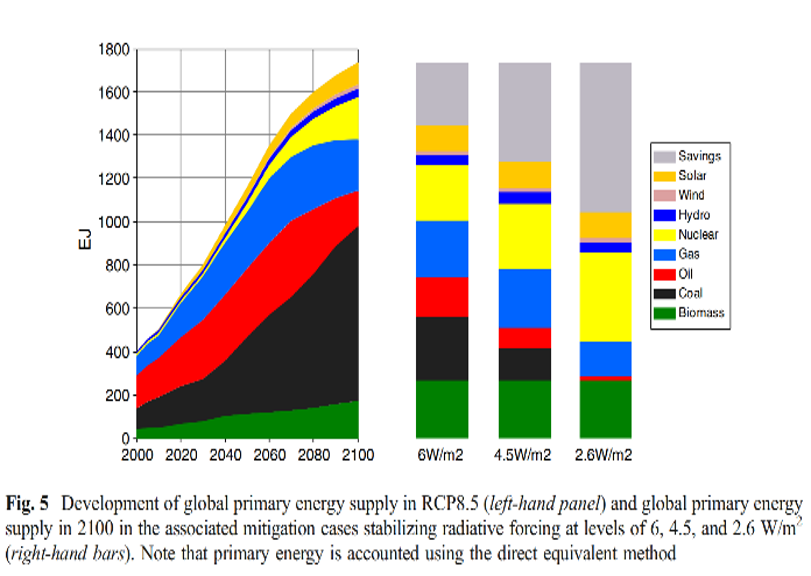
Nobody today expects a return to coal or anything similar. More importantly, it was never a credible energy market forecast.
Developed in 2010, RCP8.5 projects roughly 7,300 gigatons of CO2 emissions during the 21st century. That is approximately 2.6 times larger than British Petroleum’s June 2010 estimate (2,800 gigatons) of CO2 emissions embedded in global proved reserves of coal, oil, and natural gas. The Energy Transitions Commission in November 2023 estimated embedded CO2 emissions at 3,130 gigatons. Higher than BP’s 2010 estimate but not enough to change the big picture.
Dubious assumptions about population growth (too high) and energy efficiency improvement (too slow) also contribute to RCP8.5’s implausibility. More importantly, RCP8.5 was conceived in apparent ignorance of hydraulic fracturing.
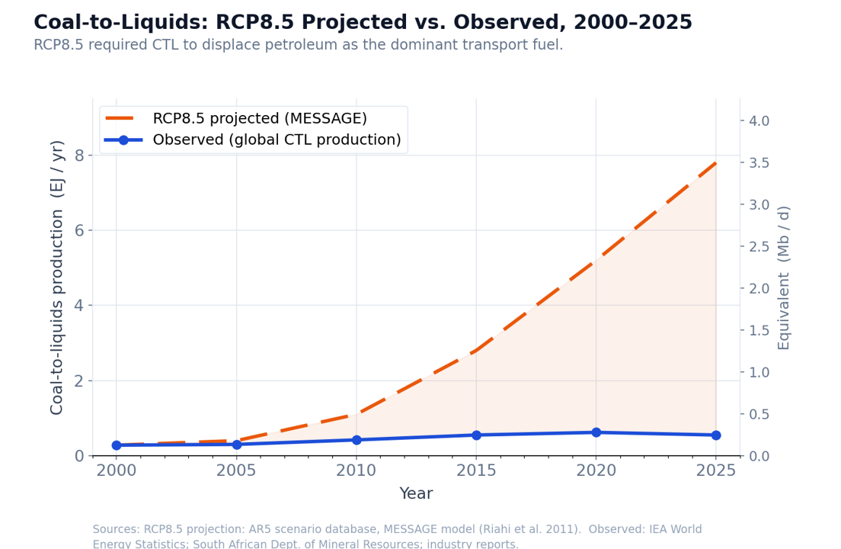
Although the Shale Revolution began in 2007, Riahi et al.’s description of the “RCP8.5 energy system” does not mention shale gas, hydraulic fracturing, or directional drilling. Many scenario developers in the 2000s assumed oil and gas would become increasingly costly to extract, significantly expanding demand for coal-to-liquids for motor fuel and gasified coal for electricity generation (Ritchie and Dowlatabadi, 2017). That did not happen.
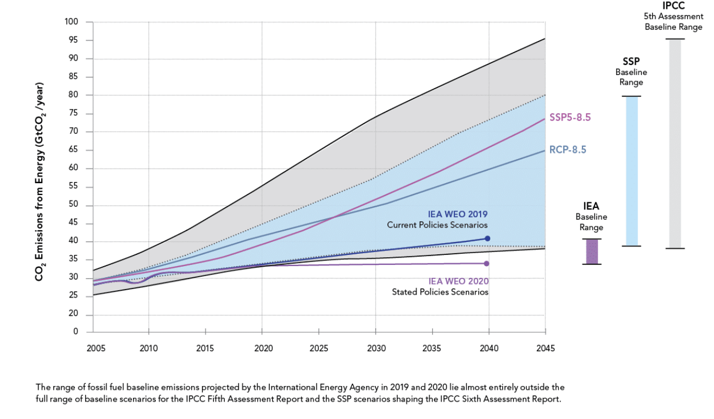
RCP8.5’s implausibility became increasingly evident as later projections estimated lower emissions. Ditto for SSP5-8.5. For example, Hausfather and Peters (2020) found that SSP5-8.5 emissions in 2050 were more than double those projected by the International Energy Agency’s (IEA) baseline emission scenarios (“pledged policies” and “stated policies”). See this chart.
Similarly, Pielke, Jr. and Ritchie (2021) showed that the “range of fossil fuel baseline emissions” projected by the IEA in 2019 and 2020 “lie almost entirely outside the full range” of IPCC RCPs and SSPs and way below the top ends of those ranges.
The next big shoe to drop was Rennert et al. (2022), a set of updated emission baselines published by Resources of the Future (RFF). Informed by IEA and other market forecasts, the RFF baseline contains less than half the CO2 emissions projected by SSP5-8.5 in 2050 and less than one-fifth those projected in 2100.
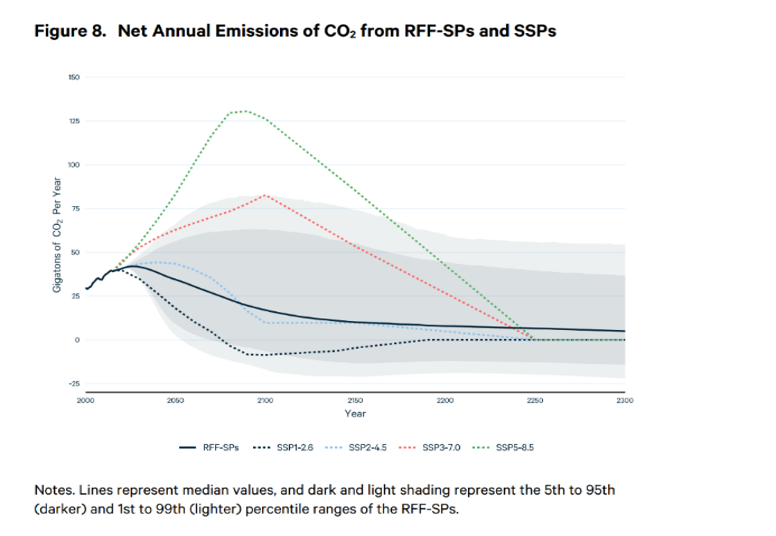
The RFF baseline closely aligns with SSP2-4.5, the “modest mitigation scenario” that results in 2.5°C of global warming by 2100, compared to 5.0°C in SSP5-8.5, according to Hausfather and Peters (2020). However, the RFF baseline may itself be out of date.
Pielke Jr. et al. (2022) argue that the most realistic emission scenario is not SSP2-4.5 but an even cooler scenario, SSP2-3.4. Assuming the IPCC’s central estimate of climate sensitivity (how much the Earth warms from a doubling of CO2 concentration), SSP2-3.4 results in 2.0°C-2.4°C of global warming by 2100.
Part II can be found here.