RCP8.5: Dead and buried
Photo Credit: Getty
On April 29, American Enterprise Institute scholar and Substack author Roger Pielke, Jr. announced that RCP8.5, the high-end emission scenario that dominated the climate change impacts literature over the past 15 years, is “officially dead.” Then, on July 15, he broke the news that RCP8.5 is not, to quote the Wizard of Oz, “only merely dead;” it is really, most sincerely, dead.
This is a big deal. RCP8.5, and its offspring, an even more unrealistic emission scenario called SSP5-8.5, underpinned tens of thousands of peer-reviewed studies, propped up the climate “crisis” narrative, and “informed” — or rather, misinformed — numerous costly climate-themed regulations.
Pielke, Jr.’s April 29 article reviewed a preprint of Van Vuuren et al. (2026), a paper co-authored by members of the “scientific steering committee” responsible for developing emission scenarios for the forthcoming Seventh Assessment Report (AR7) of the Intergovernmental Panel on Climate Change (IPCC). The committee declared RCP8.5 to be “implausible, based on trends in the costs of renewables, the emergence of climate policy and recent emission trends.”
The committee developed a new set of emission scenarios for AR7, including a new high-end scenario that projected cumulative carbon dioxide (CO2) emissions about 40 percent lower than those of SSP5-8.5, the most frequently cited emission scenario in the IPCC’s 2021 Sixth Assessment Report (AR6).
Pielke, Jr.’s July 15 article examines the “final versions” of the steering committee’s new scenarios as “they have emerged from integrated assessment models (IAMs), updating the placeholders that accompanied their April announcement.” Here is how the April and final high-end scenarios compare to SSP5-8.5.
Cumulative emissions during 2025-2100 are 7,380 Gt CO2 in SSP5-8.5, 4,349 Gt CO2 in the committee’s April draft analysis, and 3,438 Gt CO2 in the updated July analysis.
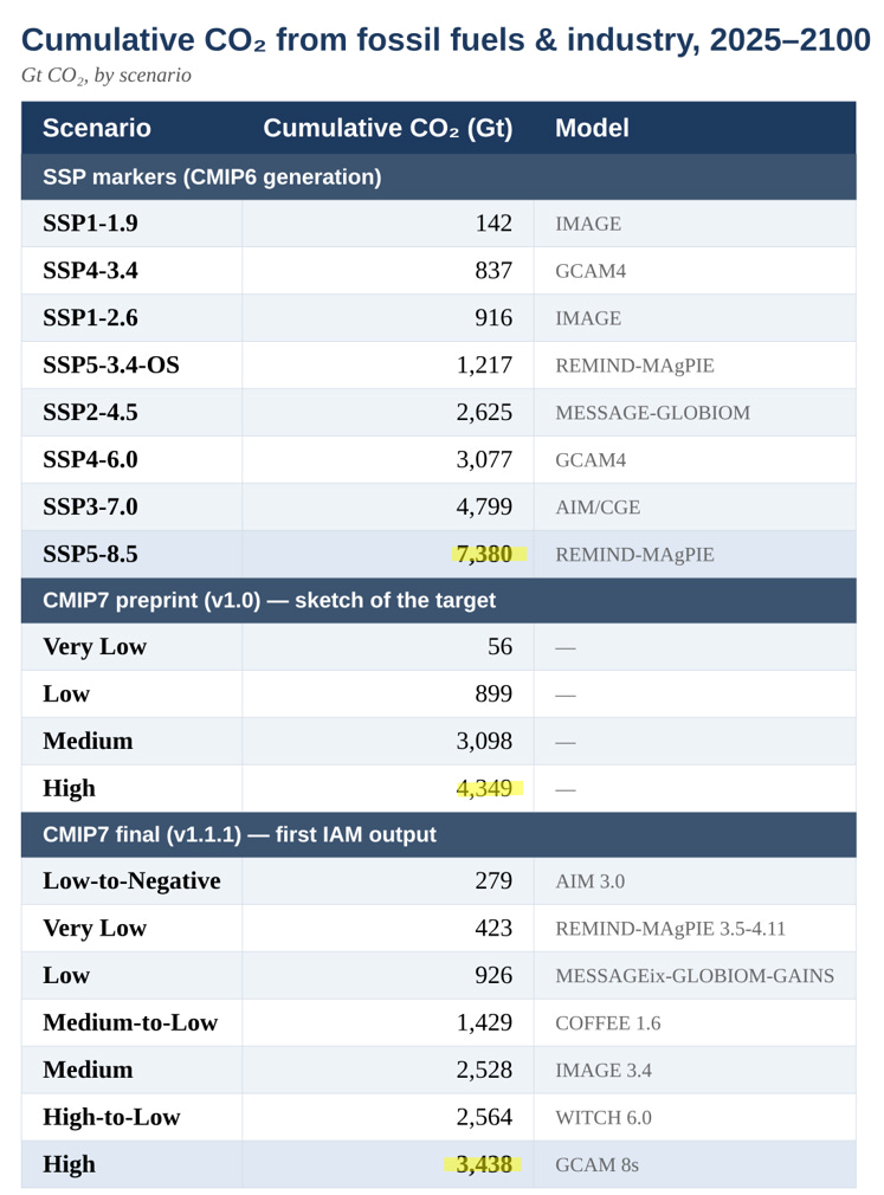
In other words, in April, the committee proposed a new high-end emission scenario with 41 percent lower cumulative CO2 emissions than SSP5-8.5. In July, the committee updated its high-end emission scenario, which now has 53 percent lower CO2 emissions than SSP5-8.5.
There is, of course, much more to this story. RCP8.5 was never plausible as a reference case or “no policy baseline” scenario, nor was it originally designed for that purpose. Yet legions of experts who presumably knew better portrayed it as a plausible or even likely projection of humanity’s fate absent ambitious new climate policies. For further discussion, see my two-part commentary, “RCP8.5: Climate establishment officially retires extreme scenario.”