State Directed Payments redistribute money across states and supercharged growth

Photo Credit: Getty
Differences in states’ use of SDPs cause an interstate redistribution of taxes as well. Because states are setting different levels of SDPs, spending varies across states. Federal tax money, however, is raised nationwide.
In total, SDPs cost federal taxpayers $93 billion in 2026, according to the Kaiser Family Foundation, though other estimates are larger. Using this estimate and allocating it evenly across all Americans results in an estimated $274.13 on average per person whether they are enrolled in Medicaid or not. Conversely, SDP use varies across states. States heavily using SDPs spend around $900 per person while 10 states have no SDPs. Even residents of states without SDPs finance the other states’ through their federal tax dollars.
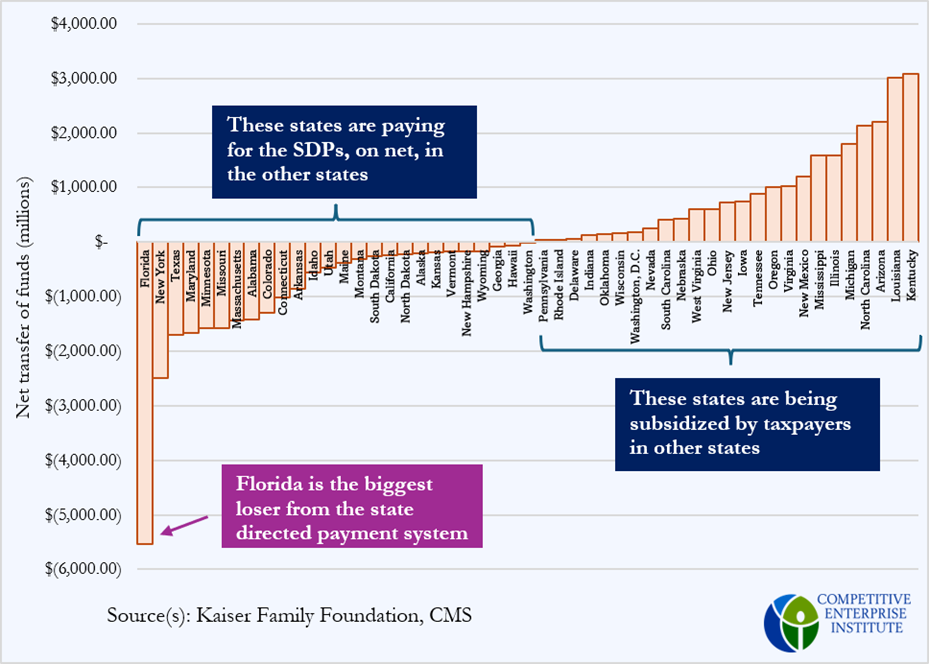
Assuming the cost of the SDPs is distributed uniformly across all Americans, the biggest loser is Florida, as its use of SDPs is relatively low. Florida’s federal SDP spending is about $889 million, yet if total federal SDP spending were divided across all Americans, Floridians would pay $6.4 billion of the total SDP bill. Under that assumption, Florida would send about $5.5 billion to other states disproportionately using SDPs. New York and Texas are also substantial net contributors to the SDP system. Kentucky, Louisiana, North Carolina, and Arizona are the largest gainers in dollar terms.
Per capita, Floridians are still among the largest net contributors and losers from the scheme, but the Great Plains states, and the Northeast states are paying more than they’re getting out. Missouri, Arkansas, Alabama, Alaska, and Texas are also payers, on net.
Incentives lead to uncontrolled growth
The incentives on the states, allowing them to grow programs without fully paying for them, cause unplanned and harmful growth. Since 2020, total State Directed Payments have grown from $26 billion in annual spending to $137 billion in 2026, a fivefold increase. Meanwhile, national GDP has risen by 50 percent. This means SDPs have grown more than eight times faster than the national economy. The Office of the Actuary projected that, before the OBBBA was passed, SDPs were expected to grow to $296 billion by 2034, greatly exceeding the growth in the economy.
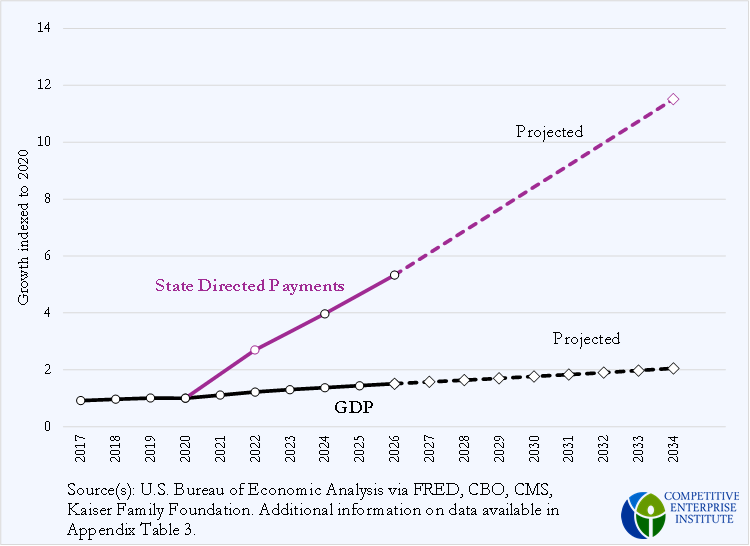
This growth is a direct result of states’ uncapped ability to expand these programs and costs that are subsidized externally, meaning the costs to the states of implementing these programs are artificially low.
Conclusion
The state directed payment system redistributes funds from some states to others and systemically encourages such redistribution at a national scale, leading to rising costs and deficits, distortions, and the diversion of resources toward financing mechanisms rather than services.
The OBBBA’s limits on Medicaid managed care State Directed Payments are economically justified because they reduce incentives for states to shift Medicaid costs to federal taxpayers, limit interstate redistribution, and restrain the rapid growth of payment arrangements that have expanded far faster than the broader economy.
Explore more on this topic: