The regulatory costs we still aren’t counting

Several years ago, I assembled a “Costberg” working paper surveying the largely impenetrable and undisclosed costs of regulation. The project grew out of several simple observations: Office of Management and Budget (OMB) cost tallies for conventional regulations were highly incomplete even on their own terms; many federal economic and social interventions occur outside conventional rulemaking; and the pursuit of ever more comprehensive government control by progressives who populate the permanent bureaucracies implies a denial of regulatory costs altogether. These unfortunate realities can render much of the cost-benefit analysis purportedly taking place little more than an accounting fiction.
Overall, Washington’s expertise is not in cost-benefit analysis but rather in placing most forms of government intervention outside the regulatory ledger and beyond accountability. Accordingly, the annual Ten Thousand Commandments report includes an informal compilation of unmeasured, disregarded, and unfathomed costs of federal intervention. Here’s an abbreviated version:
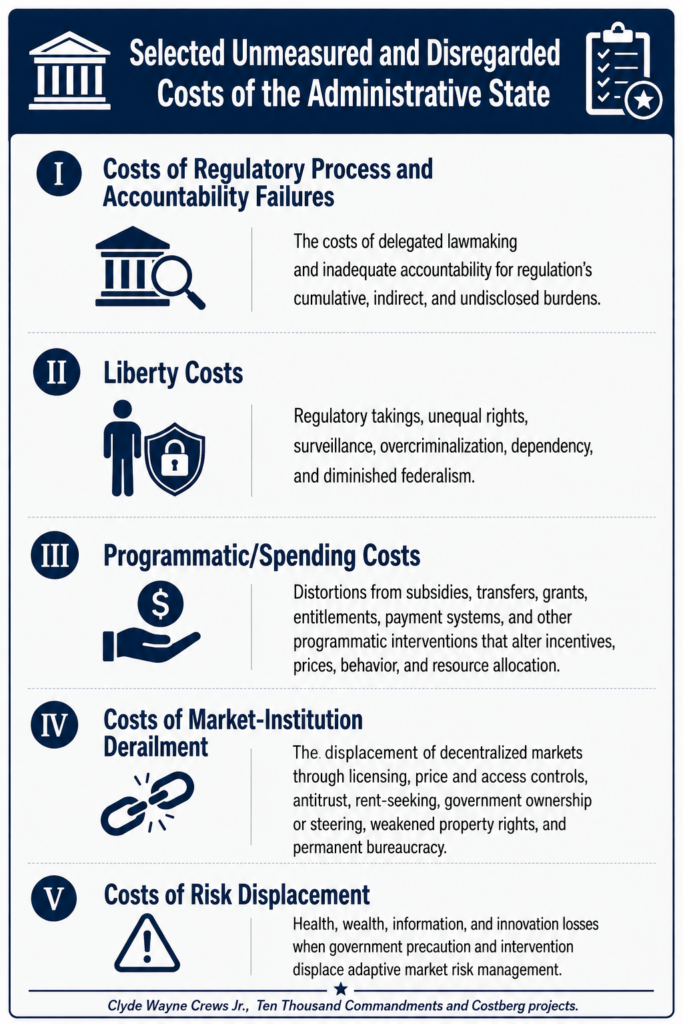
The recent appearance of the Trump administration’s Spring 2026 Regulatory Program and Unified Agenda of Federal Regulatory and Deregulatory Actions (Agenda) marks an occasion for policymakers to reflect upon Part III of the diagram above: Programmatic/Spending Costs.
The Agenda depicts 3,954 rules at various stages — pre-rule, active, and recently completed — of which 345 are considered “economically significant,” or bearing at least $100 million in annual economic effect. For the purposes of Executive Order 14192 (“Unleashing Prosperity Through Deregulation”), the 64 rules comprising the “recently completed” subset are of special interest. Of these, 25 were deemed deregulatory and 12 were deemed regulatory, which exceeds a two-for-one ratio on an apples-to-apples basis. The implication is that the administration will eventually claim technical success in its one-in, ten-out endeavors, as it did in late 2025.
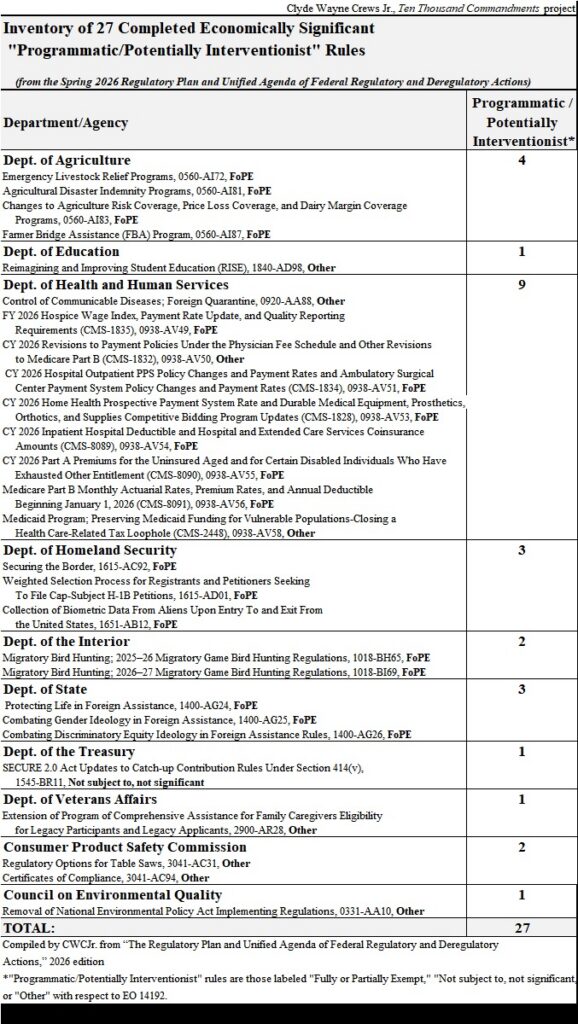
For present purposes, however, the remaining 27 rules, broken down in the Supplement below as Programmatic/Potentially Interventionist, are of greater interest. These represent entries from a somewhat more mysterious ledger, rooted in what the Office of Management and Budget has long referred to as budget and transfer rules. Such rules implement and administer federal programs involving transfers, payments, eligibility, and other forms of intervention, including changes to Medicare and Medicaid and government services, such as leasing and revenue collection requirements for federal lands.
Major budget and transfer rules are partially acknowledged with dollar amounts in each year’s OMB Report to Congress (whose lateness has given way to abandonment). But they are not included in OMB’s cost-benefit tallies. OMB has described budget and transfer rule effects this way:
[T]ransfer rules may…impose real costs on society to the extent that they cause people to change behavior, either by directly prohibiting or mandating certain activities, or, more often, by altering prices and costs.
So while these are not typically conventional command-and-control regulations like EPA emissions standards or OSHA workplace mandates, they establish, administer, expand, contract, or modify government programs involving grants, subsidies, insurance arrangements, benefit formulas, payment systems, and eligibility rules. They can impose compliance obligations on private parties, operate through guidance and administrative requirements, and constitute not merely part of government’s growth, but an increasingly important component of today’s escalating fusion of spending and regulation.
As the custodial entitlement state advances while the fiscal surpluses needed to sustain it have long since evaporated, the absence of Programmatic/Spending Costs from regulatory burden calculations and from in-versus-out rule compilations leaves a major blind spot. Their economic non-neutrality takes on growing significance as the second quarter of the 21st century opens. Even as wealth-transfer program administration increasingly regulates personal lives at the deepest levels, these interventions (now sought in response to changes being wrought by artificial intelligence) somehow manage to shed their fundamental identity as regulations or coercive interventions with each passing generation.
Ronald Reagan called Medicare “socialism” to universal jeers, as proponents insisted it would never lead to the broader government takeover of medicine now proposed by Medicare for All socialists. Should that come to fruition, Republicans can be expected to oppose it with precisely the vigor with which they now seek to dismantle Social Security and conventional Medicare.
So while not technically regulation for EO 14192 purposes or as OMB has historically used the term, economically significant budget and transfer rules represent federal economic management and intervention at scale. Among the current crop of 27 rules classified as “Fully or Partially Exempt,” “Not subject to, not significant,” or “Other” for purposes of the Trump administration’s EO 14192 accounting, we find:
- Department of Agriculture: Farmer Bridge Assistance (RIN: 0560-AI87): Federal payments and eligibility rules reshape agricultural incentives and market outcomes.
- Consumer Product Safety Commission: Regulatory Options for Table Saws (RIN: 3041-AC31): Even plainly conventional regulation can escape the regulatory ledger.
- Department of Agriculture: Agricultural Disaster Indemnity Programs (RIN: 0560-AI81): Federal disaster payments redistribute resources and influence production incentives.
- Consumer Product Safety Commission: Certificates of Compliance (RIN: 3041-AC94): Compliance certification and filing requirements affect manufacturers and importers.
- Department of Health and Human Services: Medicare physician payment revisions (RIN: 0938-AV50): Federal payment formulas governing hospitals, physicians, nursing facilities, home health providers, and others influence prices, investment, business decisions, and health care delivery.
The Trump administration’s one-in, ten-out experiment provides a useful new reason to create a Regulatory Program for Programmatic Rules (RPPR), particularly to track economically significant interventions. While some really are purely administrative or technical and probably ought not be counted as a regulatory “in” (such as State Department passport rules), many others expand federal involvement in markets, redistribute resources, alter incentives, or impose consequential obligations on recipients and private parties. They may escape conventional regulatory accounting while nevertheless operating as instruments of government intervention.
This submerged portion of the regulatory Costberg ought to be brought to the surface: less like a monster summoned from one of Lovecraft’s sunken cities than a part of government intervention that has been there all along, simply left beneath the official waterline.
Just as some departments and agencies are beginning to grapple with and publicize regulatory dark matter more generally, Washington should maintain a separate accounting track for programmatic rules alongside conventional regulation. Rules should be identified by program and accompanied by disclosures of transfer, administrative, and deadweight costs, along with significant coercive behavioral or paternalistic “nudge” features. Such accounting should also indicate whether a rule expands, contracts, or merely administers existing federal intervention.
This new endeavor would not diminish the accomplishments of the one-in, ten-out effort, which is marred instead by Trump’s tariffs, industrial policy, government equity stakes in private firms, and other rule equivalents. Rather, an RPPR would provide a practical demonstration of the proposition that the administrative state is far larger than the portion visible through conventional regulatory accounting and would make future reckonings far more meaningful.
Programmatic and potentially interventionist rules change incentives and the allocation of resources and, in doing so, can themselves reshape or displace voluntary institutions through which normal markets otherwise coordinate. Grappling with this horned difficulty is vital to ensuring that the gains achieved by streamlining conventional regulation are more than ephemeral.
We can celebrate genuine deregulation while still insisting on a more complete accounting of government intervention.
For more, see:
“A Brief Outline of Undisclosed Costs of Regulation,” Competitive Enterprise Institute
“Diary of deconstruction: White House releases 2026 Unified Agenda of Federal Regulations,” Competitive Enterprise Institute
“The Regulatory Costberg is melting — or is it? An update on Trump’s ‘one-in, ten-out’ initiative,” Competitive Enterprise Institute