The rules Congress never gets to see
The 1996 Congressional Review Act (CRA) has been used to overturn only a few dozen federal regulatory directives since its enactment, most during the two Trump administrations. Some 110,000 rules have been issued during that span.
It’s not a great streamlining record, but there’s another problem. The Government Accountability Office’s (GAO) FAQ reminds us that “The CRA requires an agency promulgating a rule to submit the rule to Congress and GAO before it can take effect.”
That reporting represents a formal marker that provides Congress the opportunity to issue a CRA “resolution of disapproval” for expedited reversal of a covered rule. But many rules go unsubmitted and are arguably unlawful.
That is, considerably more rules get finalized in the Federal Register than are ever submitted to GAO, raising questions of legitimacy. We know of the gap because GAO maintains an online database of submitted rules (there’s an official form for agencies to use) that contains considerably fewer entries than the number of rules finalized in the Federal Register. Guidance documents are also subject to some of these requirements, but compliance there is even more spotty.
This is not breaking news, but confirmation of a broken system. A 2014 Administrative Conference of the United States (ACUS) report called “Congressional Review Act: Many Recent Final Rules Were Not Submitted to GAO and Congress” found that, from 1997 through 2011, agencies submitted to GAO roughly 88 percent of the final rules published in the Federal Register. That did not mean the remaining 12 percent necessarily violated the CRA, since some Federal Register rules were and are outside the CRA’s coverage. But it provided a useful historical benchmark for submission compliance in the years after the CRA’s passage. Then something changed: the ACUS report found that, after GAO reduced its routine checks for missing submissions in 2011, the rate fell to about 71 percent by 2013.
Fast forward more than a decade, and the concern about unsubmitted rules highlighted by ACUS appears to be ongoing. By comparing gross counts of rules classified as “received by GAO” with rules in the Federal Register, covered rules still appear not to be properly reported to GAO.
Granted, no one-to-one mapping exists between the finalized population in the Register and the GAO-reported subset in any calendar year. But in each of the years 2020, 2021, and 2022, over 30 percent of rules in terms of flow were not reported to GAO by the reckoning appearing below. The years 2023 and 2024 were a bit better, at 25 percent and 28 percent, respectively.
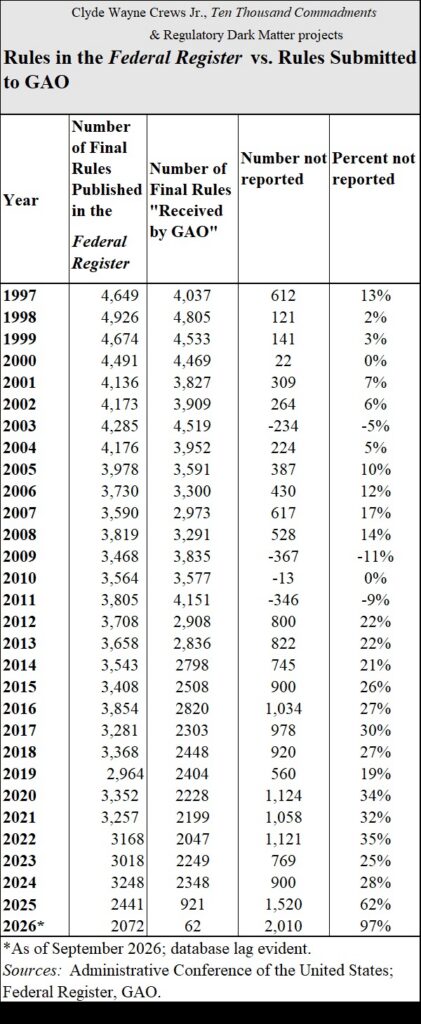
The two Trump years appear particularly stark, but there can be a lag in reporting rules to GAO that should improve those ratios in future surveys. (Indeed, as years of compiling the Ten Thousand Commandments report have revealed, it is not uncommon for regulatory archival databases to rewrite themselves slightly.)
The subset cannot be bigger than the whole, but the chart does show “overages” in some of the GAO counts compared to the full set represented by the Federal Register at times. This is likely explained by GAO posting in batches, some rules being applied to an adjacent calendar year, or lags between when rules land at GAO and when they get posted in the rules database.
In any event, since the CRA’s passage, hundreds of rules a year, sometimes more than 1,000, go unreported. Congress should require better mapping between the Federal Register, GAO’s database, and congressional receipt records. It should ask GAO, or the Congressional Research Service, to investigate what is actually happening with CRA compliance.
The GAO gap implies a significant population of “invalid” rules may be out there now. It gets worse, since as yet there is no readily available capability for tracking reporting (or lack thereof) to both Houses of Congress. One can observe some executive communications regarding rules in the Congressional Record, but even today nothing in the congressional archive or official process readily certifies compliance with the CRA on the congressional side. The status of federal agency guidance documents as covered “rules” for which almost no reporting exists further compounds the problem.
To be sure, many “non-compliant” rules and guidance documents may be “routine or informational,” but even seemingly inconsequential rules in areas such as health care, retirement, and insurance can displace what would have otherwise been robust private activity.
A quick remedy for the failure to report rules, and the broader problem of being unable to ascertain whether reporting happened, would be a legislative patch requiring prominent, simultaneous documentation of the reporting of covered rules to both GAO and Congress (for example, in the Federal Register and Congressional Record).
The formal presentment of rules and guidance to GAO and Congress is not a mere paperwork exercise; it is the mechanism that tells Congress and the public that a rule has entered the system and that Congress has the opportunity to review it. Members of Congress should not be reduced to having to root around to discover what may have slipped through the cracks.