Here’s how one-in, ten-out is successfully cutting rules — but not draining the swamp
Photo Credit: Getty
It’s October already, and while there’s no real fiscal year for federal regulation, the September 30 closing of the 2026 budgetary fiscal year marks a moment for another quarterly update on federal regulatory activity.
The upshot? In terms of issuance of conventional notice-and-comment rules and regulations in the Federal Register, the Trump administration continues to set records for inactivity and embody certain values of principled federal neglect. The most recent quarter, the July–September batch of “significant” rules, happens to be overwhelmingly deregulatory under the “one-in, ten-out” regulatory operating mode.
For context, the September 30 Federal Register revealed 2,238 final rules so far in 2026, placing us on track for 2,992 by December 31. If the administration successfully comes in at under 3,000 rules at year-end, that’ll mark only the third time in history that’s happened, all under Trump. Trump’s net counts are always even lower since even actions intended to be deregulatory nonetheless require a rulemaking proceeding.
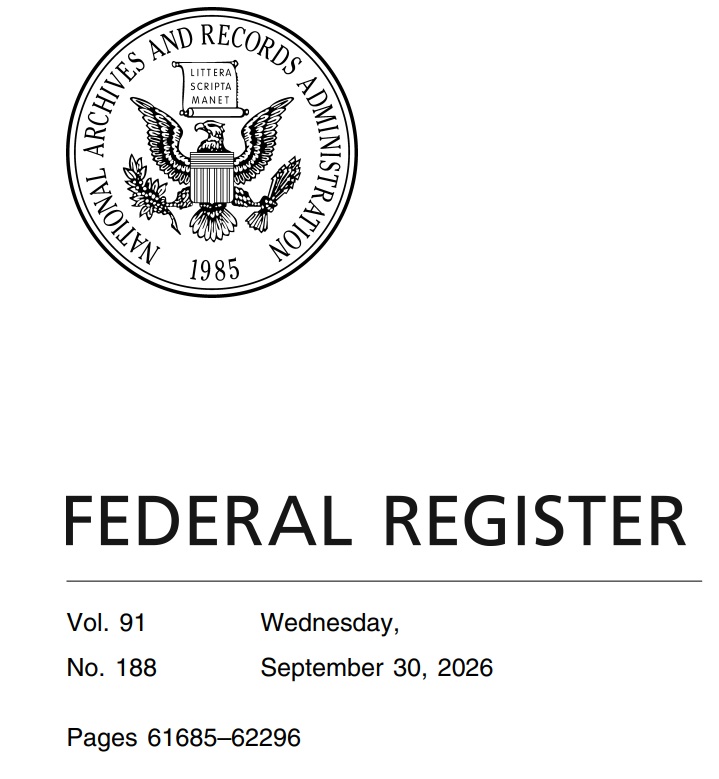
Incongruously, the September 30 Federal Register volume, at 62,296 pages (see the image below), appears headed toward one of the highest annual page counts on record. But again, Trump-era deregulatory actions like repeals, withdrawals, postponements and effective-date delays, technical corrections, rescissions, removal of requirements, streamlining measures, fee reductions, and sunset provisions require composing rules that increase page counts even as they potentially reduce burdens. Unwinding older mandates and complex regulatory regimes can generate significant Federal Register activity.
Notably, for purposes of the administration’s “one-in, ten-out” campaign, 166of the aforementioned 2,238 final rules are deemed “significant” under EO 12866 (meaning they carry at least $100 million in anticipated economic effects). However,86 of these rules (just over half) appear to be deregulatory, as the preliminary tally below indicates, while “only” 34 are regulatory. Forty-six rules occupy the corrections, clarifications, and technical adjustments category.
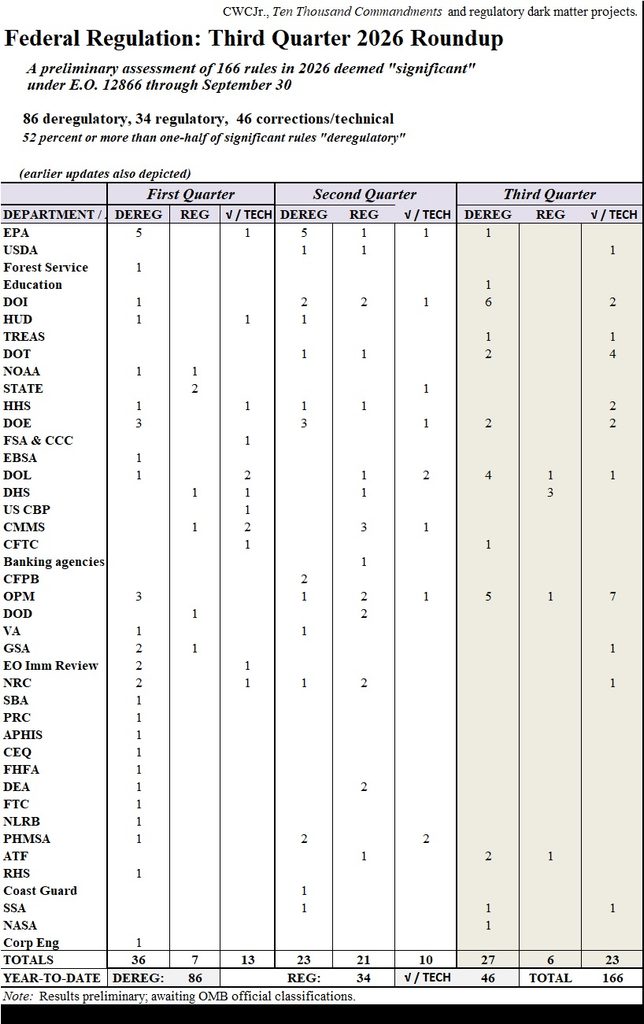
Perhaps the administration will prepare a formal update of “one-in, ten-out” on its own, but as it stands, significant deregulatory rules outnumber significant regulatory actions more than 2.5-to-one. For purposes of Trump’s program, non-significant regulatory actions (none of which are contained in the table) and even guidance documents can be used to offset significant rulemakings, so more than a two-for-one offset for significant rules on an apples-to-apples basis is impressive.
The just-completed third quarter is notable, with 27 deregulatory actions but only six significant regulatory ones, for a 4.5-to-one performance.
Regulatory measures include rail cargo reporting from the Department of Homeland Security and explosive materials storage reporting from the Bureau of Alcohol, Tobacco and Firearms at the Department of Justice.
But deregulatory rules are clearly the big story. Granted, there’s some subjectivity involved in my preliminary assessment in the absence of an official “one-in, ten-out” reckoning from the administration. Also, when a rule is merely a correction or technical change, or is truly regulatory or deregulatory, may sometimes be debated. With such caveats in mind, notable significant deregulatory or likely deregulatory actions since our last update on June 30 include:
- Rescission of disparate impact liability requirements by the Department of Education;
- NEPA environmental quality regulations from NASA;
- Margin streamlining and collateral option expansions from the Commodity Futures Trading Commission;
- Several endangered species- and critical habitat-related reforms by the Fish and Wildlife Service (Interior Department);
- Reduction-in-force-related rules and increased flexibility in probationary/trial employment from the Office of Personnel Management;
- Modification of disability affirmative-action requirements by the Department of Labor;
- Waste reduction in disability claim outcomes by the Social Security Administration;
- Power-plant rule revisions from the Environmental Protection Agency;
- Revisions involving biofuels and manufactured housing energy conservation from the Department of Energy (which unfortunately has also paused its “Zero-Based Regulating” rule);
- Reductions in stringency of Corporate Average Fuel Economy standards and NEPA environmental review documentation from the Department of Transportation.
We’ve presented here a shiny interpretation of the Trump deregulatory agenda. Offsetting it, as we never fail to point out, are the administration’s interventions and attempted crusades outside conventional rulemaking. These include tariffs, antitrust activism, price interventions, industrial policy, equity stakes in private firms, and agitations for subsidies of various kinds — even in the form of “dividends” to households (an inexplicable act that plays right into the hands of progressives in pursuit of a universal basic income).
Since they often do not take the shape of traditional notice-and-comment rules, Trump’s “swamp things” of this sort are unlikely to show up in our Federal Register roundups. If they did, the one-in, ten-out story would look considerably less rosy. The unavoidable conclusion is that Washington needs to expand its definition of regulation or risk mistaking a smaller swamp on paper for a smaller government in reality.
For more detail on Trump deregulation in 2026, see:
“Mid-year 2026: Is Washington actually deregulating?” Competitive Enterprise Institute
“Diary of deconstruction: White House releases 2026 Unified Agenda of Federal Regulations,” Competitive Enterprise Institute
“Federal regulation 1st quarter 2026 report: Bureaucracy on the back foot,” Competitive Enterprise Institute