What Trump’s vaccine executive order actually does

Photo Credit: Getty
Yesterday, President Trump signed an executive order directing federal health agencies to revise childhood vaccine recommendations, reducing the number of vaccines recommended for all children from 18 to 11.
Two things are worth keeping in mind.
First, the changes in the real world are less significant than the headlines might suggest. No vaccines are being removed from the market. No vaccine requirements are being changed; those are set by state and local governments. Insurance will still cover the same vaccines as before. All previously recommended vaccines will remain available to any family that wants them. Nothing has been banned.
Second, remember that both the president and the Secretary of Health and Human Services are politicians, not medical doctors. Nor are they scientists. For questions about vaccine safety and scheduling, Americans should consult their doctor to understand the potential risks and benefits. They should not be listening to politicians for medical advice.
What is actually changing
The federal childhood vaccine schedule has long organized its recommendations into categories. Universal recommendations cover vaccines recommended for all children. Risk-based recommendations cover vaccines for children with higher risks of contracting specific diseases. The final category — shared clinical decision-making — was first used in 2019. It is used when the benefits and risks for a given population depend on individual circumstances.
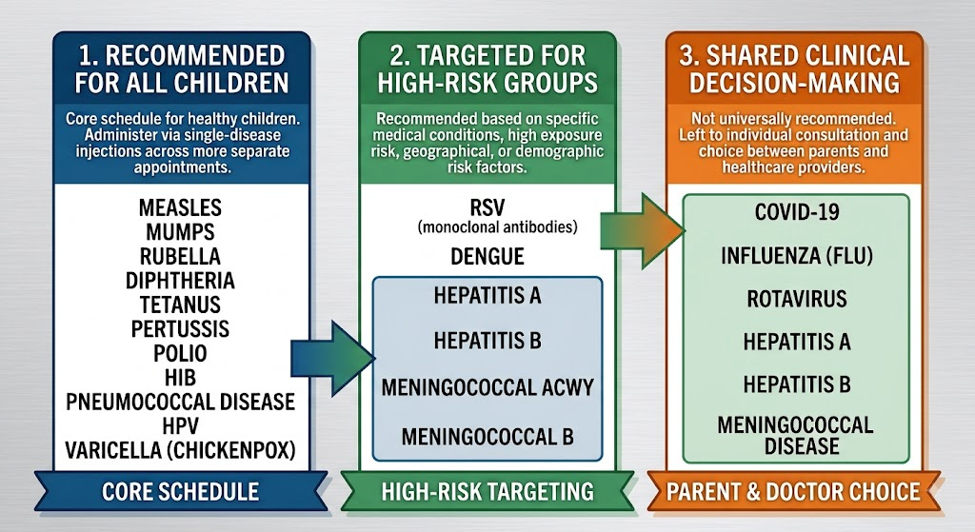
The new schedule, which the Trump administration has been building toward since January, moves several vaccines from the universal category into the risk-based or shared decision-making categories. The order places vaccines for hepatitis A and B, along with some meningococcal variations, in the risk-based category. Influenza, rotavirus, COVID-19, and meningococcal vaccines are now in the shared decision-making category. The vaccines remaining in the universal category include those for diseases people most associate with childhood immunization: measles, mumps, rubella, polio, diphtheria, tetanus, pertussis, HPV, and chickenpox.
The executive order also recommends breaking up the MMR vaccine, currently administered as a single combined shot for measles, mumps, and rubella, into three separate vaccines given individually, which would, ironically, require more injections. It additionally recommends spacing out vaccine visits generally, giving children more time between immunizations when possible.
The European comparison
The administration has cited European peer countries as reference points to defend these changes. Several European countries do organize their pediatric vaccine schedules along tiered lines, and the prior US schedule called for vaccination against more diseases than most of its European counterparts. Denmark, for example, universally recommends vaccines against roughly 10 diseases; in 2024, the US recommended 18. The reorganization of the schedule into universal, risk-based, and shared decision-making categories therefore has at least some precedent abroad. However, countries differ on which diseases they require vaccinations against.
The MMR comparison is less straightforward. European countries generally administer measles, mumps, and rubella as a single shot, and the individual vaccines recommended by the executive order do not currently exist on the US market. If there were meaningful clinical or consumer demand for separate measles, mumps, and rubella vaccines, manufacturers would produce them. The combined MMR exists because that is what the market has gravitated toward, though the CDC does purchase half of the MMR vaccines used. On this specific recommendation, the executive order has neither a foreign precedent nor a market signal behind it.
The federal government doesn’t need to be involved
Underlying this order is a more fundamental question: why does the federal government need to issue vaccine recommendations in the first place?
Synthesizing the clinical literature on vaccine safety and efficacy does not need to involve the federal government. It requires only researchers who can read and evaluate the relevant studies. This task is well within the capacity of a state health department, a city, or even a private medical organization. In fact, several private organizations already do exactly this. The American Academy of Pediatrics has published its own independent childhood immunization schedule since the 1930s. Its 2026 schedule, which diverges from the current CDC schedule on several points, is endorsed by 12 medical and health organizations representing more than one million physicians, pharmacists, and pediatric health professionals, including the American Academy of Family Physicians and the Infectious Diseases Society of America. The market for vaccine guidance can function without federal oversight and should be allowed to do so.
Federal involvement adds little beyond the possibility that a single set of recommendations is applied uniformly across the country. Differences between rural and urban areas may mean vaccination schedules should be more condensed or more spread out. States, cities, and private organizations are better positioned to tailor guidance to the needs of the populations they serve. The federal government’s role here is not essential. At best, it is unnecessary, and at worst, harmful.