There are two main areas in which Congress can enact meaningful reform. The first is to rein in regulatory guidance documents, which we refer to as “regulatory dark matter,” whereby agencies regulate through Federal Register notices, guidance documents, and other means outside standard rulemaking procedure. The second is to enact a series of reforms to increase agency transparency and accountability of all regulation and guidance. These include annual regulatory report cards for rulemaking agencies and regulatory cost estimates from the Office of Management and Budget for more than just a small subset of rules.
In 2019, President Trump signed two executive orders aimed at stopping the practice of agencies using guidance documents to effectively implement policy without going through the legally required notice and comment process.
Featured Posts
Blog
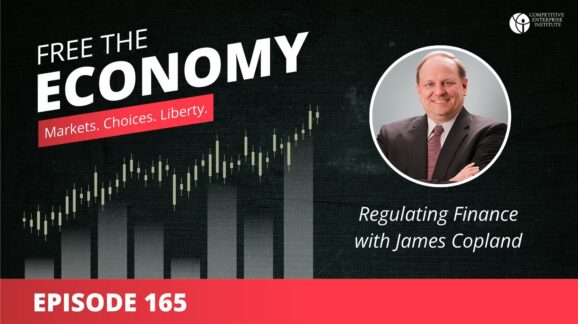
Free the Economy podcast: Regulating finance with James Copland
In this week’s episode we cover the 250th anniversary of Adam Smith’s Wealth of Nations, fighting fraud in broadband deployment, and cutting…

Blog
The week in regulations: Shellfish inclusion and paper manifest sunsets
The labor force shrank by 92,000 jobs in January. Oil prices spiked. Twenty-two state attorneys general filed a lawsuit against President Trump’s Section 122 tariffs.
Blog
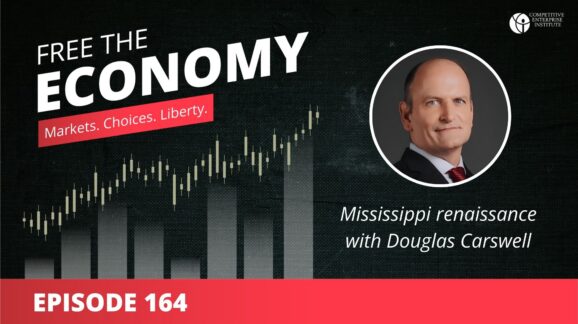
Free the Economy podcast: Mississippi renaissance with Douglas Carswell
In this week’s episode we cover housing abundance, capitalism’s approval rating, audits of state finances, and the consumer nostalgia of…
Search Posts
Products
Chapter 12: The 2024 Unconstitutionality Index: 44 rules for every law
Article I of the Constitution notwithstanding, administrative agencies rather than Congress do most of the lawmaking in the United States. Congress enacts weighty legislation but…
Products
Chapter 10: Federal regulations affecting state and local governments
State and local officials’ concerns over federal mandates’ overriding their own priorities and prerogatives resulted in the Unfunded Mandates Reform Act of 1995, the requirements…
Products
Chapter 11: Government Accountability Office database on rules and major rules
The federal government’s regulatory reports and databases serve different purposes. The Federal Register presents all proposed and final rules affecting the private sector, as well…
Products
Chapter 2: Why we need a regulatory budget
Well before Biden’s unique transformations, policymakers recognized a role for regulatory restraint, transparency, and disclosure. Federal programs are funded either by taxes or by borrowing,…
Products
Chapter 8: The “Regulatory Plan and Unified Agenda of Federal Regulatory and Deregulatory Actions”
Along with the Report to Congress, Federal Register, and Code of Federal Regulations, another vehicle for regulatory disclosure is the spring and fall editions of…
Products
Chapter 9: Federal regulations affecting small business
The aforementioned National Association of Manufacturers (NAM) report found that average annual per-employee regulatory costs to firms vary by firm size in a way that…
Staff & Scholars

Clyde Wayne Crews
Fred L. Smith Fellow in Regulatory Studies
- Business and Government
- Consumer Freedom
- Deregulation

Ryan Young
Senior Economist and Director of Publications
- Antitrust
- Business and Government
- Regulatory Reform

Fred L. Smith, Jr.
Founder; Chairman Emeritus
- Automobiles and Roads
- Aviation
- Business and Government

Sam Kazman
Counsel Emeritus
- Antitrust
- Automobiles and Roads
- Banking and Finance

Marlo Lewis, Jr.
Senior Fellow
- Climate
- Energy
- Energy and Environment