There are two main areas in which Congress can enact meaningful reform. The first is to rein in regulatory guidance documents, which we refer to as “regulatory dark matter,” whereby agencies regulate through Federal Register notices, guidance documents, and other means outside standard rulemaking procedure. The second is to enact a series of reforms to increase agency transparency and accountability of all regulation and guidance. These include annual regulatory report cards for rulemaking agencies and regulatory cost estimates from the Office of Management and Budget for more than just a small subset of rules.
In 2019, President Trump signed two executive orders aimed at stopping the practice of agencies using guidance documents to effectively implement policy without going through the legally required notice and comment process.
Featured Posts
Blog
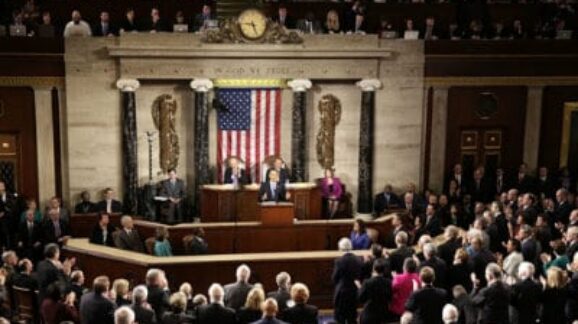
Trump’s SOTU conundrum: Deregulation today, swamp tomorrow?
Donald Trump’s 2026 State of the Union (SOTU) address presents an opportunity to confront the federal spending, entitlement, and regulatory behemoth in a new way…

Blog
The week in regulations: Grandfathered driver vision and socializing dogs
The Supreme Court declared President Trump’s IEEPA tariffs unconstitutional. The White House responded by enacting a 15 percent global tariff under a different statute. The…
Blog
Free the Economy podcast: What’s wrong with Congress with Kevin Kosar
In this week’s episode we talk about we talk about Consumer-Regulated Electricity, the amazing falling US poverty rate, and how smart…
Search Posts
Daily Caller
Hammertime: Japanese silver lining? Not hardly
Blog
Alcohol Regulatory Roundup: St. Patrick’s Hangover Edition
While you guzzled green beer and nursed the subsequent hangover, politicians and other interested parties were busy creating or preventing regulatory headaches of their own.
Blog
Are Text Messages an Antitrust Issue?
Text messages cost 20 cents to send, even though they use a fraction of a penny of bandwidth. What gives? Antitrust authorities want to know.
The Wall Street Journal
How Washington Ruined Your Washing Machine
It might not have been the most stylish, but for decades the top-loading laundry machine was the most affordable and dependable. Now it’s ruined—and Americans…
American Spectator
Are Text Messages an Antitrust Issue?
Text messages are expensive. Most carriers charge customers 20 cents for every text they send. But the tiny messages use up only a fraction…
Blog
Interchange — Will 16 Republicans Again Back Durbin’s Price Controls? (Corrected)
Correction: In the original post, I erroneously included Sen. Mike Crapo twice, when I meant to include Sen. Mike Enzi (R-Wyo.) as one of the pro-price…
Staff & Scholars

Clyde Wayne Crews
Fred L. Smith Fellow in Regulatory Studies
- Business and Government
- Consumer Freedom
- Deregulation

Ryan Young
Senior Economist and Director of Publications
- Antitrust
- Business and Government
- Regulatory Reform

Fred L. Smith, Jr.
Founder; Chairman Emeritus
- Automobiles and Roads
- Aviation
- Business and Government

Sam Kazman
Counsel Emeritus
- Antitrust
- Automobiles and Roads
- Banking and Finance

Marlo Lewis, Jr.
Senior Fellow
- Climate
- Energy
- Energy and Environment