There are two main areas in which Congress can enact meaningful reform. The first is to rein in regulatory guidance documents, which we refer to as “regulatory dark matter,” whereby agencies regulate through Federal Register notices, guidance documents, and other means outside standard rulemaking procedure. The second is to enact a series of reforms to increase agency transparency and accountability of all regulation and guidance. These include annual regulatory report cards for rulemaking agencies and regulatory cost estimates from the Office of Management and Budget for more than just a small subset of rules.
In 2019, President Trump signed two executive orders aimed at stopping the practice of agencies using guidance documents to effectively implement policy without going through the legally required notice and comment process.
Featured Posts
Blog
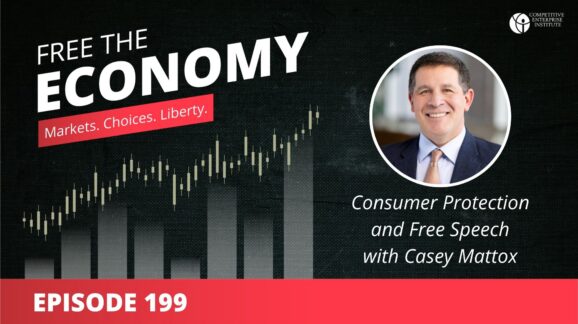
Free the Economy podcast: Consumer protection and free speech with Casey Mattox
In this week’s episode we cover the debt load of state and local governments, advances in nuclear waste storage, and hope…

News Release
Update in CEI’s case against Wisconsin’s unconstitutional rule barring voter participation in prediction markets
Yesterday, a District Court denied CEI’s motion for a preliminary injunction against Wisconsin’s rule denying voters the right to participate in election prediction market…

Blog
The regulatory dark matter beyond Washington’s graveyard of rules: 83,141 ghosts and counting
The clocks have turned back, the days are growing darker, and Washington’s regulatory shadows lengthen. Washington’s policy ghouls are waking up to the fact…
Search Posts
Credit Union Times
Payment Card Networks Under Assault
Blog
Public Sector Unions’ Heavy Burden on Taxpayers
As the old saying goes, when you start getting flak, you must be over the target. That seems like a good reason for the hysterical…
Blog
Congress Mulls More Credit Card Restrictions, in Legislation Likely to Backfire on Consumers
Some in Congress want to impose interest rate ceilings on credit cards and restrictions on interchange fees. Australia tried the same thing, and it…
Blog
Regulation of the Day 95: Buying Wine in Ohio
It is illegal to buy more than 288 bottles of wine per year in Ohio.
Blog
Government Uses Takeover of Mortgage Giants to Deliberately Increase Their Massive Losses at Taxpayer Expense
The Wall Street Journal notes that the Obama administration has used the federal government’s bailout of mortgage giants Fannie Mae and…
Blog
Regulation of the Day 94: Plastic Shopping Bags
Washington, DC’s city government is now requiring stores to charge customers five cents for each plastic bag they use at checkout. There were 84 unsolved…
Staff & Scholars

Clyde Wayne Crews
Fred L. Smith Fellow in Regulatory Studies
- Business and Government
- Consumer Freedom
- Deregulation

Ryan Young
Senior Economist and Director of Publications
- Antitrust
- Business and Government
- Regulatory Reform

Fred L. Smith, Jr.
Founder; Chairman Emeritus
- Automobiles and Roads
- Aviation
- Business and Government

Sam Kazman
Counsel Emeritus
- Antitrust
- Automobiles and Roads
- Banking and Finance

Marlo Lewis, Jr.
Senior Fellow
- Climate
- Energy
- Energy and Environment