There are two main areas in which Congress can enact meaningful reform. The first is to rein in regulatory guidance documents, which we refer to as “regulatory dark matter,” whereby agencies regulate through Federal Register notices, guidance documents, and other means outside standard rulemaking procedure. The second is to enact a series of reforms to increase agency transparency and accountability of all regulation and guidance. These include annual regulatory report cards for rulemaking agencies and regulatory cost estimates from the Office of Management and Budget for more than just a small subset of rules.
In 2019, President Trump signed two executive orders aimed at stopping the practice of agencies using guidance documents to effectively implement policy without going through the legally required notice and comment process.
Featured Posts

Blog
The week in regulations: Deepwater port licenses and nuclear credit ratings
Voters made known their feelings about tariffs, gas prices, and corruption. The FAA announced that it still uses floppy disks for air traffic control…
Blog
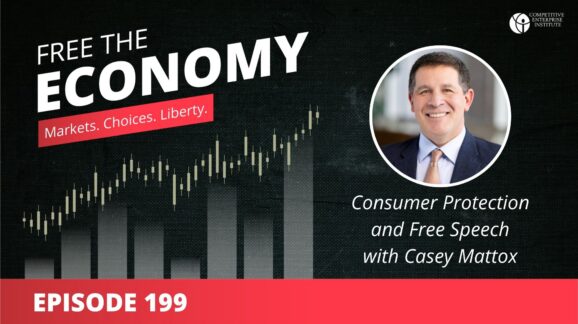
Free the Economy podcast: Consumer protection and free speech with Casey Mattox
In this week’s episode we cover the debt load of state and local governments, advances in nuclear waste storage, and hope…

News Release
Update in CEI’s case against Wisconsin’s unconstitutional rule barring voter participation in prediction markets
Yesterday, a District Court denied CEI’s motion for a preliminary injunction against Wisconsin’s rule denying voters the right to participate in election prediction market…
Search Posts
Blog
Florida Attorney General Questions Constitutionality of Healthcare Bills in Congress
Florida Attorney General Bill McCollum is questioning whether it is constitutional to force people to buy health insurance, as the health…
Newsletter
Cell Phones and Cancer, Political Anniversaries and the Regulation of the Day
A new study finds no link between cell phone use and brain cancer. News outlets assemble their 2009 “year in review” features. The state of…
Blog
Regulation of the Day 92: Camping at the Beach
In Oregon, it is illegal to set up a tent at most beaches.
Blog
MI Senate not “FAIR” and it’s a good thing
The Michigan Senate recessed last week without passing the proposed insurance reforms that would, among other things, prevent insurers from using factors such as…
Blog
Is ObamaCare’s “Individual Mandate” Unconstitutional?
The health care bills backed by the President require that individuals buy health insurance if it is not provided by their employer. Is that unconstitutional?…
Blog
Say No to EFCA in 2010
Given the amount of palm-greasing that was required to get reluctant moderate Democratic senators to vote to end debate on Obamacare, it's unlikely that those…
Staff & Scholars

Clyde Wayne Crews
Fred L. Smith Fellow in Regulatory Studies
- Business and Government
- Consumer Freedom
- Deregulation

Ryan Young
Senior Economist and Director of Publications
- Antitrust
- Business and Government
- Regulatory Reform
Fred L. Smith, Jr.
Founder; Chairman Emeritus
- Automobiles and Roads
- Aviation
- Business and Government

Sam Kazman
Counsel Emeritus
- Antitrust
- Automobiles and Roads
- Banking and Finance

Marlo Lewis, Jr.
Senior Fellow
- Climate
- Energy
- Energy and Environment