There are two main areas in which Congress can enact meaningful reform. The first is to rein in regulatory guidance documents, which we refer to as “regulatory dark matter,” whereby agencies regulate through Federal Register notices, guidance documents, and other means outside standard rulemaking procedure. The second is to enact a series of reforms to increase agency transparency and accountability of all regulation and guidance. These include annual regulatory report cards for rulemaking agencies and regulatory cost estimates from the Office of Management and Budget for more than just a small subset of rules.
In 2019, President Trump signed two executive orders aimed at stopping the practice of agencies using guidance documents to effectively implement policy without going through the legally required notice and comment process.
Featured Posts
Blog
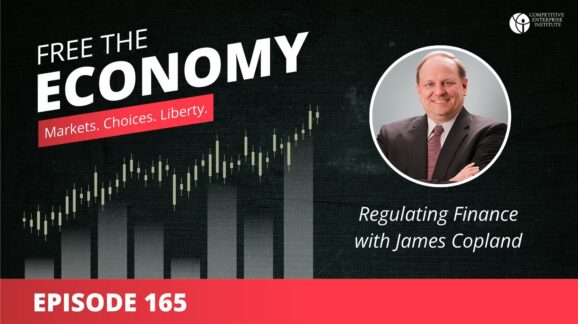
Free the Economy podcast: Regulating finance with James Copland
In this week’s episode we cover the 250th anniversary of Adam Smith’s Wealth of Nations, fighting fraud in broadband deployment, and cutting…

Blog
The week in regulations: Shellfish inclusion and paper manifest sunsets
The labor force shrank by 92,000 jobs in January. Oil prices spiked. Twenty-two state attorneys general filed a lawsuit against President Trump’s Section 122 tariffs.
Blog
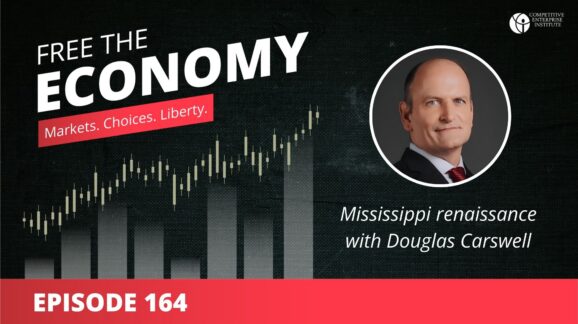
Free the Economy podcast: Mississippi renaissance with Douglas Carswell
In this week’s episode we cover housing abundance, capitalism’s approval rating, audits of state finances, and the consumer nostalgia of…
Search Posts
Study
Spitzer Strains out Grasso While Swallowing Camels
Full Document Available in PDF Recently, New York Attorney General Eliot Spitzer…
Products
A More Creative and Productive World
Full Document Available in PDF I’m grateful to all of you for…
Products
Ronald Reagan, Freedom’s Champion
Full Document Available in PDF Former President Ronald Reagan’s passing has prompted innumerable words about…
Products
June Edition of CEI’s Monthly Planet
Full Document Available in PDF “A More Creative and Productive…
Op-Eds
Split Decision at the SEC
Nobel Prize economist Ronald Coase long ago warned of a political risk—that of wishing to be an “economic statesman,” which he defined as a person…
News Release
SEC Set To Over-Regulate Mutual Fund Industry With Vote on June 23
***MEDIA ADVISORY***<?xml:namespace prefix = o ns = “urn:schemas-microsoft-com:office:office” /> SEC Set To Over-Regulate Mutual Fund…
Staff & Scholars

Clyde Wayne Crews
Fred L. Smith Fellow in Regulatory Studies
- Business and Government
- Consumer Freedom
- Deregulation

Ryan Young
Senior Economist and Director of Publications
- Antitrust
- Business and Government
- Regulatory Reform
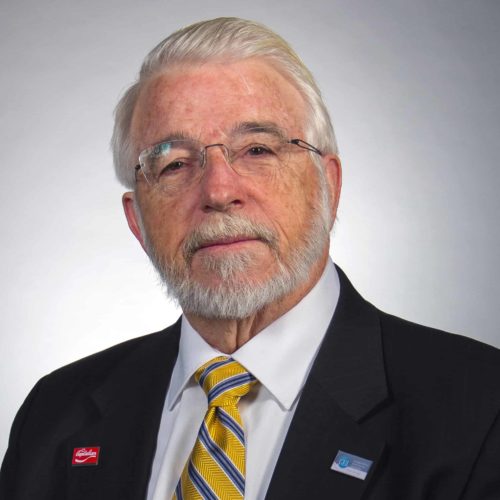
Fred L. Smith, Jr.
Founder; Chairman Emeritus
- Automobiles and Roads
- Aviation
- Business and Government

Sam Kazman
Counsel Emeritus
- Antitrust
- Automobiles and Roads
- Banking and Finance

Marlo Lewis, Jr.
Senior Fellow
- Climate
- Energy
- Energy and Environment