There are two main areas in which Congress can enact meaningful reform. The first is to rein in regulatory guidance documents, which we refer to as “regulatory dark matter,” whereby agencies regulate through Federal Register notices, guidance documents, and other means outside standard rulemaking procedure. The second is to enact a series of reforms to increase agency transparency and accountability of all regulation and guidance. These include annual regulatory report cards for rulemaking agencies and regulatory cost estimates from the Office of Management and Budget for more than just a small subset of rules.
In 2019, President Trump signed two executive orders aimed at stopping the practice of agencies using guidance documents to effectively implement policy without going through the legally required notice and comment process.
Featured Posts
Blog
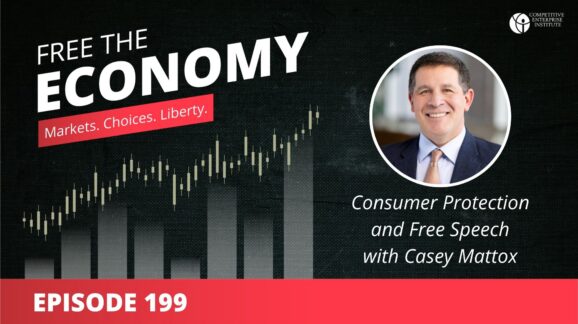
Free the Economy podcast: Consumer protection and free speech with Casey Mattox
In this week’s episode we cover the debt load of state and local governments, advances in nuclear waste storage, and hope…

News Release
Update in CEI’s case against Wisconsin’s unconstitutional rule barring voter participation in prediction markets
Yesterday, a District Court denied CEI’s motion for a preliminary injunction against Wisconsin’s rule denying voters the right to participate in election prediction market…

Blog
The regulatory dark matter beyond Washington’s graveyard of rules: 83,141 ghosts and counting
The clocks have turned back, the days are growing darker, and Washington’s regulatory shadows lengthen. Washington’s policy ghouls are waking up to the fact…
Search Posts
Blog
Sugarplums or Lumps of Coal? White House’s 192 Big Rules in Pipeline Herald More Regulation than Deregulation
No matter the presidential administration, every year there are thousands of federal rules and regulations compared to a relative handful of laws passed by Congress.
Blog
What Regulations Did Trump Administration Add in 2019?
The Trump administration recently issued “Regulatory Reform Results for Fiscal Year 2019.” This is its fiscal year 2019 status update on the one-in, two-out directive initiated in Executive…
Blog
This Week in Ridiculous Regulations
Britain held a major election, and the U.S. House of Representatives is set to impeach President Trump. At the same time, Trump is poised for…
Blog
This Week in Ridiculous Regulations
The House began preparing articles of impeachment, President Trump announced new tariffs against three allies, a NATO summit was surprisingly contentious, and the federal government…
Blog
What Regulations Did the Trump Administration Eliminate in 2019?
The Trump administration has issued its fiscal year 2019 status update on one-in, two-out. It’s called “Regulatory Reform Results for Fiscal Year 2019.” According to…
The Wall Street Journal
A Republican Proposal to Feed the Country to the Swamp
Progressives dream of making the District of Columbia into a state, but now a pair of Republican senators have the same vision reflected through a…
Staff & Scholars

Clyde Wayne Crews
Fred L. Smith Fellow in Regulatory Studies
- Business and Government
- Consumer Freedom
- Deregulation

Ryan Young
Senior Economist and Director of Publications
- Antitrust
- Business and Government
- Regulatory Reform

Fred L. Smith, Jr.
Founder; Chairman Emeritus
- Automobiles and Roads
- Aviation
- Business and Government

Sam Kazman
Counsel Emeritus
- Antitrust
- Automobiles and Roads
- Banking and Finance

Marlo Lewis, Jr.
Senior Fellow
- Climate
- Energy
- Energy and Environment