There are two main areas in which Congress can enact meaningful reform. The first is to rein in regulatory guidance documents, which we refer to as “regulatory dark matter,” whereby agencies regulate through Federal Register notices, guidance documents, and other means outside standard rulemaking procedure. The second is to enact a series of reforms to increase agency transparency and accountability of all regulation and guidance. These include annual regulatory report cards for rulemaking agencies and regulatory cost estimates from the Office of Management and Budget for more than just a small subset of rules.
In 2019, President Trump signed two executive orders aimed at stopping the practice of agencies using guidance documents to effectively implement policy without going through the legally required notice and comment process.
Featured Posts
Blog
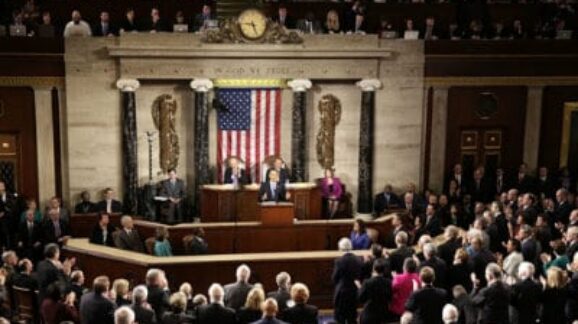
Trump’s SOTU conundrum: Deregulation today, swamp tomorrow?
Donald Trump’s 2026 State of the Union (SOTU) address presents an opportunity to confront the federal spending, entitlement, and regulatory behemoth in a new way…

Blog
The week in regulations: Grandfathered driver vision and socializing dogs
The Supreme Court declared President Trump’s IEEPA tariffs unconstitutional. The White House responded by enacting a 15 percent global tariff under a different statute. The…
Blog
Free the Economy podcast: What’s wrong with Congress with Kevin Kosar
In this week’s episode we talk about we talk about Consumer-Regulated Electricity, the amazing falling US poverty rate, and how smart…
Search Posts
Blog
NLRB Targets Boeing, Ignores Congress
It is now well known that the Obama administration is trying to use the National Labor Relations Board (NLRB) as a battering ram to…
Blog
New York Times on “Paternalistic” Government
The Dining section of today’s New York Times has a short piece reporting that the U.S. Department of Agriculture has lowered…
Blog
Dismantling Sarbanes-Oxley
My colleague Ryan Radia and I recently wrote in an editorial for Investor's Business Daily that the 2002 Sarbanes-Oxley Act should be dismantled for the…
Blog
Mind-boggling Increase in Tuition Since 1960 Even as Students Learn Less and Less
There has been a truly mind-boggling increase in college tuition since 1960. For example, law school tuition has risen nearly 1,000 percent after adjusting…
Blog
Alcohol Producers in Texas Must Unite For their Right to Produce
As discussed in my latest "Alcohol Regulation Roundup" post, a representative for brewing giant, Anheuser-Busch (AB-InBev) testified at a Lone Star State Senate…
Investor's Business Daily
Reform Sarbox To Galvanize High-Tech IPOs
Silicon Valley is teeming with budding startups whose user bases and valuations are skyrocketing. As these companies seek breathing room to grow, they will…
Staff & Scholars

Clyde Wayne Crews
Fred L. Smith Fellow in Regulatory Studies
- Business and Government
- Consumer Freedom
- Deregulation

Ryan Young
Senior Economist and Director of Publications
- Antitrust
- Business and Government
- Regulatory Reform

Fred L. Smith, Jr.
Founder; Chairman Emeritus
- Automobiles and Roads
- Aviation
- Business and Government

Sam Kazman
Counsel Emeritus
- Antitrust
- Automobiles and Roads
- Banking and Finance

Marlo Lewis, Jr.
Senior Fellow
- Climate
- Energy
- Energy and Environment