There are two main areas in which Congress can enact meaningful reform. The first is to rein in regulatory guidance documents, which we refer to as “regulatory dark matter,” whereby agencies regulate through Federal Register notices, guidance documents, and other means outside standard rulemaking procedure. The second is to enact a series of reforms to increase agency transparency and accountability of all regulation and guidance. These include annual regulatory report cards for rulemaking agencies and regulatory cost estimates from the Office of Management and Budget for more than just a small subset of rules.
In 2019, President Trump signed two executive orders aimed at stopping the practice of agencies using guidance documents to effectively implement policy without going through the legally required notice and comment process.
Featured Posts

Blog
The week in regulations: Deepwater port licenses and nuclear credit ratings
Voters made known their feelings about tariffs, gas prices, and corruption. The FAA announced that it still uses floppy disks for air traffic control…
Blog
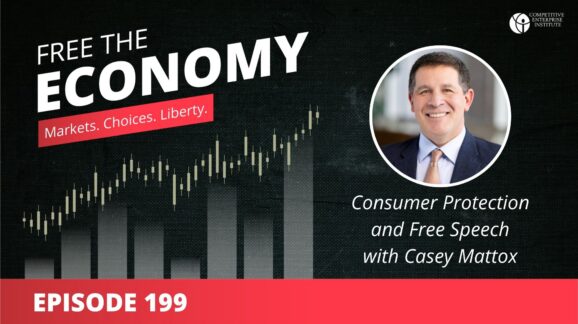
Free the Economy podcast: Consumer protection and free speech with Casey Mattox
In this week’s episode we cover the debt load of state and local governments, advances in nuclear waste storage, and hope…

News Release
Update in CEI’s case against Wisconsin’s unconstitutional rule barring voter participation in prediction markets
Yesterday, a District Court denied CEI’s motion for a preliminary injunction against Wisconsin’s rule denying voters the right to participate in election prediction market…
Search Posts
Blog
Climategate and consensus nonsense
Cato’s Pat Michaels, one of the scientists attacked in the Climategate emails, has an excellent editorial in the Wall Street Journal today with examples…
Blog
CEI Weekly: CEI at Copenhagen
CEI weekly is a compilation of articles and blogs from CEI's staff. This week features reports from two CEI analysts, Myron Ebell and William Yeatman,…
Blog
Regulation of the Day 87: The Volume of TV Commercials
The House passed the Commercial Loudness Act on Wednesday. If it becomes law, the FCC would control the volume level of television commercials.
Blog
FDIC Prepares for “an even-larger number of bank failures” in 2010
[T]he increase is intended to “ensure that [they] are prepared to handle an even-larger number of bank failures” in 2010.
Blog
Comprehensive Immigration Reform Helps Highly Skilled Immigrants
Section 320 of the The Comprehensive Immigration Reform for America’s Security and Prosperity Act of 2009 H.R. 4321 (CIR ASAP) is fantastic. It exempts…
Blog
Regulation of the Day 86: Cockfighting Advertisements
If you’re thinking of sending out advertisements for a cockfight through the mail, you should be aware that a new regulation allows the postal service…
Staff & Scholars

Clyde Wayne Crews
Fred L. Smith Fellow in Regulatory Studies
- Business and Government
- Consumer Freedom
- Deregulation

Ryan Young
Senior Economist and Director of Publications
- Antitrust
- Business and Government
- Regulatory Reform

Fred L. Smith, Jr.
Founder; Chairman Emeritus
- Automobiles and Roads
- Aviation
- Business and Government

Sam Kazman
Counsel Emeritus
- Antitrust
- Automobiles and Roads
- Banking and Finance

Marlo Lewis, Jr.
Senior Fellow
- Climate
- Energy
- Energy and Environment