Chapter 10: Federal rules affecting state and local governments

State and local officials’ concerns about federal mandates overriding their priorities resulted in passage of the Unfunded Mandates Reform Act (UMRA) of 1995. The law requires Congressional Budget Office cost estimates for mandates affecting state, local, and tribal governments above the then-threshold of $50 million. The threshold stands at $100 million today. While the federal government continues to impose mandates on state and local governments, recent legislative enactments have meant that many are funded rather than unfunded, undermining alliances between small businesses and lower-level governments for regulatory reform and red tape relief. The Congressional Research Service, for example, now estimates grants-in-aid to states now exceed $1 trillion.
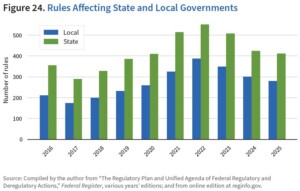
As Figure 24 shows, agencies report that 279 of the 3,816 rules in the spring 2025 Unified Agenda pipeline affect local governments and 411 affect state governments, both marked declines from the Biden years.
Of the 2,102 active rules in the spring 2025 Unified Agenda, only four are acknowledged to impose unfunded mandates on state, local, or tribal governments. Two of the rules are from the Department of Health and Human Services, and one each are from the Environmental Protection Agency and the Department of Agriculture. Just one of 807 long-terms actions is noted to contain unfunded mandates.
Economically significant rules affect state and local governments just as they do the private sector, meaning federal strictures will overrule local decision-making. But so long as extraordinary sums of money flow unimpeded from Washington, lower-level governments may remain content. Fourteen economically significant rules affecting state and/or local governments were listed in the spring 2025 Agenda as completed since Biden’s fall 2024 edition. There are 23 economically significant active rules and three planned for the long term across all lower-level governments.