Chapter 9: Federal regulations affecting small business

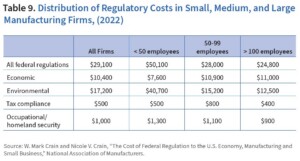
The National Association of Manufacturers report reaffirmed that average annual per-employee regulatory costs vary by firm size. The smaller the organization, the higher the per-employee regulatory costs, particularly in manufacturing. As shown in Table 9, NAM found that per-employee regulatory costs for firms with fewer than 50 workers can be substantially higher than those for larger firms—$50,100 compared with $24,800.
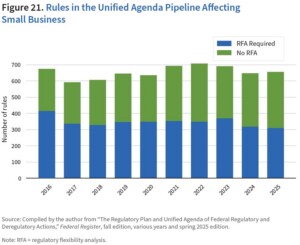
The Regulatory Flexibility Act (RFA) directs federal agencies to consider their rules’ effects on small entities. Figure 21 depicts active, completed, and long-term rules in the spring Unified Agenda that require RFA analysis, as well as rules that do not require RFA scrutiny but that agencies still believe will affect small businesses. Of the 655 rules affecting small business in the 2025 spring Agenda, 310 required an RFA analysis, which is the lowest level seen in Figure 21. Earlier Obama-era overall tallies were higher, occasionally exceeding 800. The total count fell to 590 in 2017 under the Trump administration.
The following are averages of the number of rules requiring RFA analysis in fall Unified Agenda snapshots of completed, active, and long-term rules during recent administrations:
- George W. Bush: average of 377 rules requiring small-business RFA analysis.
- Barack Obama: average of 406 rules.
- Donald Trump: average of 341 rules (including dozens deemed deregulatory).
- Joe Biden: average of 348 rules.
Table 10 breaks out the spring 2025 Unified Agenda’s 655 rules affecting small business by department, agency, and commission. The top five—the FCC; the Departments of Commerce, Health and Human Services, and the Treasury; and the Environmental Protection Agency—are the standouts, accounting for 361 rules, or 55 percent of the 655 rules affecting small business.
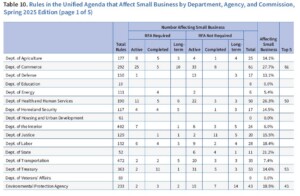
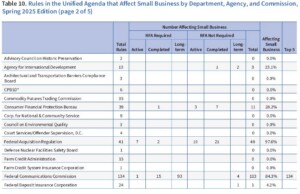
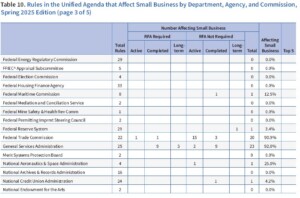
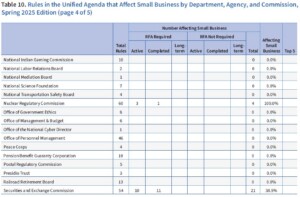
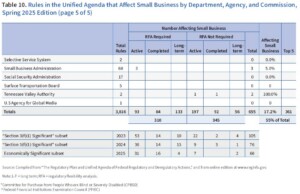
The FCC alone contributes 93 long-term rules deemed to require RFA analysis. The overall proportion of total rules affecting small business in the Unified Agenda stands at 17 percent but varies among agencies. Of the 655 rules affecting small business, 60 are deemed economically significant, compared to 76 Section 3(f)(1) Significant rules in 2024 under Biden. These significant rules are broken out at the bottom of Table 10.
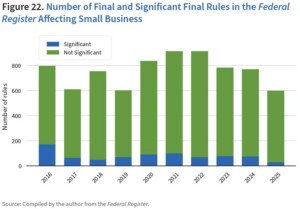
To complement the Unified Agenda snapshots, we return to the Federal Register and its calendar-year depictions of finalized small-business rules. Figure 22 depicts completed final rules in the Federal Register deemed to affect small business, as well as the subset of such rules classified as significant under EO 12866. The 599 small-business final rules and the subset of 30 significant rules both stand at the lowest levels of all time, again with unrules notable among them.
Trump’s rule counts are substantially below recent averages, particularly with deregulatory or streamlining moves taken into account. Once again recognizing the transition-year overlap caveat, the following are calendar-year averages of the number of final and final significant rules in the Federal Register affecting small business during recent administrations:
- Barack Obama (eight years): average 694 rules per year affecting small business, 117 significant.
- Donald Trump (four years): average 701 rules per year affecting small business, 70 significant (including deregulatory).
- Joe Biden (four years): average 846 rules per year, 82 significant.
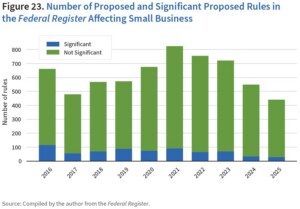
Mirroring final rules, total proposed rules in the Federal Register affecting small business fell to a low of 440 in 2025 after peaking at 823 in 2021, as seen in Figure 23. Counts for significant proposed rules deemed to affect small business fell to a low of 30.
Transition-year caveat in mind yet again, the following are calendar-year averages of the number of proposed and significant proposed rules affecting small business during recent administrations; Trump’s 2025 results, even including Biden rules issued in January, remain well below recent historical averages:
- Barack Obama (eight years): average 612 proposed rules per year affecting small business, 128 significant.
- Donald Trump first term (four years): average 572 proposed rules per year, 72 significant (including deregulatory).
- Joe Biden (four years): average 711 rules per year, 66 significant.
As firms grow, they encounter a regulatory regime that expands mechanically with employee headcount. Federal workplace regulation features a sequence of statutory triggers, each imposing new mandates once a firm crosses a specified size threshold. Appendix K documents this accumulation by listing major non-sector-specific federal laws whose regulatory requirements attach incrementally as businesses add workers, creating compliance hurdles that can discourage hiring and distort firm growth.